
How do mezzanine loading gates contribute to workplace efficiency?
Mezzanine loading gates improve workplace efficiency by allowing goods to be transferred safely between floor levels without interrupting nearby work areas. They create a controlled loading point, helping reduce manual handling, minimise delays and maintain a clearer, more organised workflow.
Mezzanine loading gates improve workplace efficiency by creating a controlled transfer point for goods moving between floor levels. They allow pallets, containers and other loads to be placed at the open edge of a mezzanine floor without leaving the edge permanently exposed. This separates loading and unloading from nearby work areas, helping material handling continue in a more organised and predictable way.
Without a suitable loading gate, staff may need to move goods around obstructions, wait for access to be cleared or work close to an unprotected edge. A properly selected and correctly operated gate provides a defined loading position, reducing avoidable interruptions and making the movement of goods easier to coordinate with forklift, pallet truck or hoist operations.
- More controlled material flow: Goods can be transferred through a specific opening rather than being moved across the wider working area.
- Less disruption: Loading activity can take place at the designated point while other tasks continue away from the edge.
- Reduced manual handling: The gate can support a planned transfer process, limiting unnecessary carrying, lifting and repositioning.
- Clearer floor layouts: Defined loading areas make it easier to organise walkways, workstations and temporary storage.
- Improved coordination: Operators can follow a consistent sequence for positioning, securing and removing loads.
Safety and efficiency are closely linked. A loading gate with suitable edge protection helps prevent people or loads from entering the open loading area when it is not in use. This reduces the likelihood of an incident, but it also avoids the delays that follow unsafe access, damaged goods, equipment contact or an area being taken out of service. The gate should never be treated as a substitute for safe working procedures; it is one part of the overall transfer system.
The operating sequence is particularly important. In many applications, the gate is designed so that the access side cannot be opened without the load side being closed or protected. Depending on the design, this may be achieved through a counterbalanced, hinged, sliding or self-closing arrangement. The correct option depends on the load dimensions, handling equipment, available clearance and how frequently transfers take place. A gate that is difficult to operate or poorly positioned can create delays and encourage unsafe workarounds.
Efficiency also depends on how the loading gate fits into the surrounding layout. Before installation, the working area should be assessed to confirm:
- the size, weight and shape of the loads being transferred;
- the approach route and turning space required by handling equipment;
- the position of columns, doors, walkways and other fixed obstructions;
- the required clear opening and operating height;
- the location of edge protection and any exclusion zone below;
- the visibility and communication arrangements between operators on different levels; and
- the way the gate will be used during normal work, cleaning, inspection and maintenance.
These factors help determine whether a single loading position is sufficient or whether the operation would benefit from separate transfer points or a different gate configuration. They also help prevent a common efficiency problem: installing a gate that meets the basic dimensional requirement but does not suit the actual handling process.
Loading gates can support safer, more consistent working practices when staff understand the operating sequence. Training should cover how to position a load, when the gate may be opened, how to confirm that the receiving area is clear and what to do if the gate does not close or operate correctly. Clear markings and simple instructions can reinforce the process, particularly where several shifts or different operators use the same transfer point.
Regular inspection is needed to maintain both safety and efficiency. Operators should report damage, unusual movement, loose components, corrosion, worn hinges, failed latches or problems with self-closing and counterbalance mechanisms. Planned inspections should examine the structure, fixings, guarding, moving parts and the condition of the surrounding floor and edge protection. Prompt attention to minor defects helps prevent a gate becoming difficult to operate or being removed from service during a busy period.
A loading gate should also be considered as part of the wider workplace risk assessment. The assessment should cover falling objects, access by unauthorised people, interaction with vehicles and lifting equipment, load stability, visibility and emergency arrangements. Where the use of the gate changes, or the types of goods and equipment change, the assessment and operating instructions should be reviewed.
In practical terms, the most efficient solution is not necessarily the fastest-opening gate. It is the design that allows the required loads to be transferred safely, repeatedly and with minimal interference to other work. Correct specification, suitable installation, clear procedures and ongoing maintenance ensure that mezzanine loading gates contribute to a dependable material-handling process rather than becoming an obstruction or additional risk.
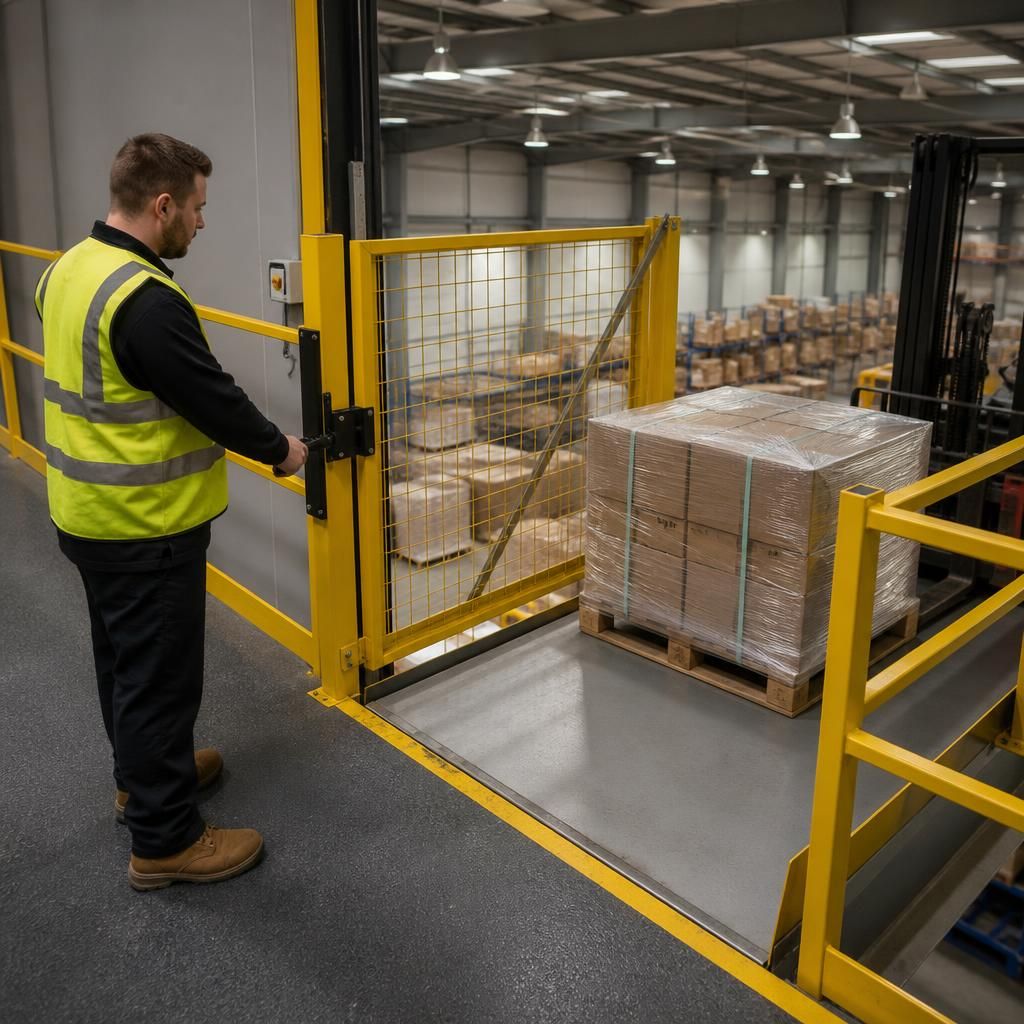
Mezzanine loading gates improve workplace efficiency by providing a controlled point for transferring goods between floor levels. By separating loading activity from nearby walkways and work areas, they help operators follow a consistent process while reducing unnecessary movement, delays and interference with other tasks.
The gate should be selected and positioned around the actual handling method. Loads, equipment access, clear opening, visibility and the space available below all affect how smoothly transfers can take place. A gate that is difficult to operate or poorly aligned with the approach route may encourage unsafe workarounds and create avoidable interruptions.
- Keep the loading area clearly defined and free from unnecessary obstructions.
- Use a consistent sequence for positioning, securing and removing loads.
- Ensure operators can confirm that the receiving area is clear before transfer.
- Report damage, worn components or operating difficulties promptly.
Efficiency depends on reliable operation as well as the gate design. Clear instructions, suitable training and regular checks help keep the transfer point available for use and prevent minor defects from developing into disruption or a safety issue.
Discuss Your Mezzanine Loading Gate Requirements
Discuss your mezzanine loading gate requirements with Able Racking to confirm the most suitable design, operating arrangement and safety measures for your workplace.