
How do portable timber mezzanine floors compare to steel mezzanine floors in terms of durability and cost?
Portable timber mezzanine floors are typically more cost-effective and easier to relocate, while steel mezzanine floors generally provide greater durability, load capacity and resistance to moisture, impact and fire. The better option depends on your warehouse conditions, intended loads, required lifespan and whether future relocation is important.
Portable timber mezzanine floors are usually the lower-cost and more adaptable option, while steel mezzanine floors generally offer greater durability, load capacity and resistance to demanding warehouse conditions. The right choice depends on the intended use, imposed loads, environment, expected service life, relocation requirements and the total cost of ownership rather than the initial purchase price alone.
Durability and service life
Steel provides a robust structural frame that is well suited to frequent use, heavier loads and areas where equipment or materials may cause accidental impact. When correctly designed, protected against corrosion and maintained appropriately, a steel structure can provide a long service life with relatively little structural deterioration.
A portable timber floor can also be durable when it is properly specified, installed and protected from unsuitable conditions. Its performance depends particularly on the quality of the supporting frame, the grade and thickness of the decking, the way loads are distributed and the condition of the surrounding environment. Timber components can be more vulnerable to moisture, abrasion, impact and localised damage than steel, so inspections and prompt repairs are important.
Neither material is automatically maintenance-free. Steel may require attention where protective coatings are damaged or corrosion develops, while timber decking may need replacing if it becomes worn, wet, split or damaged. A floor used for light storage in a clean, dry building will experience different demands from one exposed to traffic, dampness or harsh industrial processes.
Load capacity and everyday use
Steel is generally the better choice where the floor must support high imposed loads, concentrated loads, wheeled equipment or intensive operational activity. Its design can accommodate substantial structural demands, although the permitted loading still depends on the complete system, including columns, beams, decking, access points and the supporting building structure.
Portable timber floors are often suitable for offices, picking areas, light storage, welfare space and other applications where the loads are moderate and clearly defined. They should not be selected on the basis of appearance or available floor area alone. The intended use must be assessed so that the structure, decking and access arrangements are designed for the actual loads and working practices.
Loads should be distributed in accordance with the design information. Storing heavy items in a small area, placing loads close to an edge or changing the use of the floor without review can create risks, regardless of whether the structure is timber or steel.
Initial installation cost
Portable timber systems can have a lower initial cost because they may use simpler components and lighter construction methods. They are often practical where the required floor area is modest, the duty is light to moderate and the business needs a flexible solution without committing to a permanent heavy-duty structure.
Steel systems commonly cost more at the outset. The price reflects the structural material, fabrication, protective finish, heavier lifting requirements and the engineering needed for larger spans or higher loads. Additional costs may also arise from foundations, fire protection, access equipment, installation constraints and any alterations required to the building.
A direct quotation should therefore compare equivalent specifications. A lower-cost timber floor may not be comparable with a steel floor designed for substantially higher loading, longer spans or more demanding use. The assessment should include decking, stairs, handrails, gates, edge protection, delivery, installation, design checks and any required building or structural work.
Whole-life cost
The initial purchase price is only one part of the financial comparison. A timber floor may offer good value where its expected use is light, the environment is controlled and relocation or future modification is likely. Its lower weight can also simplify handling and reduce some installation requirements.
A steel floor may provide better long-term value where it will remain in place for many years, carry demanding loads or be exposed to repeated operational wear. Its greater resistance to impact and heavy use can reduce the likelihood of major structural replacement, although coatings, fixings, decking and other components still require inspection and maintenance.
Whole-life costs should account for:
- Design, surveys and structural verification
- Materials, delivery and installation
- Access systems, guardrails, gates and edge protection
- Building alterations, foundations or fire-related requirements
- Routine inspections and planned maintenance
- Replacement of damaged decking, finishes or fixings
- Future relocation, extension or removal
- Downtime and disruption during installation or repair
Flexibility and relocation
Portability is one of the main advantages of a timber system. Depending on its design, it may be dismantled, moved and reconfigured more easily than a heavier steel installation. This can suit businesses expecting changes to storage layouts, tenancy arrangements, production processes or space requirements.
Steel systems can also be designed for dismantling or extension, but relocation may require more planning, lifting equipment and specialist labour. Their weight and structural connections can make changes more disruptive, particularly where the original design did not allow for future alteration.
Portability should not mean moving the floor without professional review. Any relocation must confirm that the new position, supporting surface, clearances, access arrangements, load requirements and connection details remain suitable.
Moisture, fire and environmental conditions
Steel is generally more resistant to moisture-related damage than timber, but it is not immune to corrosion. Condensation, leaks, high humidity, chemicals and damaged protective coatings can affect steel components. The specification should reflect the environment, with suitable finishes and planned checks where corrosion is a possibility.
Timber is more sensitive to prolonged dampness and water ingress. It can swell, distort, soften or deteriorate if moisture is not controlled. It also requires careful consideration of fire performance. The fire strategy for the building should address the floor construction, escape routes, access points, storage contents and any fire detection or suppression measures required.
Fire precautions cannot be determined by choosing timber or steel alone. The complete design must be reviewed against the building’s use and applicable requirements, with advice from the relevant competent professionals where necessary.
Installation and maintenance implications
Portable timber floors may be quicker to handle and install in suitable locations, especially where access is restricted or the structure is intended for a straightforward application. Steel installation can involve heavier components, lifting operations and more detailed site coordination, although an experienced installation team can plan these activities to reduce disruption.
Both systems require a suitable supporting surface, secure connections, safe access and effective edge protection. Once installed, routine checks should look for movement, loose or damaged fixings, deflection, deterioration, impact damage, unsafe alterations and obstructions to access or escape routes.
Any damage should be assessed before the floor is returned to normal use. Repairs must use compatible components and follow the original design or a revised design prepared by a competent person. Unauthorised drilling, cutting, overloading or removal of structural or protective components can compromise either type of floor.
Which option is most suitable?
Choose a portable timber mezzanine floor when flexibility, lower initial cost and ease of future relocation are priorities, and when the proposed use involves moderate, well-defined loads in a dry and controlled environment.
Choose a steel mezzanine floor when the priority is high structural capacity, long-term heavy use, increased resistance to impact or a demanding industrial environment. Steel is also more appropriate where the floor must accommodate heavier equipment, concentrated loads or frequent operational traffic, subject to suitable structural design.
The decision should be based on a site assessment and a clear design brief. Consider the building structure, available headroom, access and escape routes, floor loading, storage methods, environmental conditions, fire requirements and likely future changes. A competent specialist can then compare both materials on an equivalent specification and explain the likely installation, maintenance and relocation costs.
In practical terms, timber is often the economical and flexible solution for lighter-duty applications, whereas steel is usually the stronger long-term investment for demanding use. Correct design, competent installation and regular inspection are essential whichever material is selected.
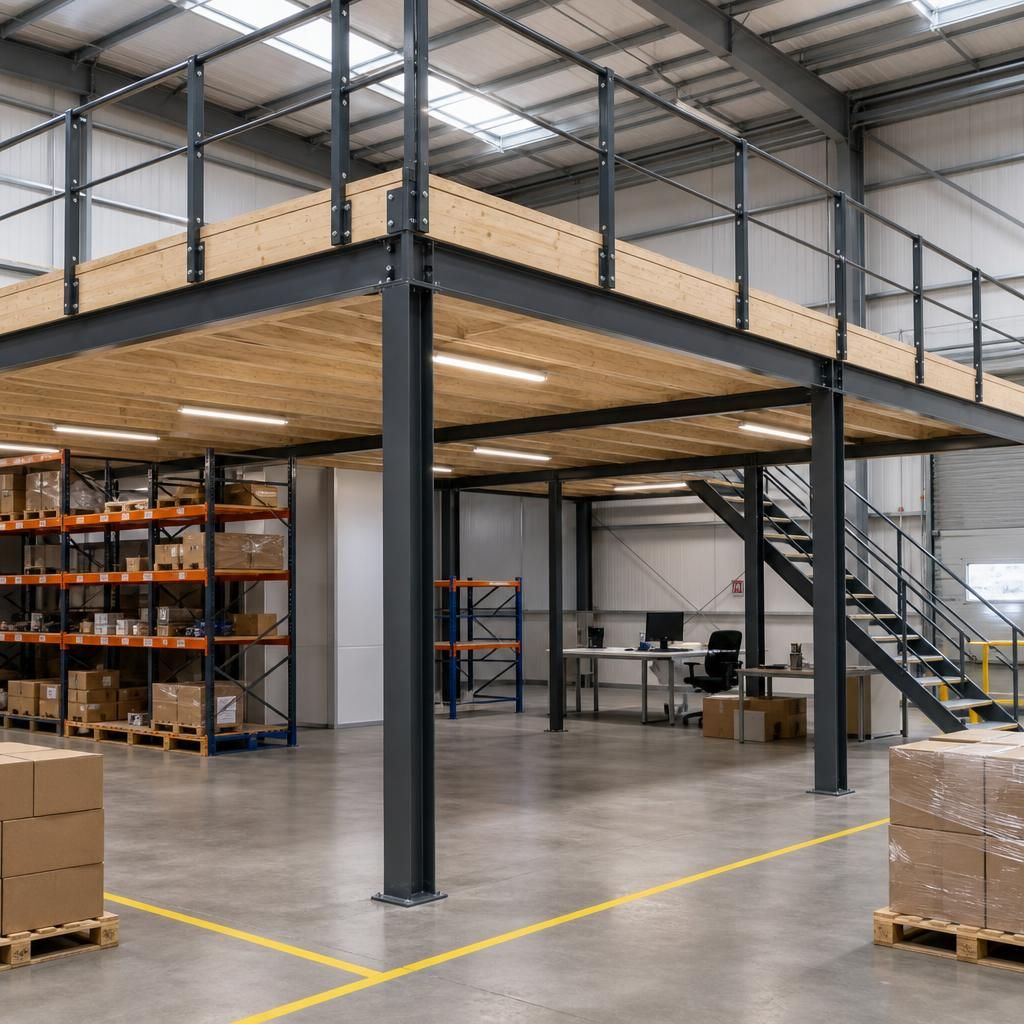
Portable timber mezzanine floors usually have a lower initial cost and are easier to relocate, while steel mezzanine floors generally provide greater resistance to heavy loads, impact, moisture and prolonged industrial use. The most suitable option depends on the floor’s design loading, operating environment and expected service life.
Timber can offer good value for light to moderate-duty areas such as offices, picking zones and controlled storage. Steel is often the better long-term choice where concentrated loads, wheeled equipment or frequent operational traffic are expected. When comparing quotations, assess the complete specification rather than the material alone, including decking, access, edge protection, installation, maintenance and any future relocation requirements.
Discuss your portable timber mezzanine floor requirements
Discuss your portable timber mezzanine floor requirements with our specialist team to compare suitable designs, loading needs, installation considerations and expected costs.