
How does regular warehouse racking inspection enhance operational efficiency and prevent costly disruptions?
Regular warehouse racking inspections identify damage, instability and loading issues before they cause unsafe conditions, stock damage or operational stoppages. By enabling timely repairs and maintaining compliant, reliable storage systems, inspections support efficient warehouse operations and help prevent costly disruption.
Regular warehouse racking inspection improves operational efficiency by identifying damage, overloading, instability and other defects before they lead to injury, stock loss or an unplanned shutdown. It allows remedial work to be prioritised, keeps storage areas usable and supports the safe, compliant operation of the warehouse.
Warehouse racking is exposed to continual operational pressures. Forklift impacts, moving loads, altered layouts, uneven loading and general wear can gradually affect frames, beams, connectors, floor fixings and protective components. Some defects may be difficult to detect during routine work, particularly when goods obscure structural elements. A competent inspection provides a structured assessment rather than relying on informal observations.
Inspections protect continuity of operations
Even a relatively small defect can develop into a wider operational problem if it is not addressed. A damaged upright may reduce the safe capacity of a bay, while a displaced beam or missing safety component can affect how loads are stored and handled. If the condition worsens, the affected area may need to be isolated at short notice, restricting access to stock and interrupting picking, replenishment or despatch activities.
Regular inspections help prevent this escalation. Defects can be recorded while they remain manageable, allowing repairs or replacement components to be arranged during planned maintenance periods. This is generally less disruptive than responding to a sudden failure or discovering that a storage area must be taken out of service immediately.
They support safer and more efficient stock handling
Well-maintained warehouse racking provides dependable locations for goods and helps operators work to the intended layout. When components are damaged, loads are incorrectly positioned or capacity information is unclear, employees may need to move stock, search for alternative locations or work around restricted bays. These avoidable activities consume time and can increase the risk of handling errors.
An inspection can identify conditions that affect day-to-day handling, including:
- impact damage to frames, beams, bracing or protective equipment;
- missing, loose or incorrectly fitted locking components;
- loads that exceed the stated capacity or are unsuitable for the bay;
- uneven, unstable or poorly positioned pallets;
- obstructions that reduce safe access or visibility;
- signs of movement, distortion, corrosion or inadequate floor fixing; and
- changes to the warehouse layout that have not been properly assessed.
Addressing these issues helps maintain clear storage locations and predictable workflows. It also gives supervisors better information when deciding whether a bay can remain in use, requires unloading or needs urgent repair.
They reduce the likelihood of stock and equipment damage
Unstable storage increases the possibility of goods falling, pallets being damaged or loads becoming difficult to retrieve. A collapse or impact can also damage forklifts, conveyors, flooring, doors and other warehouse equipment. The direct repair cost may therefore be accompanied by damaged stock, disposal costs, investigation time and delayed customer orders.
Inspection findings provide an opportunity to correct the underlying problem before it causes these losses. For example, replacing damaged protection, correcting poor loading practices or reviewing a changed bay arrangement can reduce repeated impacts and improve the reliability of the storage system.
They make maintenance more targeted
A formal warehouse racking inspection should produce clear findings that can be acted upon. Rather than treating every issue as an emergency or carrying out unnecessary work, the responsible person can assess the condition of each affected area and allocate action according to the level of risk. This may include monitoring, immediate isolation, unloading, repair or replacement.
Useful inspection records normally identify the location and nature of the defect, its severity, any immediate controls required and the recommended remedial action. Maintaining this information over time helps reveal recurring damage, problem traffic routes and areas where protection, operator practice or the warehouse layout may need improvement.
They help maintain compliance and accountability
Employers have duties to provide and maintain safe work equipment and to manage workplace risks. Warehouse racking should be inspected by a competent person at appropriate intervals, with additional checks following events such as a significant impact, structural alteration or relocation. The inspection does not replace routine reporting by employees or visual checks during daily operations; it forms part of a wider maintenance and risk-control process.
Accurate records demonstrate that the condition of the warehouse racking has been reviewed and that identified defects are being managed. They can also support internal audits, insurance discussions, contractor coordination and investigations following an incident. Compliance is not achieved by completing an inspection alone: actions identified in the report must be completed and documented.
They improve planning during warehouse changes
Storage systems often change as stock profiles, handling equipment, throughput and available space change. Adding or removing components, changing beam levels, increasing load weights or altering vehicle routes can affect the original design assumptions. An inspection can highlight when the current arrangement no longer reflects the way the warehouse is being used.
Before making significant changes, the proposed layout and loading requirements should be reviewed by a suitably competent person. Clear capacity information, appropriate protection and controlled installation help prevent changes from creating new hazards or reducing operational efficiency.
Inspection should be combined with ongoing controls
The greatest benefit comes when formal inspection findings are supported by everyday warehouse controls. Employees should be encouraged to report impacts and visible defects immediately, and damaged areas should be assessed without delay. Loads should be placed within the stated capacity and positioned so that they are stable, accessible and compatible with the bay design.
Operators should also receive suitable instruction on safe loading, unloading, vehicle movement, damage reporting and the limits of their responsibilities. Supervisors can reinforce these arrangements through routine housekeeping checks and by reviewing whether repairs have been completed effectively.
A practical inspection and maintenance cycle therefore includes:
- routine observations and prompt reporting of damage;
- competent formal inspections at an appropriate frequency;
- clear recording and risk assessment of identified defects;
- immediate controls for serious or potentially dangerous conditions;
- planned repairs using suitable components and competent installers; and
- follow-up checks to confirm that the storage system is safe to return to service.
Regular warehouse racking inspection is not simply a compliance exercise. It is a preventative control that protects people, stock, equipment and workflow. By finding defects early, supporting planned repairs and confirming that storage arrangements remain suitable for their intended use, it helps reduce avoidable downtime and keeps warehouse operations safe, organised and productive.
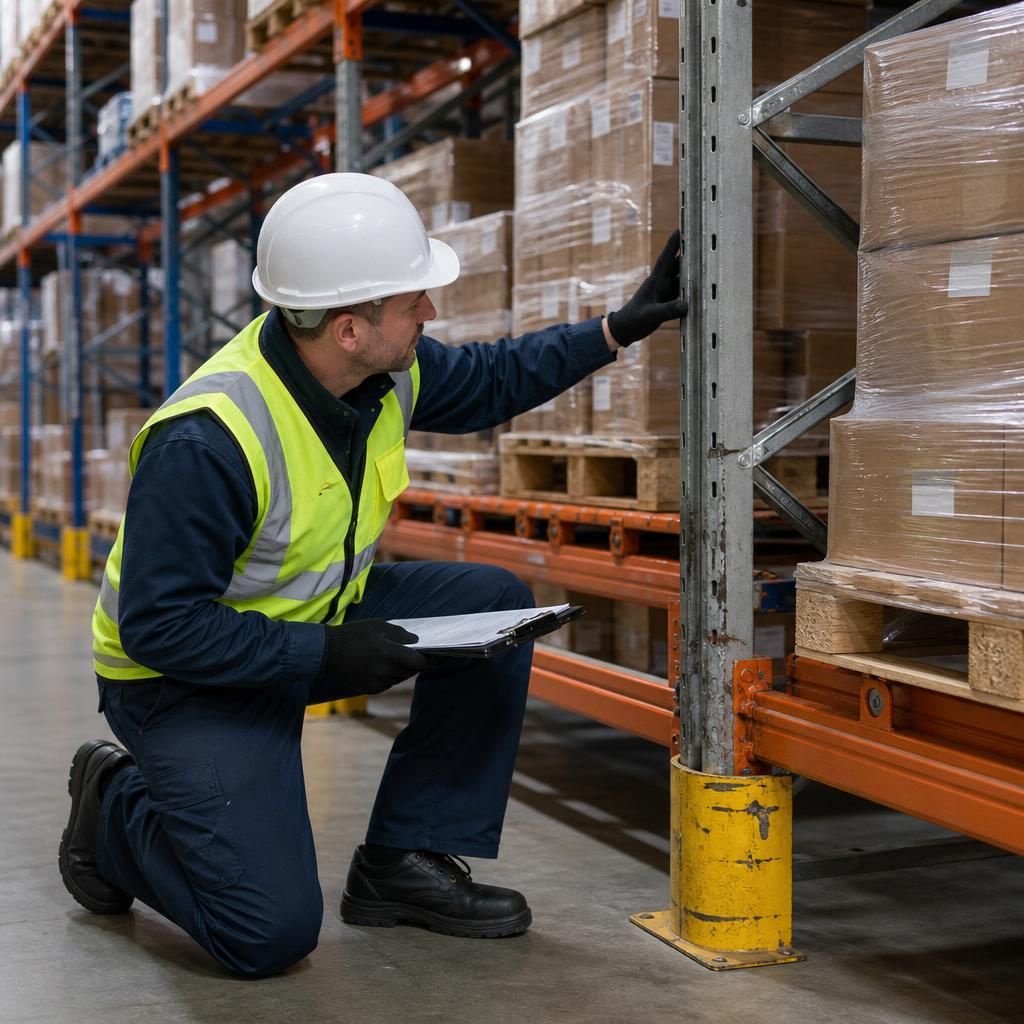
Regular warehouse racking inspection allows defects to be identified and prioritised before they require an emergency shutdown. Damage to uprights, beams, protection or floor fixings can be assessed while the affected area remains manageable, enabling planned repairs, controlled unloading or temporary restrictions instead of sudden loss of access to stock.
This supports operational continuity by reducing unexpected interruptions to picking, replenishment and despatch. Clear inspection records also help supervisors track remedial work, confirm when repairs are complete and return affected storage areas to service safely.
Arrange your warehouse racking inspection with Able Racking
Arrange your warehouse racking inspection with Able Racking to identify defects early, maintain compliance and reduce the risk of operational disruption. Contact our experienced team to discuss your inspection requirements and suitable next steps.