
How do SEMA Racking Inspection Courses ensure participants are prepared for real-world application?
SEMA Racking Inspection Courses combine technical instruction with practical inspection exercises, enabling participants to assess warehouse racking, identify damage and hazards, and record findings accurately. By applying recognised inspection principles to realistic workplace scenarios, learners develop the judgement and confidence needed to recommend appropriate action in real-world warehouse environments.
SEMA Racking Inspection Courses prepare participants for real-world application by combining structured technical learning with supervised, practical inspection work. Learners apply recognised SEMA principles to warehouse racking, assess defects in context, determine whether damage requires immediate action, and produce clear inspection records that can support effective corrective work.
Practical learning rather than theory alone
The course content is designed around the decisions an inspector must make in an operational warehouse. Participants learn how warehouse racking is constructed, how its components work together, and how loading, impact, installation issues and ongoing use can affect its condition. This technical foundation helps them understand why a defect matters, rather than simply identifying visible damage without assessing its potential consequences.
Practical exercises then require learners to inspect representative warehouse racking and consider issues such as:
- Damage to uprights, bracing, beams, guards and other structural components.
- Missing, displaced or incorrectly fitted safety components.
- Overloaded or poorly distributed storage positions.
- Items stored outside the intended configuration or beyond the safe working load.
- Signs of impact from handling equipment.
- Unauthorised alterations, unsuitable repairs or changes to the original layout.
- Obstructions, housekeeping issues and working practices that could increase risk.
Developing sound inspection judgement
Real-world inspection is not limited to finding defects. The inspector must judge the significance of what has been found, understand the likely risk and communicate the required response. SEMA Racking Inspection Courses help participants develop this judgement by using realistic examples and guided discussions around different levels of damage and deterioration.
Learners practise distinguishing between minor issues that should be monitored or corrected through planned maintenance and more serious conditions that may require prompt isolation, unloading or repair. They also learn why a decision should be based on the condition and use of the warehouse racking, the location of the defect and the possible effect on stability and safe operation. This reduces the risk of inconsistent or purely subjective reporting.
Following a consistent inspection process
A reliable inspection follows a defined method. During practical training, participants are shown how to prepare for an inspection, review available information, work through warehouse racking systematically and avoid overlooking less visible components. They learn to consider the wider installation rather than focusing only on obvious impact damage.
- Review the available layout, load information and previous inspection or repair records.
- Identify the areas to be inspected and any access or operational restrictions.
- Observe the installation from a safe position before examining individual components.
- Check structural members, connections, protection systems, load notices and storage conditions.
- Record the location, type and severity of each relevant finding.
- Decide what action is appropriate and communicate urgent concerns without delay.
- Complete a report that allows the responsible person to arrange suitable follow-up work.
This process gives participants a practical framework they can adapt to different warehouse environments while maintaining consistency between inspections.
Improving reporting and communication
An inspection report must be useful to the people responsible for warehouse safety and maintenance. The courses therefore place emphasis on accurate descriptions, clear locations, supporting photographs where appropriate and recommendations that can be understood by someone who was not present during the inspection.
Participants learn to avoid vague descriptions such as “damaged beam” and instead record the relevant component, position, nature of the damage and required action. They also practise communicating urgent findings to site managers and warehouse teams. This is important where a written report alone may not provide a sufficiently prompt response to a serious hazard.
Applying safe working practices
Inspection work takes place in active workplaces, so preparation includes more than technical assessment. Participants are expected to consider site rules, pedestrian and vehicle movements, access arrangements, personal protective equipment, visibility, safe positioning and the need to avoid interfering with warehouse operations.
Practical instruction helps learners recognise when a location cannot be assessed safely without additional controls. It reinforces the importance of not climbing warehouse racking, entering an unsafe area or attempting an unauthorised repair during an inspection. Where access is restricted or a hazard cannot be safely examined, the limitation should be recorded and referred to the responsible person.
Using realistic workplace scenarios
Scenario-based exercises help bridge the gap between classroom knowledge and the varied conditions found in working warehouses. Participants may need to assess several findings at once, decide which issue should be addressed first, and explain their reasoning. They may also need to account for damaged protection, altered storage arrangements, incomplete information or pressure to keep an area operational.
These exercises develop the confidence to pause an unsafe activity, escalate a serious concern and ask for further information when the available evidence is insufficient. They also show that an inspection is not a substitute for competent design, installation, repair or engineering advice. Where a finding falls outside the inspector’s authority or competence, it must be referred appropriately.
Checking competence through feedback
Supervised practical work allows trainers to observe how participants inspect, record and prioritise findings. Feedback can correct misunderstandings at the point they arise, including missed components, inaccurate descriptions or recommendations that do not match the observed condition. This is more effective than relying solely on a written assessment because it tests how knowledge is applied in practice.
By the end of the training, participants should understand the limits of their role, follow a repeatable inspection method and produce information that supports responsible decisions. The course provides preparation for carrying out inspections competently, although each employer remains responsible for ensuring that the person is suitable for the work, familiar with the site and supported by appropriate procedures.
Transfer to ongoing warehouse safety
After completing the course, the participant can use the inspection principles in an employer’s wider warehouse safety arrangements. This may include supporting routine visual checks, contributing to scheduled warehouse racking inspections, identifying recurring damage and helping managers track repairs or other corrective actions.
Continued competence depends on practical experience, following current site procedures and seeking advice when conditions change or a finding is outside the participant’s knowledge. Used in that way, SEMA Racking Inspection Courses provide a practical foundation for safer, more consistent inspection work rather than treating training as a one-off replacement for ongoing supervision and review.
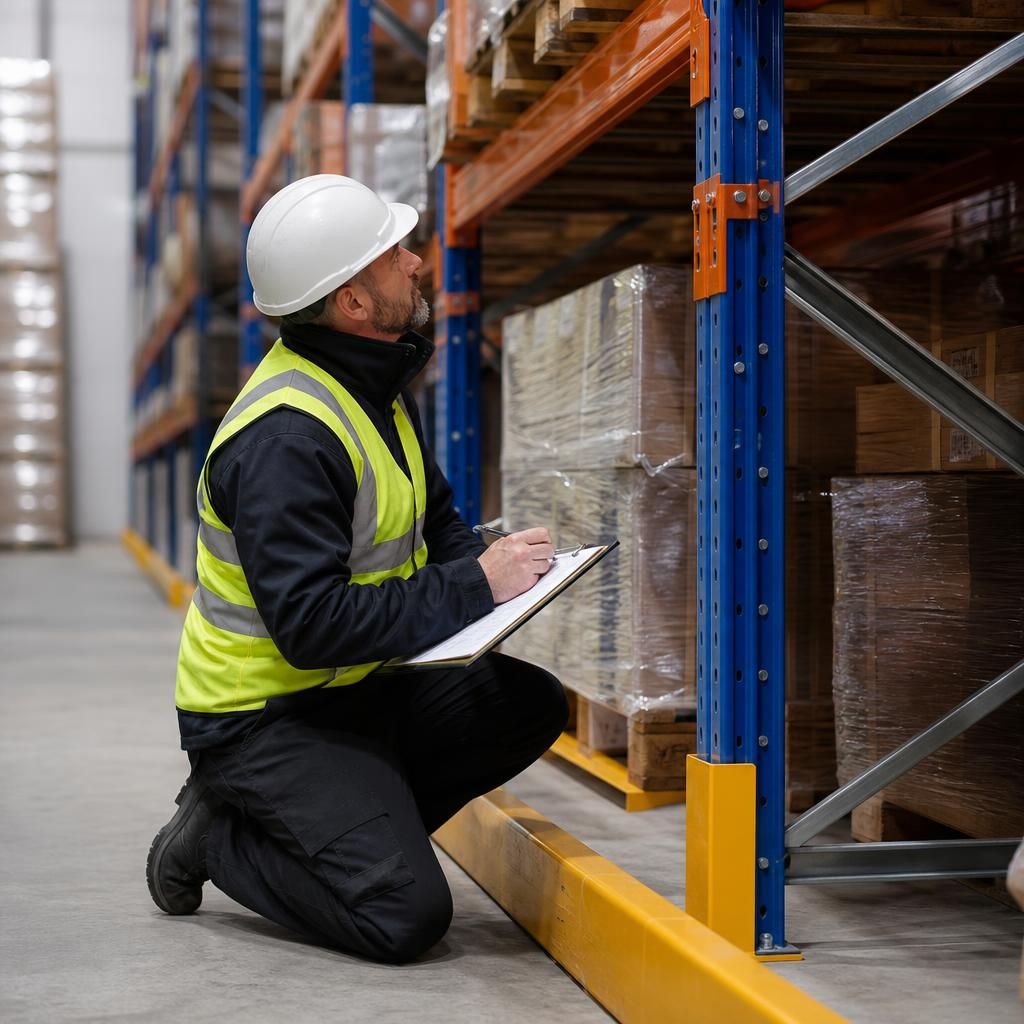
SEMA Racking Inspection Courses prepare participants for real-world application through supervised exercises based on typical warehouse conditions. Learners practise inspecting warehouse racking, identifying damage or unsafe storage, assessing the likely risk and recording findings clearly. Trainers provide feedback on missed defects, unsuitable recommendations and reporting quality, helping participants build the judgement needed to prioritise urgent concerns and communicate them to the responsible site manager.
Prepare Your Team for Real-World Racking Inspections
Speak to Able Racking about enrolling your team on a SEMA Racking Inspection Course and preparing them for practical, consistent warehouse racking inspections.