
How frequently should warehouse racking inspections be performed to ensure ongoing compliance with safety standards?
Warehouse racking should receive a thorough inspection by a technically competent person at intervals of no more than 12 months, with more frequent inspections where the risk assessment, usage or operating environment requires them. Routine visual checks should also be carried out between formal inspections, and any damage should be reported and addressed without delay.
Warehouse racking should be inspected by a technically competent person at intervals of no more than 12 months to support ongoing compliance with applicable safety requirements. This formal inspection is not a substitute for routine checks: the storage system should also be visually monitored between formal inspections, with any damage or unsafe condition reported and dealt with promptly.
The correct inspection frequency depends on the risks associated with the warehouse racking, how intensively it is used and the conditions in which it operates. A risk assessment should establish whether inspections are needed more frequently than the annual maximum. Factors that may justify a shorter interval include frequent forklift movements, repeated impact damage, heavy or irregular loads, high stock turnover, poor housekeeping, changes in working practices and a history of defects.
Formal inspection by a technically competent person
A technically competent person should complete a detailed inspection at least annually. The inspector should have suitable knowledge, training and practical experience of warehouse racking systems, their safe use, common failure modes and the relevant inspection requirements. The inspection should consider the complete storage installation rather than only visible damage to individual frames or beams.
Depending on the system and site conditions, the inspection may assess upright frames, beams, connectors, bracing, baseplates, floor fixings, guards, load notices and other protective components. It should also consider whether the installation remains suitable for its intended loads and configuration, and whether changes to the layout, equipment or loading arrangements have affected its safety.
Routine checks between formal inspections
Warehouse operators should carry out regular visual checks between formal inspections. HSE guidance and recognised industry practice commonly support a systematic inspection regime at weekly intervals, or at another frequency justified by a documented risk assessment. The person carrying out these checks does not necessarily need the same level of expertise as the formal inspector, but they should understand what damage and unsafe conditions look like and know how to report them.
Routine checks should look for issues such as:
- bent, cracked or visibly distorted uprights, beams, bracing or connectors;
- missing, loose or displaced components and fixings;
- damaged guards, baseplates or floor fixings;
- loads that are unstable, overhanging or unsuitable for the location;
- missing, damaged or inaccurate load notices;
- changes to the installation that have not been authorised; and
- obstructions, poor housekeeping or operating conditions that increase the likelihood of impact.
Checks should be carried out often enough to identify developing problems before they create a significant risk. High-traffic areas, locations used by forklift trucks and sections exposed to repeated loading activity may need closer monitoring than less heavily used areas.
When an additional inspection is required
The annual inspection date should not be treated as the only trigger for professional assessment. An additional inspection is appropriate after a significant impact, a serious defect, a structural alteration, a change of layout, relocation, a change in load type or capacity, or any event that may have affected the stability of the installation. It may also be necessary after building work, changes to the floor or operating environment, or the introduction of different handling equipment.
Any suspected structural damage should be reported immediately. The affected location should be made safe, which may involve isolating the bay, unloading it where this can be done safely and preventing further use until it has been assessed. Damaged components should not be straightened, welded or altered without suitable technical approval, as an informal repair can affect the design performance of the system.
Keeping the inspection programme compliant
An effective programme combines the formal inspection, routine visual checks and a clear process for corrective action. Inspection records should show the date, areas examined, findings, risk classification where used, recommended action, responsible person and completion date. Evidence of repairs, replacement components and follow-up inspections should also be retained.
The next formal inspection should be scheduled before the current inspection period expires, while the risk assessment should be reviewed whenever there is a change in use or a recurring pattern of damage. This approach helps demonstrate that the warehouse racking is being actively managed rather than checked only when an annual visit is due.
In practical terms, arrange a competent formal inspection at least once every 12 months, maintain regular visual checks throughout the year and increase the frequency whenever site conditions or the risk assessment require it. Prompt action on defects is essential: an inspection supports compliance, but ongoing safety depends on identifying, controlling and resolving issues without delay.
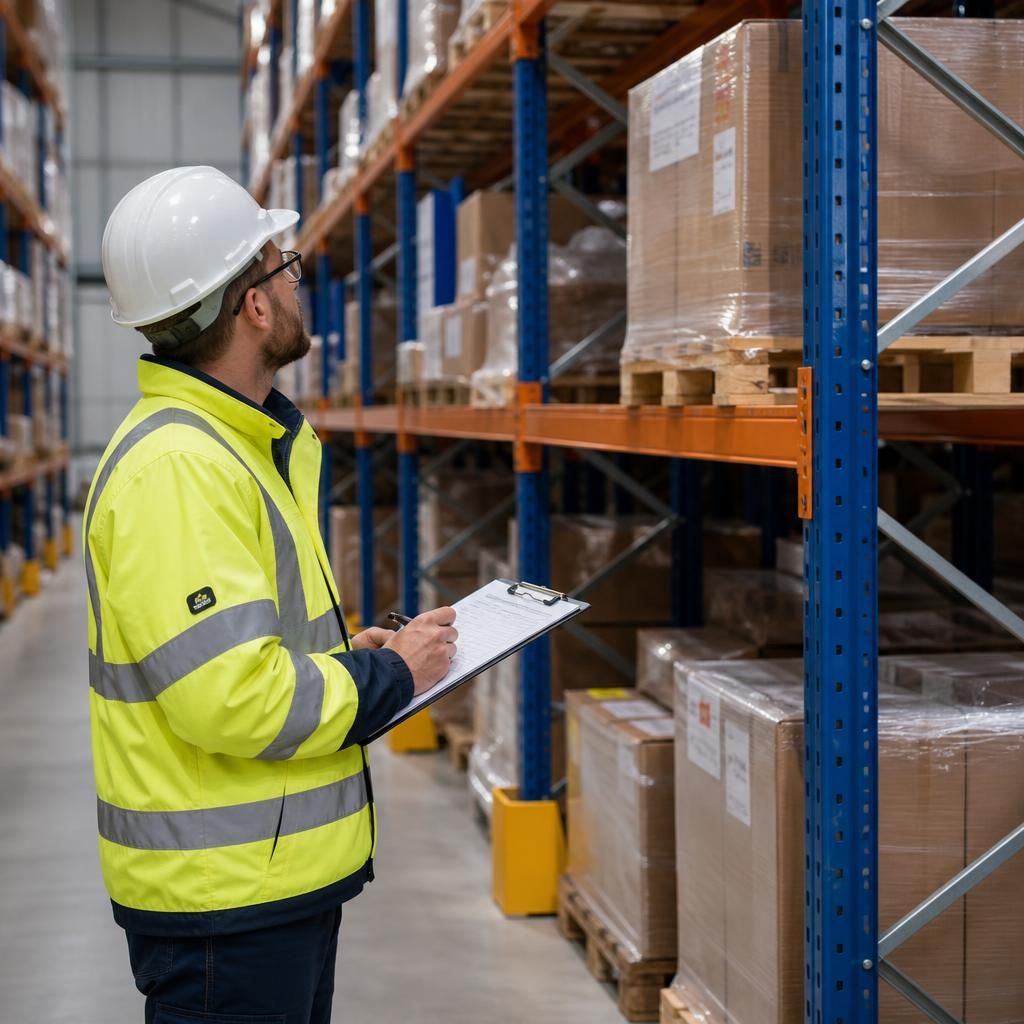
Warehouse racking should undergo a formal inspection by a technically competent person at least every 12 months, with routine visual checks carried out between formal inspections. The inspection frequency should be increased where forklift traffic, heavy loading, repeated impact or a history of defects creates greater risk.
Any suspected damage should be reported immediately and the affected area taken out of use until it has been assessed. Keep records of inspection findings, corrective actions and follow-up checks so that the inspection programme demonstrates continuous control rather than a single annual review.
Arrange Your Warehouse Racking Inspection
Contact Able Racking to arrange your next warehouse racking inspection and confirm that your inspection programme remains suitable for your site’s current risks and usage. We can provide practical guidance on any findings and the corrective action required.