
What are the most common safety hazards identified during annual racking inspections, and how can they be addressed?
Annual warehouse racking inspections commonly identify damaged uprights, beams or bracing, missing safety components, overloading, poor anchorage, corrosion and unsuitable loading practices. These hazards should be addressed by making unsafe areas safe immediately, replacing or repairing damaged components with suitable approved parts, correcting load signage and operating procedures, and recording follow-up actions until completion.
Annual warehouse racking inspections most commonly identify structural damage, missing or ineffective safety components, overloading, poor anchorage, corrosion, unsafe loading practices and evidence of impact from handling equipment. Each hazard should be assessed for its level of risk, with serious defects isolated immediately and corrective actions recorded through to completion.
Damaged uprights, beams and bracing
Impact from forklifts and other handling equipment can bend uprights, distort beams, damage bracing or loosen connections. Damage may also result from incorrect installation, unsuitable alterations or repeated overloading. Even apparently minor deformation can reduce the capacity of the affected bay and transfer additional forces to adjacent components.
Where damage presents an immediate risk, the affected area should be unloaded, clearly isolated and taken out of use. Damaged components should be replaced with suitable, approved parts rather than straightened, welded or modified without appropriate technical authorisation. The surrounding bays, connections and floor fixings should also be checked, as an impact may have caused less visible secondary damage.
Missing, loose or unsuitable safety components
Inspections often find missing locking pins, damaged upright protectors, absent beam safety devices, loose fixings or inadequate end protection. These components help prevent beams from becoming displaced and reduce the consequences of vehicle impact. Their absence can make an otherwise sound installation unsafe in normal operation.
Missing or damaged items should be replaced with compatible components designed for the particular system. Beam locks and other retaining devices must be correctly fitted, while upright and end protection should be positioned where it provides effective protection without obstructing access or creating a new hazard. Temporary substitutes should not be used unless their suitability has been formally confirmed.
Overloading and incorrect load information
Exceeding the stated capacity of a bay, beam level or upright can cause excessive deflection, permanent deformation or progressive failure. Overloading may occur when pallet weights change, storage levels are altered, load configurations are misunderstood or capacity notices are missing and operators rely on assumptions.
Load capacity notices should be present, legible and consistent with the installed configuration. The duty holder should confirm that the stated capacities reflect the actual frame height, beam arrangement, pallet dimensions, loading pattern and floor conditions. Loads that exceed the permitted capacity should be removed or redistributed under controlled conditions, and operators should be reminded not to place heavier or differently sized pallets into positions that have not been assessed.
Poor anchorage, floor damage and instability
Loose or missing floor anchors, damaged concrete, incorrect fixings and movement at the base of an upright can affect the stability of the installation. Problems may be caused by impact, unsuitable installation methods, deterioration of the floor or later building works that have disturbed the fixings.
Anchors and baseplates should be checked for movement, damage and correct installation. Repairs must use an approved fixing method suitable for the floor construction and the loads imposed by the system. If the floor or surrounding structure is damaged, it should be assessed before the storage system is returned to service. Simply tightening an accessible nut will not correct an unsuitable or failed anchor.
Corrosion and deterioration
Corrosion can reduce the effective section of steel components, particularly in areas exposed to moisture, chemicals, condensation or damaged protective coatings. It may be visible on uprights, beams, bracing, baseplates and fixings, but concealed deterioration can also occur where water or debris collects.
The extent and location of corrosion should be recorded and assessed rather than treated as a cosmetic issue. Affected components may need cleaning, environmental controls, protective treatment or replacement, depending on the loss of material and the operating conditions. The source of moisture or chemical exposure should be addressed to prevent the defect recurring.
Unsafe loading and unloading practices
Loads placed unevenly, pallets positioned outside the intended support area, damaged pallets and goods projecting into access routes can destabilise loads and increase the likelihood of impact. Inconsistent pallet sizes or loads that are not properly secured can also create gaps, falling-object risks and obstructions.
Storage arrangements should match the design assumptions for the system. Loads should be stable, suitable for the support arrangement and positioned with the required clearances. Damaged pallets should be removed from service, access routes kept clear and operators instructed to report unsafe loads rather than attempting to correct them in a live location.
Unauthorised alterations and poor installation
Changing beam levels, removing bracing, adding components, extending runs or relocating bays without technical approval can invalidate the original design. Inspections may also identify incorrect assembly, incompatible components, missing fixings or inadequate clearances resulting from installation work.
Any alteration should be reviewed by a suitably competent person before it is implemented. The configuration should be checked against the design information and manufacturer requirements, and updated capacity information should be provided where the arrangement has changed. Unapproved modifications should be removed or corrected before the affected area is used.
Inadequate housekeeping and access control
Obstructed aisles, stored goods outside designated locations, poor lighting and limited access around the installation can increase the risk of collision and make defects harder to identify. Housekeeping issues may also prevent emergency access or interfere with inspection and maintenance work.
Storage areas should have clearly defined access routes, suitable lighting and sufficient space for handling equipment to operate safely. Items should not be stored against damaged components or in locations that conceal defects. Where a bay has been isolated, barriers or clear signage should prevent accidental use until the corrective work has been completed.
How inspection findings should be managed
A thorough inspection should distinguish between defects requiring immediate action and lower-risk issues requiring planned monitoring or repair. Findings should identify the precise location, affected components, observed condition and recommended action. Photographs, bay references and inspection records can help maintenance teams locate defects accurately and verify that actions have been closed.
- Immediate risk: unload and isolate the affected area, prevent access and arrange urgent remedial work.
- Significant defect: restrict use as necessary, implement a controlled repair plan and monitor the area until completion.
- Minor defect or developing issue: record the finding, assign responsibility and include it within planned maintenance and follow-up checks.
After repairs, the affected area should be re-examined to confirm that the work is suitable and that no related damage remains. Inspection records, repair evidence, updated load information and any revised drawings or instructions should be retained as part of the warehouse safety system. Regular internal visual checks between formal inspections are also important, particularly after an impact, layout change or unusual loading event.
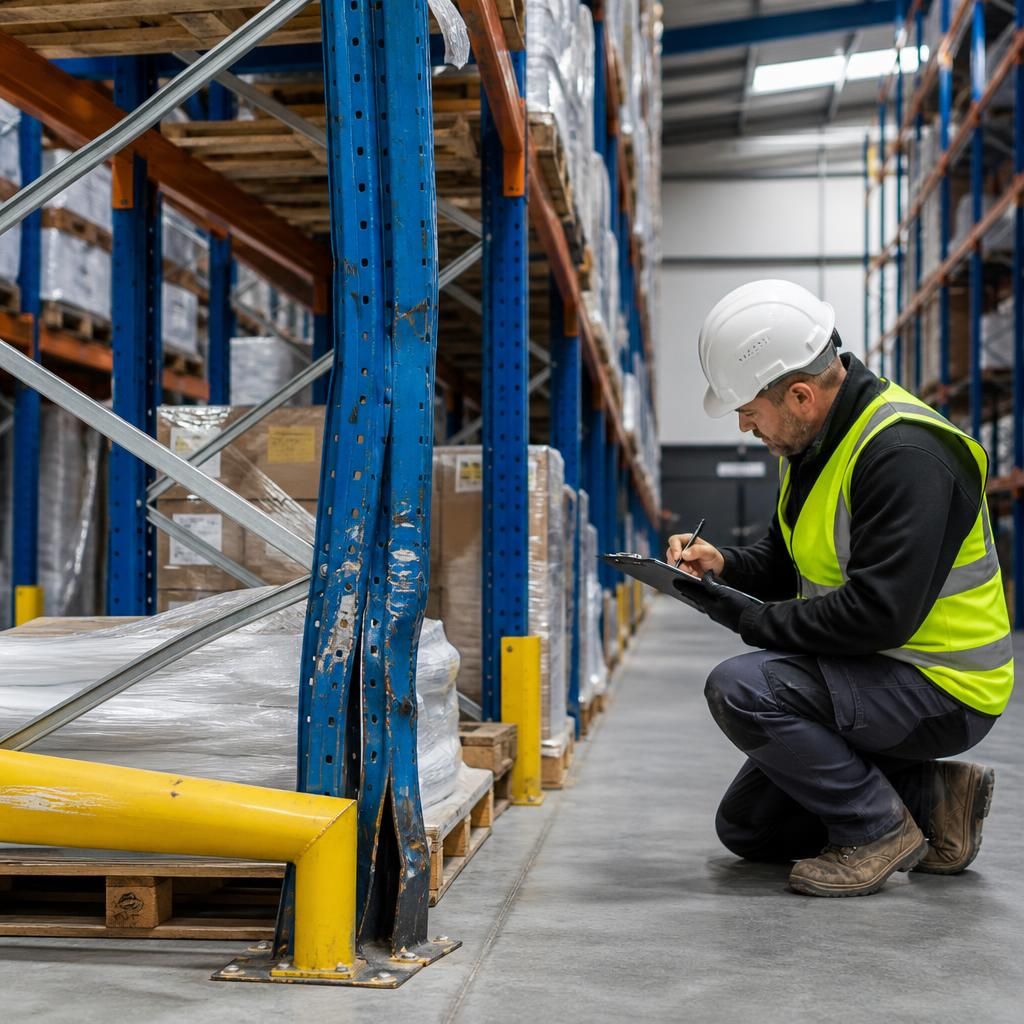
The most urgent finding during an annual warehouse racking inspection is damage that could affect stability or load capacity. A bent upright, displaced beam, failed anchor or missing retaining device should not be treated as a routine maintenance issue, because continued use may increase the risk of collapse or falling goods.
The affected bay should be unloaded where safe, clearly isolated and labelled to prevent further use. The defect should then be assessed by a competent person and repaired or replaced using compatible, approved components. Straightening, welding or improvised repairs can alter the component’s strength and should not be undertaken without suitable technical authorisation.
Before the area is returned to service, the completed work should be checked and recorded. The inspection report should identify the exact location, defect, action required and closure evidence, allowing the duty holder to demonstrate that serious hazards have been controlled rather than simply noted.
Arrange expert help addressing warehouse racking hazards
Contact Able Racking to arrange expert assessment and corrective support for hazards identified during your warehouse racking inspection. Our experienced team can help prioritise defects, coordinate suitable repairs and confirm that affected areas are safe to return to use.