
What are the differences between pallet racking and cantilever racking in terms of application and cost?
Pallet racking is suited to warehouses storing palletised goods with regular access and stock rotation, while cantilever racking is designed for long, bulky or awkward items such as timber, piping and sheet materials. Pallet racking is usually more cost-effective for standard pallet storage, whereas cantilever racking can cost more because of its specialist design, heavier construction and greater space requirements.
Pallet racking is generally the more suitable and economical choice for warehouses storing standardised palletised goods, while cantilever racking is designed for long, bulky or awkwardly shaped items that cannot be stored efficiently on conventional pallet beams. The correct option depends on the goods, handling equipment, available floor and headroom, access requirements, load characteristics and the condition of the system being purchased.
Pallet racking: applications
Pallet racking uses vertical frames, horizontal beams and adjustable storage levels to create accessible locations for palletised stock. It is commonly used for cartons, packaged goods, components, finished products and other loads that are stored on standard pallets. Forklift trucks or other mechanical handling equipment can normally access each beam level from an aisle.
This arrangement is particularly useful where a business needs:
- Direct access to individual pallets
- Clear stock identification and organised location control
- Regular stock rotation, including first-in, first-out processes where appropriate
- Adjustable storage levels to accommodate changing pallet heights
- Good use of available vertical space
- A storage system that can be extended or reconfigured as requirements change
Selective pallet racking is often chosen because it provides straightforward access to every stored pallet. Other layouts, including drive-in, push-back or narrow-aisle configurations, can increase storage density but may affect access, stock rotation, handling equipment requirements and overall cost.
Cantilever racking: applications
Cantilever racking has projecting arms supported by vertical columns and a stable base. It does not use front upright frames and beam levels in the same way as pallet racking. This makes it suitable for products that are too long, flexible, heavy or irregularly shaped for standard pallet locations.
Typical applications include the storage of timber, steel sections, pipes, plastic profiles, sheet materials, doors, windows, furniture components and other long loads. Items can be placed on the arms from the front using a forklift, crane or suitable manual handling method, depending on their weight and dimensions.
Cantilever systems are useful where goods need to be loaded along their length rather than placed into enclosed pallet locations. Arm spacing and height can often be adjusted to suit the stock, but the system must be designed around the load length, weight distribution, centre of gravity and handling method. Long products should be supported adequately to prevent sagging, rolling or instability.
Key differences in design and access
The main practical difference is the type of load each system supports. Pallet racking is based around pallet dimensions and beam capacities, whereas cantilever racking is based around the length, weight and shape of individual products. Pallet racking creates defined pallet bays, while cantilever racking provides open access along the arms.
Pallet racking usually requires carefully planned aisles for forklift access. Cantilever racking also requires sufficient aisle width and clearance, but its open-fronted design can make long products easier to load and retrieve. The handling equipment must be suitable for the load as well as the storage system. A layout that appears to provide high capacity may be impractical if vehicles cannot safely manoeuvre or loads cannot be placed without impact.
How the costs compare
Pallet racking is usually less expensive for standard pallet storage because it is widely available in modular configurations and uses common components. Its cost is influenced by the number and height of frames, beam capacities, aisle arrangement, protection requirements, installation, handling equipment compatibility and any alterations needed to the building.
Cantilever racking can have a higher purchase and installation cost because it uses heavier structural components and is engineered for longer or more demanding loads. The total project cost may also increase where the system needs substantial bases, specialist handling equipment, additional protection or a larger footprint. Long products can require more clearance between storage rows, which may reduce the amount of floor space available for other uses.
Neither system should be compared on purchase price alone. A cheaper system may provide less usable capacity if it does not suit the products, requires inefficient handling or creates excessive unused space. The relevant comparison is the cost of safely storing the required stock, including installation, inspection, maintenance, adaptations and potential changes to the operation.
Factors that affect the final price
- Required load capacity and the weight distribution of stored goods
- System height, number of storage levels and available building clearance
- Bay length, arm length and the dimensions of the products
- Required aisle widths and the type of handling equipment used
- Floor condition, slab capacity and fixing requirements
- Column, frame, arm and end protection
- Delivery, installation and dismantling of existing equipment
- Design changes, extensions or relocation of the storage system
- Inspection, maintenance and replacement of damaged components
Used equipment can reduce the initial purchase cost, but it still needs to be checked for damage, compatibility, capacity information and suitability for the proposed layout. Missing components, obsolete parts, poor condition or unverified load ratings can create additional costs and safety risks. A competent assessment should be completed before buying or installing used equipment.
Safety and suitability
Both types of storage system must be designed, installed and used according to the manufacturer’s instructions and the site’s risk assessment. Loads should remain within stated capacities, be evenly positioned and be stored in a way that prevents falling, rolling or projecting into access routes. Uprights, frames, arms, bases and connections should be protected from vehicle impact where necessary.
Regular visual checks by trained staff and a documented expert inspection at appropriate intervals help identify damage, overloading, displacement, missing components and other defects. Any damaged part should be reported, assessed and taken out of service where necessary until a competent person confirms the appropriate repair or replacement. Capacity notices and safe working procedures should be kept clear and up to date, particularly after alterations.
Choosing between the two systems
Choose pallet racking when the stock is predominantly palletised, standardised and accessed individually, especially where direct access and flexible stock rotation are important. Choose cantilever racking when the stock consists mainly of long, bulky or irregular items that need open-fronted storage and cannot be handled efficiently in pallet locations.
Before committing to a purchase, review the product dimensions, maximum weights, loading method, stock turnover, handling equipment and planned growth. A site survey and capacity-led design can confirm whether the proposed system will fit the building and support the intended operation. This approach normally produces a more reliable cost comparison than comparing component prices in isolation.
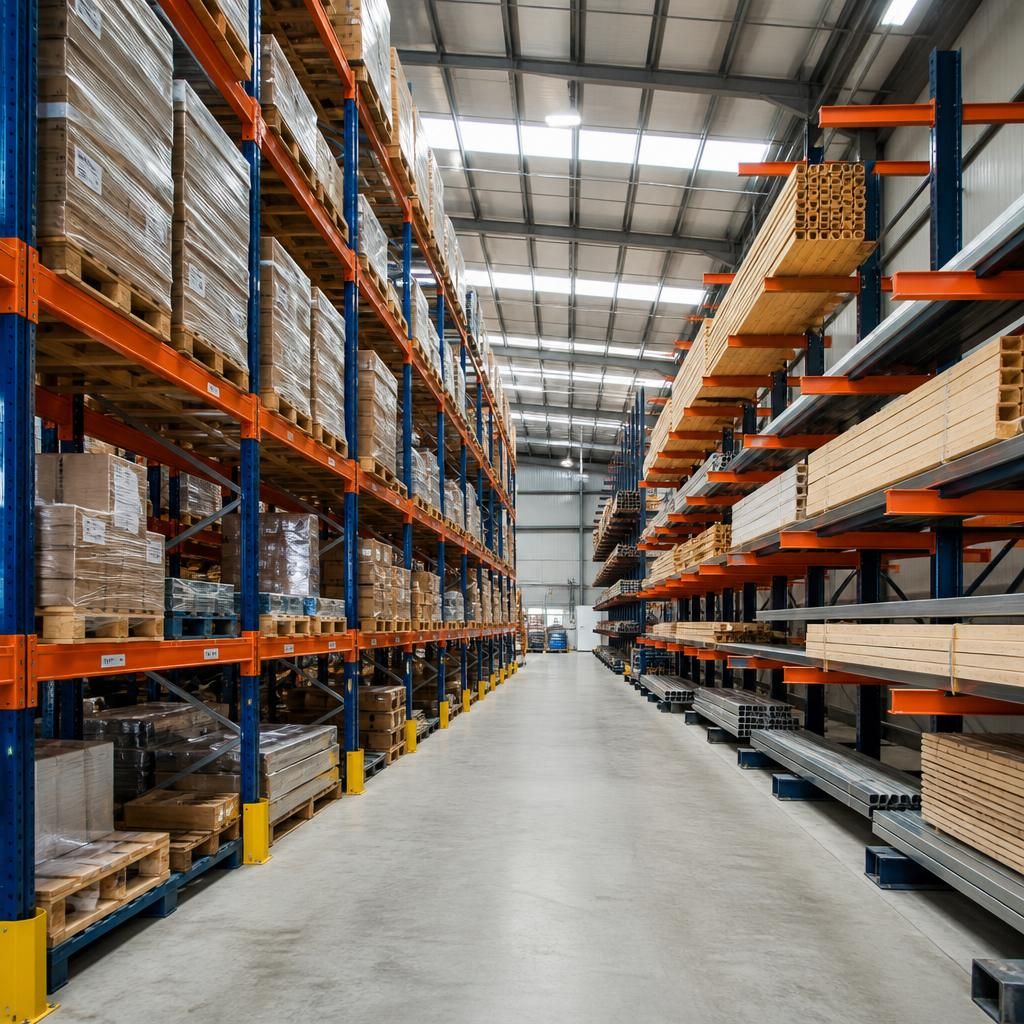
The most important difference between pallet racking and cantilever racking is the type of stock each system is designed to hold. Pallet racking suits standardised pallet loads that need individual access, while cantilever racking is intended for long, bulky or irregular products such as timber, pipes, sheet materials and profiles.
This distinction directly affects cost. Pallet racking is often the more economical option for conventional pallet storage because its components and layouts are widely available. Cantilever racking can require heavier bases, longer clearances and specialist handling arrangements, so its overall cost may be higher. However, using pallet racking for long products can create wasted space, difficult handling and additional safety risks.
Compare the systems by assessing usable capacity rather than the purchase price alone. Consider product dimensions and weight, loading methods, aisle requirements, floor capacity, impact protection, installation and future alterations. A competent site assessment can confirm which system provides safe, practical storage before equipment is purchased.
Discuss your pallet or cantilever warehouse racking requirements
Discuss your pallet or cantilever warehouse racking requirements with Able Racking so our experienced team can assess your loads, available space, handling methods and safety needs before you purchase or install a system.