
How does a pallet shuttle system operate within a warehouse racking setup?
A pallet shuttle system uses a motorised shuttle running on rails within deep-lane warehouse racking to transport pallets into and out of storage positions. A forklift places a pallet onto the shuttle at the lane entrance, then the shuttle moves it to an available location or retrieves it for collection, reducing forklift travel inside the aisle.
A pallet shuttle system uses a motorised shuttle carriage running on rails within deep-lane warehouse racking to move pallets into and out of storage positions. A forklift places a pallet at the lane entrance, after which the shuttle collects the load, transports it along the lane and positions it in the next available location. For retrieval, the shuttle brings the selected pallet back to the access point, reducing the need for forklifts to travel into the storage lanes.
The system is designed for high-density pallet storage. Instead of requiring a forklift to access every pallet position directly, the warehouse racking provides the structural storage lanes while the shuttle performs the horizontal movement within them. This can make better use of available floor space and reduce unnecessary forklift travel, particularly where many pallets of the same product or batch are stored together.
The main components are:
- Shuttle rails: fixed rails installed along the depth of each storage lane. These guide the shuttle and support its movement.
- Motorised shuttle carriage: a battery-powered unit that travels along the rails and carries the pallet to or from its storage position.
- Control system: controls on the shuttle, usually operated by remote control or integrated with warehouse management software, direct loading, storage and retrieval movements.
- Positioning and safety sensors: sensors detect pallet position, lane conditions and obstructions so the shuttle can stop accurately and operate within defined limits.
- Warehouse racking structure: uprights, beams, rails, guides, stops and protection components support the stored loads and provide the shuttle lanes.
Loading a pallet into the system
- The forklift operator checks that the pallet is suitable for the lane, correctly loaded and stable. Pallet dimensions, weight and condition must be compatible with the warehouse racking and shuttle manufacturer’s specifications.
- The forklift places the pallet on the shuttle at the lane entrance. The load must be positioned squarely, with no part of the pallet or its contents fouling the uprights, rails or adjacent loads.
- The operator activates the required storage command. Depending on the system, this may be selected using a remote control, a local control panel or an interface with the warehouse management system.
- The shuttle lifts or engages with the pallet sufficiently to move it, then travels along the rails to the allocated storage position.
- The shuttle places the pallet down in the correct location, confirms that the position is occupied and returns to the lane entrance or remains ready for the next instruction.
In many systems, the shuttle fills the lane from the far end towards the entrance. This reduces the amount of unused space and allows multiple pallets to be stored closely together without requiring forklift access between them. The control system may record the occupied locations, but stock location records still need to be managed accurately so that the physical contents of each lane match the warehouse inventory.
Retrieving a pallet
For retrieval, the operator selects the required lane and instructs the shuttle to collect the pallet. The shuttle travels beneath or engages with the load, moves it towards the access point and presents it for removal. The forklift then collects the pallet from the lane entrance. If other pallets remain in the lane, the shuttle can reposition them as required, depending on the system’s operating sequence and control functions.
The storage and retrieval sequence depends on the stock rotation method required. A last-in, first-out arrangement generally loads and unloads pallets from the same end of a lane. This is often suitable for uniform products that do not require strict chronological rotation. A first-in, first-out arrangement requires loading at one end and retrieval at the other, normally using a through-loading configuration. This can support stock rotation where production date, expiry date or batch sequence is important. The arrangement must be selected during the warehouse racking design stage because it affects the building layout, forklift access and overall system configuration.
How the system works with forklifts
Forklifts remain necessary, but their role changes. They normally load and unload at the face of the warehouse racking rather than driving deep into each storage lane. This can reduce aisle congestion and limit the risk of forklift contact with internal rails, pallet guides and stored loads. It does not remove the need for trained forklift operators, suitable traffic management or careful positioning at the lane entrance.
The forklift operator must approach the lane squarely, maintain a clear view and avoid striking the shuttle, rails or racking protection. Loads should not be pushed into position with the forklift, and a pallet should never be forced into a lane that is obstructed or already occupied. Any unusual resistance, alarm or positioning problem should be reported rather than overcome by applying additional force.
Control and automation
Basic pallet shuttle systems can be operated using a handheld remote control. More integrated installations may communicate with warehouse management software, which allocates storage positions and records movements. Automated functions can include pallet detection, lane filling, retrieval commands, load counting and battery status monitoring. The exact level of automation varies, so operating procedures must reflect the equipment installed and should not assume that the system will identify every stock or safety issue automatically.
Operators should understand the shuttle’s status indicators, emergency stop controls, permitted operating modes and battery-charging procedure. Access controls and exclusion arrangements are also important, particularly while a shuttle is moving. No person should enter a storage lane or reach into the warehouse racking while the equipment is operating unless the system has been isolated under an approved safe-working procedure.
Safety considerations
A pallet shuttle can reduce forklift movement within deep storage lanes, but the warehouse racking and shuttle still require active safety management. Loads must remain within the specified weight and dimensional limits, and pallets must be in suitable condition. Damaged pallets, unstable loads, overhanging goods and incorrectly positioned products can obstruct the shuttle or place abnormal forces on the structure.
- Keep the lane entrance, rails and shuttle path clear of debris and loose packaging.
- Use suitable end-of-aisle, upright and corner protection where required by the risk assessment.
- Follow the manufacturer’s instructions for loading, unloading, battery charging and fault recovery.
- Do not bypass sensors, guards, alarms or emergency stop functions.
- Remove the system from service if the shuttle is damaged, fails to position correctly or shows an unresolved fault.
- Report impact damage to the warehouse racking immediately and prevent further use of the affected area until it has been assessed.
Regular checks should cover the structural condition of the warehouse racking, beam and rail alignment, pallet supports, guide components, protection, shuttle wheels, batteries, sensors and control equipment. A competent racking inspector should assess the storage structure at the required intervals, with additional inspections after impact, alteration or a significant change in loading. Planned maintenance helps identify wear and alignment problems before they interfere with safe operation.
In practical terms, the pallet shuttle handles the movement inside the lane while the forklift handles the transfer between the warehouse floor and the lane entrance. The system operates effectively when the shuttle, warehouse racking, pallets, software controls and working procedures are treated as one coordinated storage installation. Correct design, compatible loads, trained operators and documented inspections are therefore essential to maintaining safe, reliable and efficient operation.
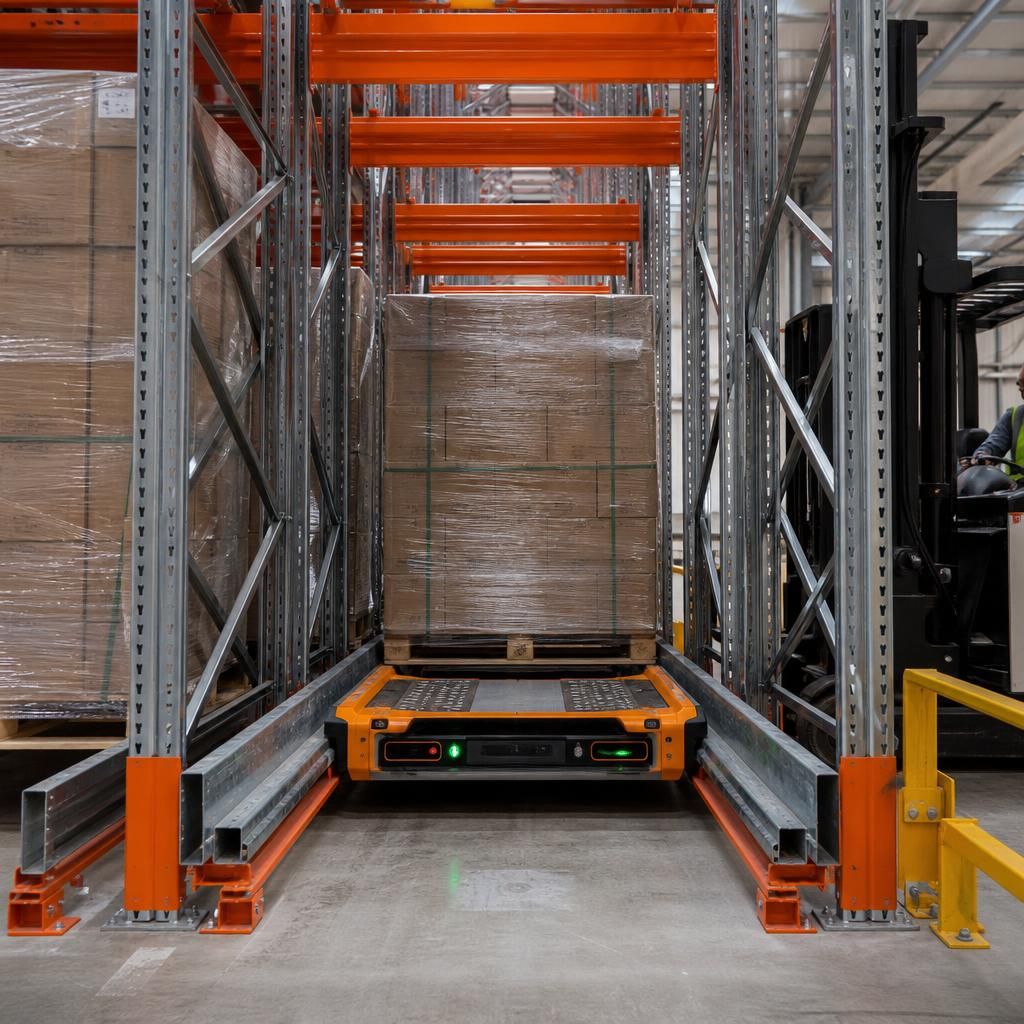
A pallet shuttle system operates by moving pallets along rails inside deep-lane warehouse racking, while a forklift loads and unloads at the lane entrance. This division of movement reduces the need for forklifts to enter storage lanes, helping limit congestion and the risk of contact with stored loads, rails and structural components.
For safe operation, the forklift must approach squarely and place each pallet centrally on the shuttle. Pallets must be stable, undamaged and within the specified dimensions and load limits. The operator should never force a pallet into an obstructed lane or use the forklift to push a load into position. Any impact, unusual resistance or shuttle fault should be reported immediately so the affected warehouse racking and equipment can be assessed before further use.
Arrange a pallet shuttle system safety assessment
Arrange a pallet shuttle system safety assessment with Able Racking to review the condition, operation and protection of your warehouse racking and shuttle equipment. Contact our experienced team to discuss your requirements and the appropriate inspection process.