
How does Pallet Flow racking improve inventory management in warehouses?
Pallet Flow racking improves warehouse inventory management by supporting first-in, first-out (FIFO) stock rotation, making products easier to identify and reducing the risk of aged or obsolete stock. Gravity-fed lanes also streamline loading and picking, helping teams maintain accurate stock control while using available storage space efficiently.
Pallet flow racking improves warehouse inventory management by using gravity-fed lanes to support first-in, first-out (FIFO) stock rotation. Pallets are loaded at the replenishment side and move towards the picking face, so the oldest suitable stock is normally presented first. This improves product visibility, reduces the risk of aged or obsolete inventory, and gives warehouse teams a more consistent method for controlling stock movement.
Improved FIFO stock rotation
FIFO is particularly important where products have a shelf life, batch requirement or date-sensitive value. With pallet flow racking, newer pallets are placed behind existing stock rather than in front of it. As the front pallet is removed, the following pallet rolls forward into position. This physical arrangement makes the correct rotation method easier to follow during busy operations and reduces reliance on memory or manual rearrangement.
Warehouse procedures should still define how dates, batches and product condition are checked. Pallet flow racking supports FIFO, but accurate rotation also depends on correct labelling, disciplined loading and staff following the agreed process.
Better stock visibility and identification
Open picking faces make it easier to see which pallets are available, being picked or awaiting replenishment. Products can be organised by SKU, batch, dispatch priority or expiry date, depending on the operational requirement. Clear location labels and consistent lane allocation help operatives identify stock without searching through multiple storage positions.
This improved visibility can support more reliable stock checks. Discrepancies are easier to investigate when each lane has a defined purpose and pallets move through the storage position in a predictable direction. It can also help supervisors identify slow-moving stock, damaged pallets or lanes that require attention.
More efficient replenishment and picking
Pallet flow racking separates loading from picking. Replenishment can take place from the rear while order picking or dispatch activity takes place at the front, reducing interference between the two tasks. This arrangement is useful in operations with frequent picking activity because replenishment does not always require access to the same working face.
The gravity-fed movement of pallets also reduces the need for operatives to enter storage lanes to retrieve stock. Pallets are presented at the front of the lane, allowing forklift operators and picking teams to work from defined access points. Shorter search and travel times can make stock handling more consistent, particularly where the system is laid out around product demand and dispatch flow.
More effective use of warehouse space
Pallet flow racking can make good use of available storage volume by arranging pallets in deep lanes rather than placing every pallet in a separate access aisle. Fewer aisles may be needed than with a fully selective layout, although the correct configuration depends on the building, pallet dimensions, equipment and required access.
High-demand or date-sensitive products can be grouped in dedicated lanes, while slower-moving products can be stored in areas that require less frequent replenishment. This approach helps align storage space with inventory behaviour instead of treating every product as though it has the same handling requirement.
Improved stock control processes
A well-managed pallet flow system provides a clear physical sequence for receiving, storing, picking and dispatching goods. This can support warehouse management procedures by making it easier to:
- Assign stock to a defined lane and product location.
- Separate replenishment activity from order picking.
- Prioritise older, earlier-dated or specific-batch stock.
- Identify empty, partially used or blocked lanes.
- Carry out location checks and investigate discrepancies.
- Reduce unnecessary handling and pallet movements.
These benefits are strongest when the physical layout is matched to accurate stock records. Location data should reflect the actual lane, product and batch position, and any changes to the layout should be updated promptly in the warehouse management system or stock records.
Reduced handling and product disturbance
Each unnecessary pallet movement creates additional handling time and an opportunity for damage or an inventory error. Pallet flow racking reduces some of this activity by allowing pallets to move through a lane in a controlled direction. Operatives do not generally need to move newer pallets to reach older stock at the front of the lane.
Reduced handling does not remove the need for careful forklift operation. Pallets must be suitable for the equipment and conveyor arrangement, and loads should be stable, evenly distributed and within the system’s specified requirements. Damaged pallets or poorly wrapped loads can affect movement and create a safety or stock-control issue.
Operational points to manage
Pallet flow racking is not automatically the best choice for every product profile. It is most effective where there is a clear need for FIFO, repeated movement of similar products and sufficient volume to justify dedicated lanes. Products that vary significantly in pallet size, weight or packaging may require a different arrangement or carefully designed lane controls.
Inventory accuracy can also be affected if pallets are placed in the wrong lane, mixed without authorisation or removed from the incorrect position. Written loading and picking procedures, clear signs and suitable training help prevent these problems. Regular checks should confirm that pallets are moving correctly, lanes are not obstructed and stock records match the physical arrangement.
Safety and maintenance considerations
The system should be inspected routinely by competent personnel, with particular attention given to frames, beams, rollers, guides, brakes, lane separators and protective equipment. Impact damage, displaced components, unusual pallet movement or a lane that fails to flow should be reported and assessed promptly. Damaged equipment should not be returned to normal use until it has been made safe.
Safe working loads, pallet specifications and loading methods must be clearly communicated to all relevant operatives. Routine housekeeping is also important because debris, packaging or damaged goods can obstruct lanes and affect both stock movement and safe access. Preventative maintenance helps preserve the predictable movement that the inventory process depends on.
Overall, pallet flow racking improves inventory management by combining FIFO stock rotation with clearer product presentation, controlled replenishment and efficient pallet movement. When the layout, stock records, loading procedures and inspection programme are properly aligned, it gives warehouse teams better control over product age, location and availability while reducing avoidable handling and storage errors.
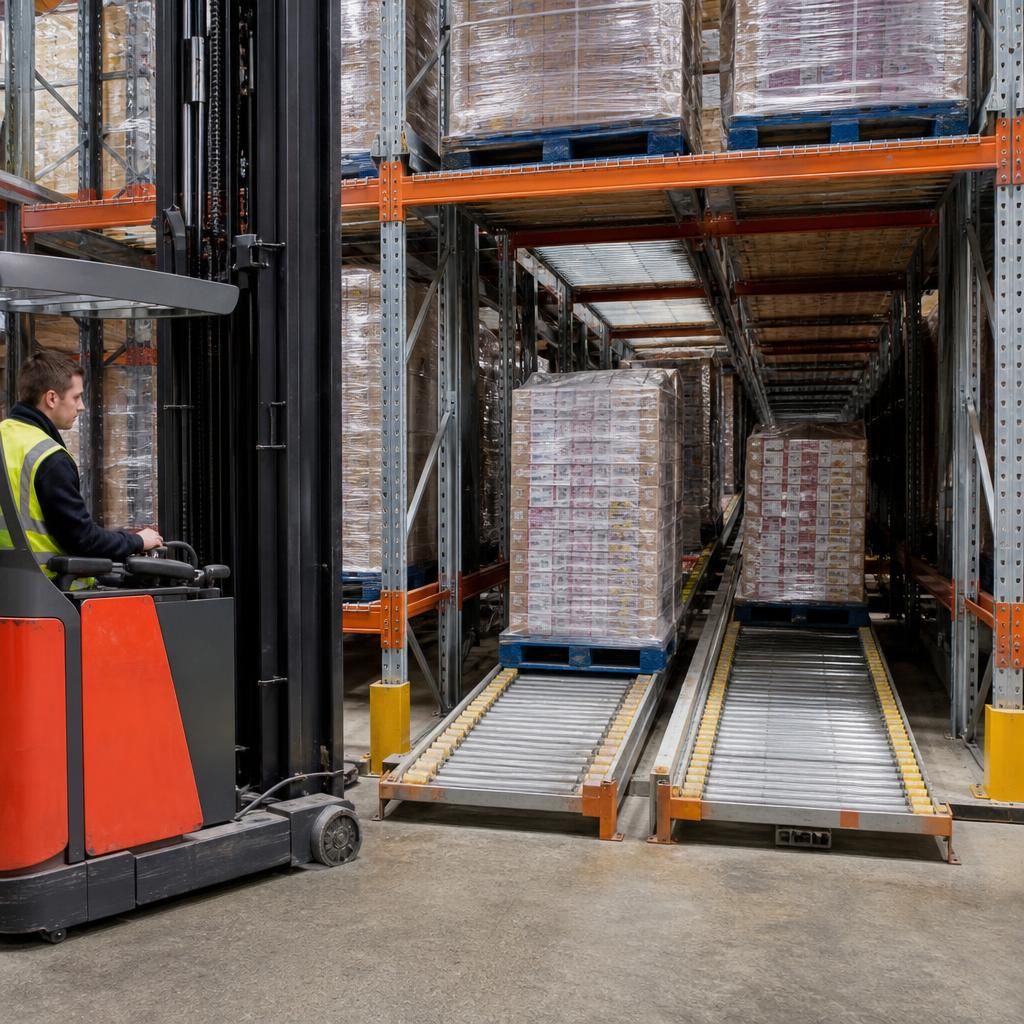
Pallet flow racking improves inventory management by presenting the oldest suitable pallet at the picking face first. Pallets are loaded from the replenishment side and move forward through the lane under gravity as stock is removed, supporting first-in, first-out (FIFO) rotation.
This arrangement gives operatives a clear view of available stock and reduces the need to move newer pallets to reach older ones. It is particularly useful for date-sensitive, batch-controlled or perishable goods, provided lanes are clearly labelled and loading procedures are followed consistently. Stock records should still be updated accurately, with routine checks confirming that pallet positions, product details and physical stock remain aligned.
Arrange a Pallet Flow Racking Inspection
Arrange a pallet flow racking inspection with Able Racking to identify damage, wear or lane issues that could affect safe stock movement and inventory control.