
What are the safety standards for mezzanine floor gates?
Mezzanine floor gates should be designed and installed to provide safe access, prevent falls and maintain protection at the open edge, with the system assessed against the Work at Height Regulations 2005 and relevant BS EN ISO 14122 guidance. The gate must suit the platform, load-handling process and operating environment, and be properly installed, inspected and maintained by competent persons.
Mezzanine floor gates are safety-critical access systems installed at open platform edges to allow goods or equipment to pass through while preventing people from falling. In the UK, their safety is assessed through a combination of the Work at Height Regulations 2005, the Provision and Use of Work Equipment Regulations 1998 (PUWER) where applicable, relevant British or international standards, the manufacturer’s instructions and a site-specific risk assessment.
There is not one single regulation that covers every type of mezzanine floor gate. The correct standard depends on the gate’s design, how it is operated, the loads being transferred and whether it forms part of a wider access system. The installation should therefore be assessed as a complete arrangement rather than treating the gate as an isolated item.
The main safety principles are:
- Preventing people, goods and equipment from falling from the open edge.
- Maintaining a physical barrier whenever the loading opening is not actively in use.
- Allowing goods to be transferred without requiring unsafe reaching, climbing or leaning.
- Ensuring the gate cannot be defeated, bypassed or left in an unsafe position during normal work.
- Providing suitable protection for people working below and around the platform.
- Keeping the gate stable, correctly aligned and capable of handling the intended operating conditions.
Work at Height Regulations 2005 are central to the assessment. They require work at height to be properly planned, appropriately supervised and carried out using suitable equipment. Where a person could fall from the platform, the employer must prioritise collective protection, such as guardrails and a properly designed gate, rather than relying only on personal protective equipment or individual behaviour.
The gate should protect the exposed edge while goods are being moved through the opening. A suitable design may use a pallet gate, lift-out arrangement, vertical gate or another engineered solution, but the choice must reflect the task and the surrounding risks. For example, a gate used with a forklift truck requires different controls from one used only for manual handling. The operating sequence must be clear so that the barrier is closed before an operator enters the loading area.
Relevant design guidance and standards
BS EN ISO 14122 provides guidance for permanent means of access to machinery, including platforms, walkways, guardrails and access points. It can be relevant where a mezzanine forms part of an industrial access or work system, although its application should be confirmed by a competent designer. Other standards may apply to the structure, materials, guarding, access equipment or powered components. The applicable standard should be recorded as part of the design and handover documentation rather than assumed from the gate’s appearance.
The supporting platform and its edge protection must also be suitable for the imposed loads and the way the area is used. The gate, fixings and supporting structure should be designed to work together, with consideration given to impact, repeated use, stored goods, lifting equipment and foreseeable misuse. Structural calculations or design information may be required where the gate is installed on an existing platform or where the use of the area changes.
Guarding and fall-prevention requirements
The gate must not create a new fall hazard when it is opened, closed or used. Its barrier should be sufficiently robust, securely fixed and arranged so that a person cannot easily pass beneath, through or around it. Openings, gaps and the operating area should be reviewed for hand, foot and body entrapment risks, particularly where the gate moves vertically or has counterbalanced parts.
Depending on the design, safety measures may include self-closing action, positive latching, interlocking, a two-position transfer arrangement or a physical barrier that remains across the edge during loading. These features are not automatically suitable in every workplace. They must be selected and tested against the actual loading process, including the size and shape of goods, visibility, access routes and the possibility of an operator being behind or beneath the moving gate.
A gate should not be relied upon as a substitute for safe working procedures. Operators need clear instructions covering who may use it, how goods are positioned, how the barrier is secured and what to do if the gate is damaged or does not operate correctly. Where there is a risk of goods falling from the platform, additional controls such as toe-boards, mesh panels, drop protection or exclusion zones may be necessary.
PUWER and other workplace duties
Where the gate is work equipment, PUWER requires it to be suitable for its intended use, maintained in an efficient condition and inspected where deterioration could create a significant risk. Operators must receive suitable information, instruction and training. Powered gates, gates with mechanical assistance and systems with control devices require additional consideration of guarding, emergency stopping, isolation and control reliability.
The Workplace (Health, Safety and Welfare) Regulations 1992 may also be relevant to safe access, traffic routes, lighting, cleanliness and the condition of the surrounding workplace. If lifting equipment is used to move goods through the opening, the lifting operation and equipment must be separately assessed under the applicable lifting-equipment requirements, including LOLER where relevant.
Installation and commissioning
Installation should be completed by competent operatives in accordance with the design and manufacturer’s instructions. Before the gate is put into service, the installer should check the fixings, clearances, movement, locking or latching action, barrier position, load-transfer process and compatibility with the supporting structure. Any protective devices or interlocks should be function-tested under realistic operating conditions.
The handover information should identify the gate type, intended use, safe working procedure, inspection requirements and any restrictions. Drawings, instructions, risk assessments, certificates and records of installation or testing should be retained. If the platform, gate, traffic route or method of handling goods changes, the assessment should be reviewed before the revised operation begins.
Inspection and ongoing compliance
Regular visual checks should identify bent or damaged components, loose fixings, corrosion, worn hinges, failed springs, damaged mesh, defective latches and changes in alignment. Operators should report defects immediately and prevent use where the gate no longer provides effective protection. A formal inspection by a competent person should be arranged at intervals based on the level of use, the environment, previous defects and the manufacturer’s recommendations.
Inspection records should state what was examined, the defects found, the risk presented, the action required and whether the gate was safe to remain in service. Repairs should use suitable components and restore the original safety function; improvised modifications, wedging gates open or removing barriers can invalidate the design and introduce serious fall risks.
In practical terms, a compliant mezzanine floor gate is one that is correctly designed for its task, provides continuous edge protection, is installed on a suitable structure, can be operated without exposing people to avoidable danger and is supported by documented inspection, maintenance and training. A competent assessment is particularly important where the gate is bespoke, frequently used, exposed to impact or integrated with lifting equipment.
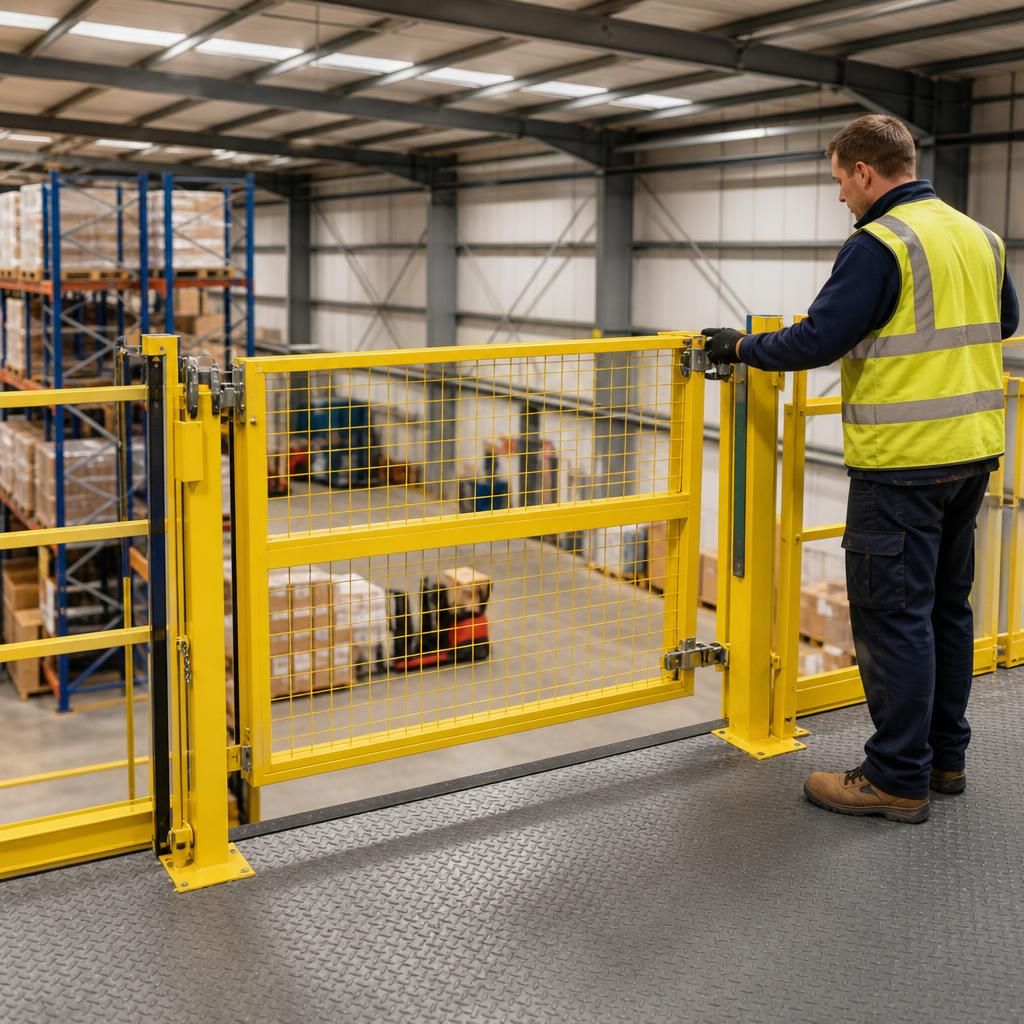
A mezzanine floor gate must maintain effective fall protection whenever goods are not actively being transferred through the opening. It should be securely fixed, suitable for the platform and designed so the barrier cannot be bypassed or left in an unsafe position during normal use.
Before use, check that the gate moves smoothly, closes or latches correctly and leaves no avoidable gaps beneath, through or around the barrier. Operators should follow a clear sequence: position the goods safely, operate the gate as instructed and keep people away from the exposed edge and the area below. Any damaged component, loose fixing, failed latch or alignment problem should be reported immediately and the gate taken out of service until assessed and repaired by a competent person.
Arrange a mezzanine floor gate safety assessment
Arrange a professional mezzanine floor gate safety assessment with Able Racking to review compliance, condition and safe operation. Our experienced team can identify risks and recommend practical corrective action.