
What are the main types of mezzanine edge protection available for industrial settings?
The main types of mezzanine edge protection for industrial settings are fixed guardrails, removable or demountable barriers, toe boards, and access gates such as pallet gates, swing gates and self-closing gates. The appropriate combination depends on the mezzanine layout, access requirements, materials handled and the level of fall protection needed.
The main types of mezzanine edge protection used in industrial settings are fixed guardrails, demountable barriers, toe boards, infill panels and access gates. Gates may include pallet gates, swing gates, vertical-lift gates and self-closing gates. The correct arrangement depends on the platform design, the type of load being transferred, access frequency, available space and the risk of people or materials falling from the edge.
Edge protection should provide a continuous barrier wherever there is a risk of falling. It must also allow authorised access for loading, inspection, maintenance and movement between working areas without creating an unprotected opening. In practice, a mezzanine will often use fixed guardrails around its perimeter, toe boards at floor level and a suitably designed gate at each loading or access point.
Fixed guardrails
Fixed guardrails are the most common form of permanent edge protection. They are secured to the structure or floor and remain in position during normal operations. A typical system includes an upper handrail, an intermediate rail and supporting posts, although the exact configuration should be determined by the design and risk assessment.
- They provide continuous protection along open platform edges.
- They are suitable for areas where access through the perimeter is infrequent or not required.
- They can be configured around columns, machinery, conveyors and changes in platform direction.
- They offer a durable solution where the layout is intended to remain largely unchanged.
Fixed guardrails are not suitable for every loading point. If materials need to pass through the edge, removing or leaving an opening in the guardrail can introduce a serious fall risk. A properly designed access gate or pallet gate is normally required instead.
Demountable and removable barriers
Demountable barriers can be removed when larger equipment, materials or temporary installations need to pass through an opening. They are useful where the platform layout changes periodically or where permanent posts would obstruct operations.
- They provide flexibility for planned changes and occasional access.
- They can be stored away when the opening is required.
- They are suitable for some maintenance, installation and project-based activities.
These systems require strict control. A removable section must not be taken out and left unsecured while the adjacent area remains in use. The components should be clearly identifiable, easy to refit correctly and included in site procedures. Where access is regular, a purpose-designed gate is usually safer and more practical than a barrier that has to be removed manually.
Toe boards and kick boards
Toe boards are fitted along the lower edge of a platform to help prevent tools, packaging, products and other small items from being pushed or kicked over the side. They also help reduce the gap beneath a guardrail system.
Toe boards are an important part of edge protection, but they are not a substitute for a guardrail. They do not prevent a person from falling over the edge. Their height, strength, continuity and fixing method should reflect the materials handled and the foreseeable impact or movement within the working area. Openings at gates, transfer points and around fixed equipment should receive particular attention.
Infill panels and mesh barriers
Infill panels, mesh sections and solid barrier panels can be installed between posts or beneath a top rail. They are useful where the risk assessment identifies a need to prevent smaller objects, packaging or loose materials from passing through the guardrail.
Mesh and panel systems can also be beneficial where there is a need to separate people from moving equipment or where visibility must be retained. The aperture size, panel strength and fixing arrangement need to suit the application. A panel that is suitable for preventing small items from passing through may not be designed to withstand a significant impact, so the system should not be selected on appearance alone.
Pallet gates
Pallet gates are designed to protect an open loading position while allowing goods to be transferred between the floor and the mezzanine. They usually have a barrier that moves or pivots to create a loading opening while maintaining protection on the unoccupied side.
Common configurations include:
- Hinged pallet gates: a barrier pivots through a controlled movement to allow loading and then closes or is returned to its protected position.
- Vertical-lift gates: the barrier rises to create access and lowers to protect the opening when loading is complete.
- Counterbalanced gates: assisted movement helps operators handle the barrier, provided the mechanism is correctly designed and maintained.
- Self-closing pallet gates: the gate returns to its closed position after use, reducing the likelihood of an opening being left unprotected.
Pallet gates must be selected according to the load dimensions, handling method, available headroom, operator position and the way goods are presented at the edge. The gate should not create a route for a person to step or climb through, and its movement must not introduce trapping, crushing or collision hazards.
Swing gates and self-closing access gates
Swing gates are used for pedestrian access, maintenance access and smaller transfer points. They may be single or double leaf, depending on the width required. A self-closing model is generally preferred where the gate protects a frequently used opening, because it reduces reliance on users remembering to close it.
The gate should open in a safe direction, remain stable during use and incorporate suitable latching or closing hardware. Its position must also be checked against walkways, doors, stairs, vehicles and handling equipment. A gate that opens into a traffic route or obstructs an escape route may create a different hazard even if the barrier itself is strong enough.
Sliding and folding barriers
Sliding or folding barriers can be appropriate where there is insufficient space for a swing gate. They are sometimes used at access points that need a wide clear opening, provided the movement can be controlled and the barrier can be secured in both its open and closed positions.
These systems need careful consideration of floor levels, running tracks, pinch points and obstruction risks. They should not be selected solely because they save space. The protection must remain effective when the barrier is closed, and the operating method must be straightforward for the people who use it.
How to choose the appropriate type
Selection should begin with a site-specific assessment rather than a standard product choice. Important considerations include:
- The height and layout of the platform edge.
- Whether the edge is used for pedestrian access, goods transfer or both.
- The size, weight and shape of materials being moved.
- Whether loads are handled manually, with lifting equipment or through a fixed transfer system.
- The frequency of access and whether the layout is permanent or likely to change.
- Available headroom, floor space and clearance around the gate.
- The potential for falling objects, vehicle impact, unauthorised access or climbing.
- Emergency arrangements, escape routes and access for inspection and maintenance.
- The strength, corrosion resistance and cleanability required for the working environment.
Where a loading opening is used frequently, an engineered pallet gate may provide better control than a removable barrier. Where only occasional pedestrian access is needed, a self-closing swing gate may be more suitable. In areas exposed to impact or loose materials, a guardrail with robust infill and a continuous toe board may be necessary.
Installation and ongoing checks
Every component should be compatible with the mezzanine structure and installed in accordance with the system design and manufacturer’s instructions. Fixings, post spacing, gate clearances, hinges, latches and counterbalance mechanisms should all be checked during installation. Cutting, drilling or modifying structural components without suitable approval can affect the integrity of the platform and its protection.
After installation, edge protection should be included in regular workplace inspections. Checks should look for loose fixings, damaged rails, bent posts, corrosion, worn hinges, faulty latches, missing toe boards and gates that fail to close or secure correctly. Any defect that leaves an opening unprotected should be dealt with promptly, with the area controlled until a safe repair is completed.
In the UK, the system should support the employer’s duties under applicable workplace and work-at-height requirements, with the design based on a competent assessment of the risks. A competent specialist can review the platform, access arrangements and working practices together, helping ensure that the selected combination of guardrails, barriers, toe boards and gates provides practical protection rather than treating each component in isolation.
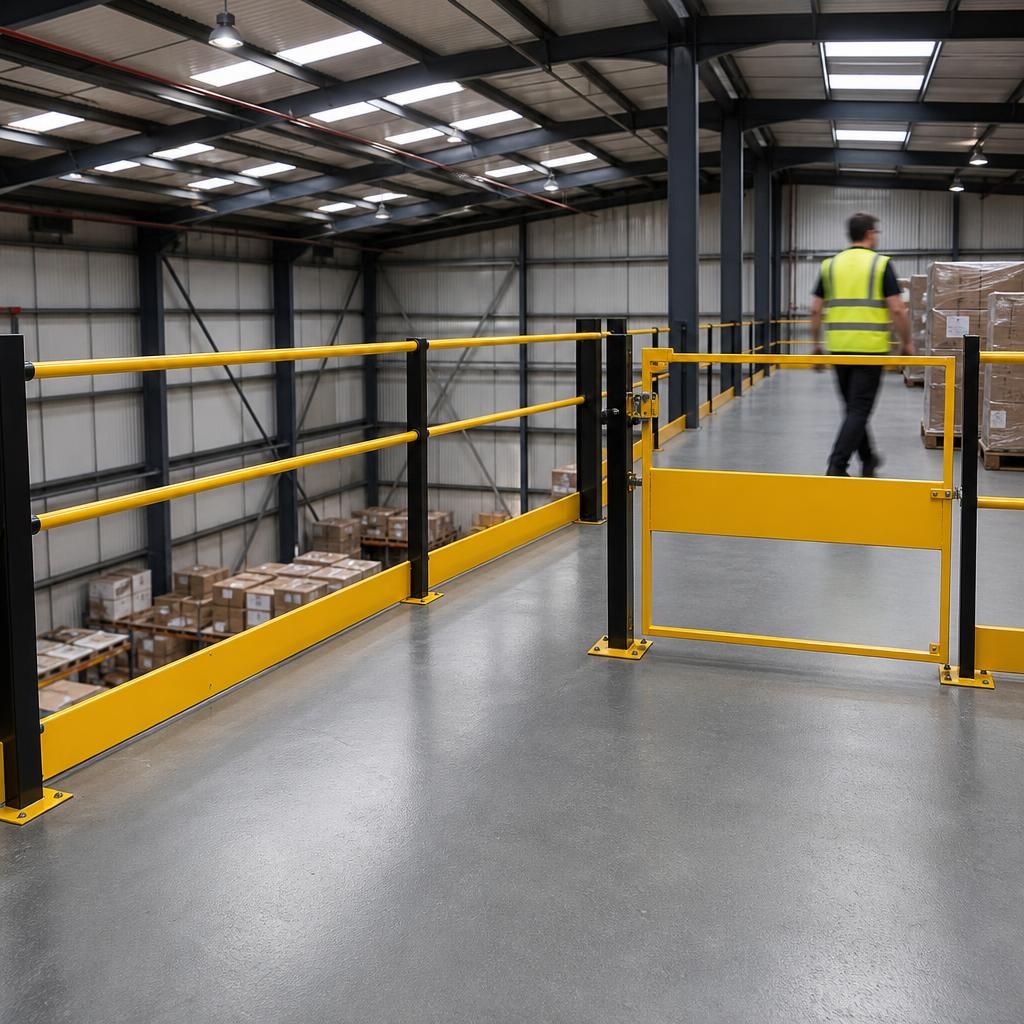
Pallet gates are a specialist form of mezzanine edge protection for loading openings, allowing goods to be transferred while keeping the unoccupied edge protected. Unlike a removable barrier, a correctly designed pallet gate remains connected to the structure and provides a controlled method of opening and closing the access point.
The most suitable type depends on the load dimensions, handling equipment, available headroom and frequency of use. Vertical-lift, hinged, counterbalanced and self-closing designs each have different operating requirements. The gate must be compatible with the surrounding guardrails, prevent people from stepping through the opening and avoid trapping or collision hazards during movement.
Get expert advice on mezzanine edge protection
Speak to our experienced team for practical advice on selecting and maintaining mezzanine edge protection for your industrial setting.