
What are the essential safety standards for warehouse racking repairs?
Warehouse racking repairs should follow the manufacturer’s instructions, relevant British and European standards such as BS EN 15635, SEMA guidance where applicable, and current Health and Safety Executive requirements. Repairs must be carried out by competent technicians after the damage has been assessed, with the affected area made safe and the completed work inspected and recorded before the system returns to service.
Warehouse racking repairs must be planned, assessed and completed by competent technicians in accordance with the manufacturer’s instructions, applicable British and European standards, relevant Health and Safety Executive requirements and recognised industry guidance. The damaged area should be made safe before work starts, the repair should restore the system to its specified capacity, and the completed work must be inspected, documented and formally released before warehouse operations resume.
Compliance is not achieved by making a damaged component look straight. A suitable repair considers the cause and extent of the damage, the structural function of the component, the loads carried by the affected bay and whether surrounding frames, beams, floors or connections have also been affected.
Applicable standards and guidance
- BS EN 15635 provides guidance on the use, inspection, maintenance and repair of steel static storage systems. It sets out important principles for reporting damage, taking immediate action, carrying out inspections and controlling unsafe areas.
- BS EN 15629 covers the specification of warehouse storage equipment and helps establish that the system is suitable for its intended use and loading arrangements.
- BS EN 15620 addresses the tolerances, deformations and clearances relevant to the installation and use of adjustable pallet storage systems.
- Manufacturer’s technical instructions must be followed because the correct repair method, component type, connection detail and permissible load depend on the specific storage system.
- SEMA guidance, where applicable, is widely recognised as good practice within the UK storage equipment industry. It should support, not replace, the manufacturer’s instructions and the duty holder’s legal responsibilities.
These standards should be considered alongside the general duties imposed by UK health and safety legislation. The exact legal requirements depend on the workplace, equipment, work activities and people exposed to risk, so a competent person should determine which controls apply to the repair.
Damage must be reported and assessed promptly
Warehouse operators should have a clear process for reporting impact damage, distortion, corrosion, missing components and other defects. Anyone who notices damage should know how to report it, and the responsible person should record its location and take immediate precautions.
The initial assessment should establish:
- which upright, beam, brace, connector, guard or ancillary component is damaged;
- whether the damage is cosmetic or affects structural performance;
- whether the bay is carrying a load and whether that load can be safely removed;
- whether adjacent bays, connected frames, floor fixings or nearby equipment are affected;
- whether the damage may have resulted from overloading, impact, poor installation, corrosion or another underlying issue; and
- whether the affected area needs to be isolated until a detailed inspection or repair is completed.
Damage should not be dismissed because it appears minor. Local distortion can reduce capacity, alter clearances or place additional force on connected components. A repair decision should be based on an assessment against the relevant specification and damage criteria, not on appearance alone.
The affected area must be made safe
Where damage could affect stability or load capacity, the bay should be unloaded or otherwise controlled in accordance with the competent person’s instructions. The area may need to be cordoned off to prevent access by warehouse operatives, visitors and mobile equipment. Warning notices alone are not a substitute for physical controls where there is a credible risk of further impact or collapse.
Temporary measures must be properly assessed. For example, moving stock to another location can create a separate overloading or stability risk if the receiving storage system has not been checked. Forklift movements around the damaged area should be controlled, and any repair sequence should prevent people from working beneath suspended or unsecured loads.
Only competent technicians should carry out repairs
Repair work should be undertaken by technicians with suitable knowledge, practical experience and training in warehouse storage systems. Competence includes understanding structural components, load paths, manufacturer requirements, safe systems of work and the limitations of proprietary repair products.
The repair team should work from an agreed method statement and risk assessment. These should address access, lifting, temporary support, traffic management, falling objects, manual handling, hot work if relevant, work at height and the safe removal or replacement of components. Personal protective equipment should be selected as a final layer of control and should not replace suitable isolation and engineering controls.
Repairs must use suitable components and methods
A compliant repair uses components that are compatible with the storage system and appropriate for the loads and conditions. This may involve an approved replacement component, a proprietary repair system or another solution specifically designed and verified for the affected structure.
Technicians should not straighten, drill, weld, cut or otherwise modify structural components without appropriate design authority and manufacturer approval. Unauthorised alterations can change the strength, stiffness, connection behaviour or corrosion protection of the system. A repair that appears secure may still be unsuitable if it has not been assessed for the forces imposed during normal use.
Replacement components should be correctly positioned, fixed and tightened. Damaged fixings, safety locks, bracing, beam connectors and floor anchors should be checked rather than assumed to remain serviceable. Where the original specification or load configuration has changed, the safe working load information must be reviewed and updated before the bay is used.
Installation tolerances and stability must be checked
After a repair, the system should be checked for plumb, alignment, connection security, clearances and the condition of nearby components. The assessment should consider the complete affected run or frame where damage may have transferred loads beyond the visibly damaged part.
Floor condition and anchorage are also relevant. A sound replacement upright will not provide the intended performance if the floor, anchor fixing or baseplate is defective. The repair should therefore confirm that the structure remains suitable for its operating environment, including the type of handling equipment and the way loads are placed and removed.
The repaired system must be inspected before return to service
Completion of physical work does not by itself authorise the warehouse racking to be used again. A competent person should inspect the repair and confirm that:
- the specified components and fixings have been used;
- the repair has been installed in accordance with the approved method and manufacturer’s instructions;
- all temporary supports, barriers and work equipment have been removed safely;
- the affected and adjacent components are free from unacceptable damage or distortion;
- load notices and identification labels are present, accurate and legible;
- the repair has not reduced clearances or interfered with safe forklift operation; and
- any further monitoring, restrictions or remedial work have been clearly communicated.
If the inspection identifies unresolved concerns, the area should remain out of service until those concerns have been addressed. Where the repair changes the design, loading arrangement or use of the storage system, additional technical verification may be necessary.
Records and handover are essential
Repair records should identify the location and nature of the damage, the assessment carried out, the selected repair solution, the components used, the technician or organisation completing the work and the date of completion. Photographs, inspection findings, updated drawings or load information should be retained where they help demonstrate what was done.
The warehouse’s responsible person should receive a clear handover. This should explain any operating restrictions, outstanding actions, changes to safe working loads and requirements for follow-up inspection. Records should be available to support the site’s ongoing inspection programme and to demonstrate that defects have been managed in a controlled way.
Preventative controls help avoid repeat damage
Repair standards are only one part of safe warehouse racking management. The site should also maintain routine visual checks, periodic expert inspections, suitable impact protection, clear load notices and appropriate operator training. Repeated damage in the same location should trigger a review of traffic routes, forklift practices, aisle clearances, storage layouts and protection measures.
Routine inspections should be carried out by trained site personnel, with more detailed inspections completed by a technically competent inspector at appropriate intervals and after significant events such as impact, alteration or a change in loading. Findings should be prioritised, recorded and closed out rather than treated as isolated maintenance tasks.
In practice, the essential safety standard is a controlled process: identify the defect, protect people and stock, assess the complete affected structure, select an approved repair, use competent technicians, inspect the finished work and retain evidence of the decision. This approach helps keep warehouse racking compliant, structurally sound and suitable for continued operation.
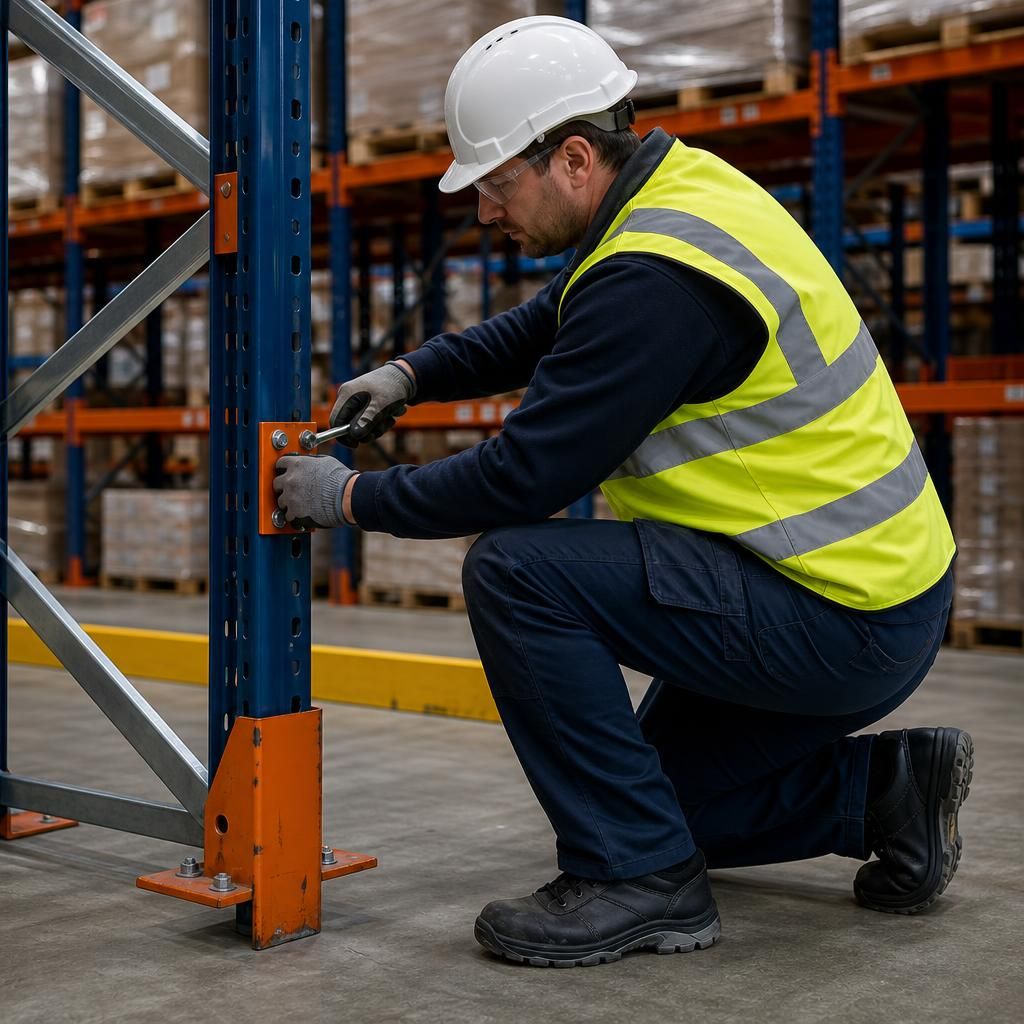
Before warehouse racking repairs begin, the damaged area must be assessed and made safe. This normally means removing or controlling stored loads, isolating the affected bay and preventing forklift access until a competent technician confirms the repair can proceed safely.
Barriers and clear warning notices help control access, but they should support—not replace—physical isolation where there is a risk of falling materials or structural instability. Nearby frames, floor fixings, connections and adjacent bays should also be checked, as impact damage can affect components beyond the part that appears visibly damaged.
Arrange Your Warehouse Racking Repair Assessment
Contact Able Racking to arrange a warehouse racking repair assessment and confirm the damaged area is made safe, assessed and repaired in line with applicable standards.