
What causes warehouse racking systems to fail, and how can these be prevented during inspections?
Warehouse racking systems commonly fail because of vehicle impact, overloading, incorrect assembly, unauthorised alterations, missing components, corrosion and damage that has not been reported or repaired. During inspections, these risks are prevented by checking structural components, load notices, connections, protection and the surrounding environment, then recording defects, setting priorities and removing unsafe areas from use until suitable repairs are completed.
Warehouse racking systems usually fail because of impact damage, overloading, incorrect assembly, unauthorised alterations, missing components, corrosion, poor housekeeping or defects that have not been reported and repaired. A thorough inspection helps prevent failure by identifying these conditions early, assessing their severity, checking that the system remains suitable for its use and ensuring unsafe areas are controlled until corrective action is completed.
Inspections are not a substitute for safe working practices or planned maintenance. They provide a structured check that the installed system, its operating environment and the way it is being used continue to match the original design and load requirements.
Vehicle and handling equipment impact
Forklift trucks, pallet trucks and other warehouse vehicles can strike uprights, bracing, beams, guards and end frames. Damage may appear minor but can reduce the load-carrying capacity of a component or affect the stability of the whole structure. Repeated low-level impacts can also cause distortion that is difficult to identify without a close examination.
During an inspection, the inspector should check exposed areas at vehicle routes, transfer points, corners, aisle ends and loading positions. The condition and suitability of protection should also be assessed. Damaged components must be recorded clearly, with the affected location identified so that the correct repair can be arranged. Where damage creates an immediate risk, the affected section should be isolated and taken out of use until it has been made safe.
Overloading and unsuitable loading
Loads that exceed the stated capacity, are poorly distributed or are placed on unsuitable beam levels can overstress the structure. Problems may also arise when pallets are damaged, loads overhang the beams or goods are stored in a way that creates uneven loading. Changes to pallet dimensions, product weights or handling methods can make an existing configuration unsuitable.
An inspection should confirm that load notices are present, legible and appropriate for the installed arrangement. The inspector should compare the physical layout with the available design or installation information, where provided, and look for signs of overloading such as bent beams, distorted connectors, damaged pallets or excessive deflection. Warehouse teams should not rely on memory when assessing capacity; the stated limits and approved configuration must be followed.
Incorrect installation or assembly
Failure can result from incorrectly positioned frames, incomplete bracing, unsecured connections, unsuitable fixings or components that have not been installed in accordance with the design. Installation defects may remain hidden until the system is loaded or affected by an impact.
Inspections should check that structural members are correctly connected, frames are plumb and stable, baseplates and anchors are secure, bracing is complete and beam locks are engaged. The inspection should also identify incompatible or visibly altered components. If the original design information is unavailable, a competent specialist may need to assess the configuration before its capacity can be confirmed.
Unauthorised changes and missing components
Removing a beam, relocating levels, changing the bay layout or adding components without approval can alter the intended load path and reduce stability. Missing clips, pins, braces, anchors, safety bars or other retaining parts can have a similar effect.
Inspectors should compare the installed system with its approved layout and identify any changes made since the previous inspection. They should check that components are present, correctly positioned and suitable for the system. Alterations should only be made following an appropriate technical assessment, with revised load information and records retained where necessary.
Corrosion, wear and environmental deterioration
Moisture, chemicals, temperature variation and poor ventilation can cause corrosion. Damage to protective coatings, standing water and contact with corrosive substances can accelerate deterioration. Components may also wear because of repeated use or contact with pallets and handling equipment.
An inspection should examine uprights, beams, bracing, baseplates, fixings and other exposed components for rust, pitting, cracking, deformation or coating failure. The cause should be considered rather than simply treating the visible symptom. For example, improving housekeeping or controlling leaks may be necessary alongside replacing affected components.
Poor housekeeping and unsafe operating conditions
Obstructed aisles, damaged pallets, loose packaging, uneven floors and poor visibility increase the likelihood of impact and incorrect loading. Inadequate separation between vehicles and stored goods can expose the structure to avoidable damage.
Inspectors should consider the surrounding environment as well as the steelwork. This includes traffic routes, aisle clearance, floor condition, lighting, signs, protection, access to emergency equipment and the condition of stored loads. Findings should be communicated to the people responsible for warehouse operations, because structural repairs alone will not prevent recurring damage if the underlying working conditions remain unchanged.
How inspection findings should be prevented from becoming failures
- Identify defects accurately: Record the location, component, type and apparent severity of each defect, supported by clear descriptions or photographs where appropriate.
- Set a suitable priority: Immediate risks should be controlled without delay. Less serious defects should still be assigned an owner and a realistic completion date.
- Control unsafe areas: Prevent access to affected bays or levels where damage could make continued use unsafe. Loads may need to be removed by a competent person using a safe method.
- Use suitable repairs: Repairs and replacements should be compatible with the system and completed by appropriately competent personnel. Damaged components should not be straightened, welded or modified without technical approval.
- Reinspect after remedial work: Confirm that repairs have been completed correctly and that the system is safe to return to service. The inspection record should be updated and retained.
- Check recurring defects: Repeated impact in the same location may indicate a problem with traffic routes, protection, visibility, training or the system layout. Addressing the cause is more effective than repeatedly replacing damaged parts.
Inspection records should make responsibilities clear. The warehouse operator remains responsible for reporting damage, preventing continued use where necessary and arranging remedial work. The inspector provides an informed assessment and prioritised findings, but the system should not be treated as safe merely because an inspection has taken place.
Effective prevention combines regular visual checks by trained warehouse staff, prompt reporting of damage, planned maintenance and a detailed periodic inspection by a competent racking inspector. Staff should know what damage to report, how to recognise missing or displaced components and when to stop using an affected area. This approach helps prevent small defects from developing into structural failures, protects people and stock, and supports continued compliance with the warehouse operator’s duties and documented safety arrangements.
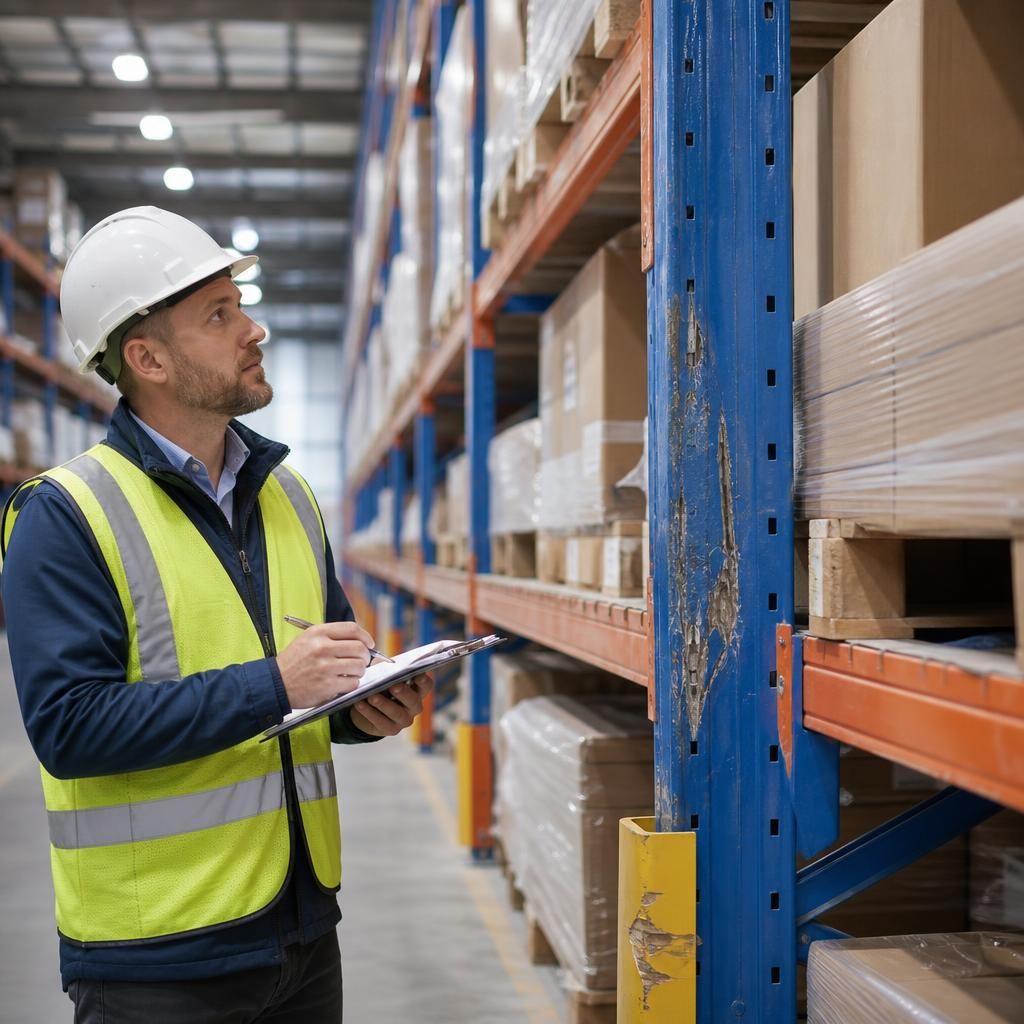
Vehicle impact is one of the most common causes of warehouse racking failure because a collision can distort uprights, bracing, beams or connections without making the full extent of the damage immediately obvious. During an inspection, exposed areas near traffic routes, aisle ends, corners and loading positions should be examined closely, including the condition of protective barriers and fixings.
Any damage should be recorded by location and severity so the affected area can be assessed and suitable repairs arranged. Where stability or load capacity may be compromised, the bay or level should be isolated and taken out of use until remedial work has been completed and the warehouse racking has been confirmed safe to return to service.
Arrange your warehouse racking inspection
Arrange a professional warehouse racking inspection to identify defects, assess risks and confirm that your storage system remains safe and suitable for use. Contact Able Racking to book an inspection for your site.