
What are the most common types of warehouse racking, and how do they differ?
The most common types of warehouse racking include selective pallet racking, drive-in racking, push-back racking, pallet flow racking and cantilever racking. They differ in accessibility, storage density, stock rotation, load type and operating method, so the right choice depends on your goods, available space and workflow.
The most common types of warehouse racking are selective pallet racking, drive-in racking, push-back racking, pallet flow racking, cantilever racking, mobile racking and longspan shelving. They differ mainly in how goods are loaded and retrieved, how much storage density they provide, whether every pallet remains directly accessible, and how well they support stock rotation. The correct system depends on the goods being stored, pallet dimensions and weights, available floor and clear height, handling equipment, throughput and the required stock control method.
Selective pallet racking
Selective pallet racking is the most widely used warehouse racking system because it provides direct access to every pallet position. Pallets are stored on adjustable beams within upright frames, with aisles arranged to suit the forklifts or other handling equipment in use.
- Accessibility: every pallet can normally be reached without moving another pallet.
- Flexibility: beam levels can be adjusted to accommodate changing pallet heights and stock requirements.
- Stock control: it suits operations handling a wide range of products or stock keeping units, particularly where first-in, first-out rotation is not the main requirement.
- Space use: it offers good accessibility but requires operating aisles, so it generally provides lower storage density than systems designed for compact storage.
Selective pallet racking is often the practical starting point for a mixed warehouse because it is adaptable and straightforward to inspect, maintain and reconfigure. The layout must still allow suitable aisle clearances, safe forklift operation and adequate protection against impact.
Drive-in racking
Drive-in racking is designed for high-density storage of similar products. Forklifts enter the storage lanes to place pallets on support rails, reducing the number of access aisles needed. Because the system typically operates on a last-in, first-out basis, it is most suitable where goods have a long or flexible shelf life and strict stock rotation is not essential.
- High density: removing many individual aisles allows more of the available footprint to be used for storage.
- Limited selectivity: pallets within a lane are not all directly accessible at the same time.
- Product suitability: it works best with large quantities of the same product and consistent pallet sizes.
- Operational demands: forklift movements inside the lanes require disciplined driving, suitable equipment and well-maintained rails and protection.
Drive-in racking can be less suitable for mixed stock, frequent order picking or goods that must be retrieved in a precise sequence. The system should be planned around the loading method, pallet condition and the ability of operators to work safely within the lanes.
Push-back racking
Push-back racking stores pallets on wheeled carts or other guided mechanisms. When a new pallet is loaded, it pushes the existing pallets further back along the lane. When the front pallet is removed, the stored pallets move forward under controlled conditions.
- Accessibility: access is generally from the front of each lane, rather than to every pallet position individually.
- Density: it provides more compact storage than selective pallet racking while retaining quicker access than many drive-in layouts.
- Stock rotation: it commonly follows a last-in, first-out pattern, making it suitable for appropriate product types rather than strict first-in, first-out requirements.
- Flexibility: multiple pallets of the same or compatible product can be held in one lane.
Push-back racking is useful where storage density matters but the operation still needs relatively fast loading and retrieval from the aisle. Pallet weights, dimensions and the condition of the carts or guides must be checked as part of routine inspections and maintenance.
Pallet flow racking
Pallet flow racking uses inclined roller tracks so pallets move from the loading side towards the picking side. New stock is loaded at one end and picked from the other, creating a controlled first-in, first-out flow.
- Stock rotation: it is well suited to dated, perishable or batch-controlled goods where older stock should be issued first.
- Throughput: loading and picking can take place from separate sides, helping to reduce unnecessary forklift movements in the picking aisle.
- Density: it uses storage lanes efficiently while maintaining a clear picking face.
- Control requirements: rollers, brakes, separators and lane components must be correctly specified and maintained for the pallet type and load.
Pallet flow racking needs accurately specified pallets and consistent loads. Damaged pallets, incorrectly positioned loads or poorly maintained rollers can affect movement and create risks during loading and retrieval. A competent inspection should assess both the static structure and the moving components.
Cantilever racking
Cantilever racking is intended for long, wide or irregularly shaped items that cannot be stored efficiently on conventional pallet beams. It uses vertical columns with projecting arms, normally allowing goods such as timber, piping, metal sections, boards and other lengthy products to be stored horizontally.
- Load type: it is designed for long loads rather than standardised pallets.
- Access: goods can usually be loaded from the front using suitable handling equipment.
- Configuration: arm levels can be selected to suit the dimensions and weight distribution of the products.
- Safety: the design must account for overhang, load stability, arm capacity, base capacity and the risk of impact from handling equipment.
Cantilever racking should be configured for the actual length, weight and stiffness of the goods. Loads should be evenly distributed across the arms and kept within the manufacturer’s stated capacities. It should not be treated as a general-purpose alternative to pallet storage unless the design and loading method support that use.
Mobile racking
Mobile racking is mounted on powered or mechanically operated bases that move along floor rails, allowing the system to open an access aisle only where it is needed. This can increase storage capacity within a defined footprint while retaining access to a broad range of stock.
- Space use: fewer permanently open aisles can improve storage density.
- Access: access is controlled through the movement of the bases, so the system requires appropriate operating procedures and controls.
- Investment and complexity: installation, flooring, controls, safety devices and ongoing maintenance are generally more involved than with static systems.
- Suitability: it can be appropriate where space is constrained and stock access is important, but it needs careful planning around workflow and emergency arrangements.
Safety features may include presence detection, emergency stops, interlocks and obstruction monitoring. These features must be kept operational and tested in accordance with the equipment supplier’s instructions and the site’s risk assessment.
Longspan shelving and small-parts storage
Longspan shelving is used for hand-loaded cartons, components, tools and other smaller items that do not require pallet storage. It can provide adjustable shelf levels and clear access for order picking, stock checking and replenishment.
This type of storage is generally selected for small-item picking rather than bulk pallet holding. Its capacity depends on the shelf construction, span, bay configuration and how loads are distributed. Heavier items should be stored at lower levels where practical, and shelving should not be overloaded or altered without confirming that the revised arrangement remains suitable.
How the systems differ in practice
- Best access to individual pallets: selective pallet racking.
- Highest density for large quantities of similar stock: drive-in racking or push-back racking, depending on the required loading method and stock rotation.
- First-in, first-out stock movement: pallet flow racking is usually the clearest option.
- Long or irregular products: cantilever racking.
- Space-efficient access to a broad stock range: mobile racking, where the additional mechanical and control requirements can be supported.
- Hand-picked cartons and components: longspan shelving or a purpose-designed small-parts system.
No system is automatically the safest or most efficient in every warehouse. A high-density design may reduce travel and floor usage but restrict access or make stock rotation more difficult. A fully accessible layout may simplify picking but require more aisle space. The assessment should therefore consider the complete operation rather than storage density alone.
Key factors when choosing warehouse racking
Start with an accurate record of the goods and the way they move through the warehouse. This should include pallet dimensions, maximum load weights, load stability, product turnover, batch requirements, picking frequency and whether stock must be accessed individually. The handling equipment is equally important because aisle width, lift height, turning space and floor conditions affect the viable layout.
The building should be assessed for clear height, floor capacity, columns, doors, lighting, fire protection, sprinkler arrangements and pedestrian routes. The proposed design must also allow safe loading, unloading, inspection and maintenance. Where the system is close to traffic routes, end frames and exposed uprights may require suitable protection, while the layout should prevent conflicts between vehicles and pedestrians.
Warehouse racking should be designed, installed and altered by competent people, with capacities clearly identified and the completed installation checked before use. Routine visual checks by trained staff, prompt reporting of damage and periodic expert inspections help identify issues such as impact damage, displaced beams, damaged bracing, missing locking devices, overloaded levels or changes that have not been approved.
Choosing between the common types of warehouse racking is therefore a balance between access, density, stock rotation, load characteristics and operating risk. A system that matches the real workflow and remains properly inspected and maintained will provide more dependable storage performance than a layout selected on capacity alone.
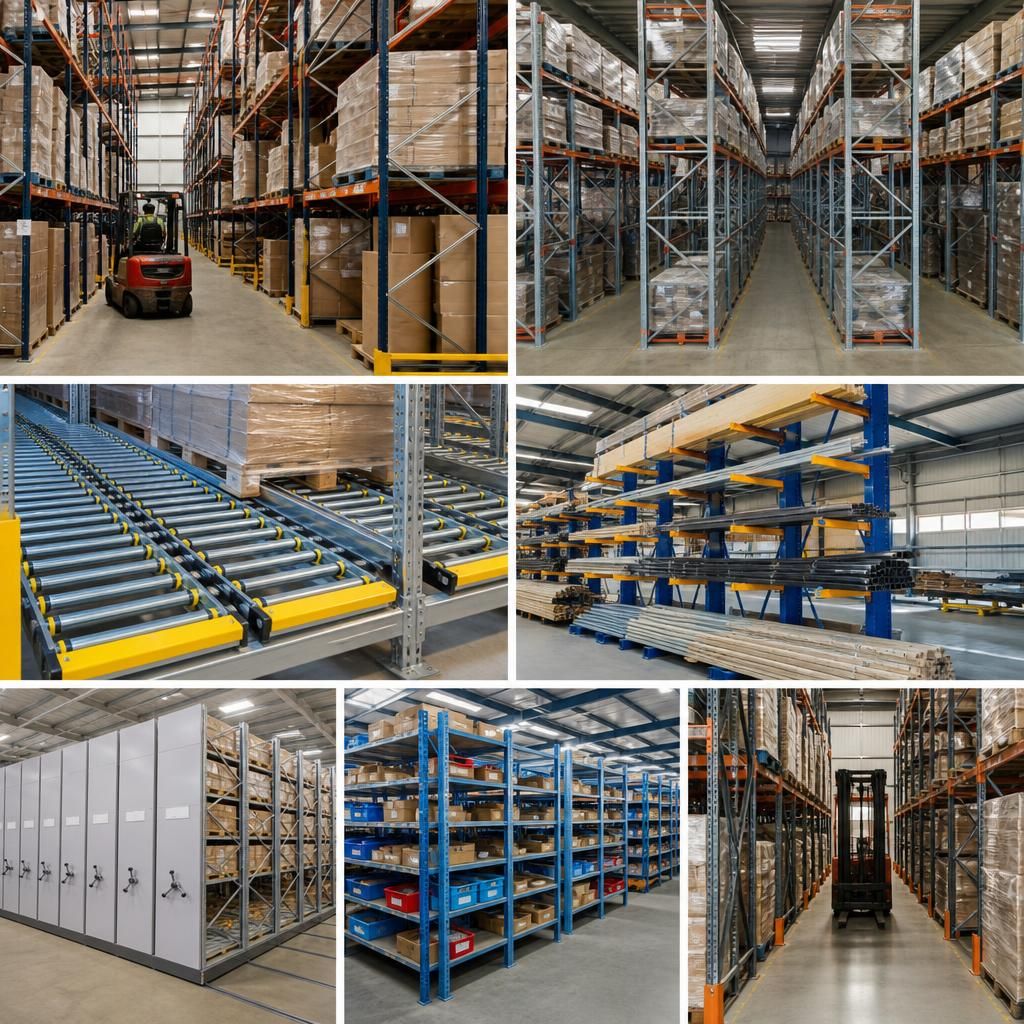
The main difference between warehouse racking types is the balance between pallet accessibility, storage density and stock rotation. Selective pallet racking provides direct access to each pallet, while drive-in, push-back and pallet flow racking use shared lanes or guided movement to store more goods within the available floor area.
Choose the system according to how stock is handled in practice. Selective pallet racking is generally suited to varied stock and frequent access. Drive-in and push-back racking can support dense storage of similar products where last-in, first-out movement is acceptable. Pallet flow racking is more appropriate where first-in, first-out rotation is important, such as with dated or batch-controlled goods.
The highest-capacity option is not automatically the most suitable. A proper assessment should consider pallet dimensions, load weights, handling equipment, aisle requirements, product turnover and safe access for inspections and maintenance. Warehouse racking must also be correctly specified, installed and protected against foreseeable impact so that improved space use does not compromise safe operation.
Get expert advice on choosing warehouse racking
Speak to Able Racking for expert advice on selecting, inspecting or maintaining the warehouse racking system suited to your stock, space and workflow. Our experienced team can help you assess your requirements and plan a safe, compliant storage solution.