
What are the main causes of warehouse racking damage?
The main causes of warehouse racking damage are forklift impacts, overloading, incorrect loading, poor installation, unauthorised alterations and falling goods. Wear, corrosion and missed inspections can allow minor defects to worsen, so prompt reporting, regular checks and competent repairs are essential for maintaining safe, compliant warehouse racking.
Warehouse racking damage is most commonly caused by forklift or other materials-handling equipment impacts, overloading, incorrect loading, poor installation, unauthorised alterations and falling goods. Corrosion, wear, inadequate protection and missed inspections can then allow small defects to become more serious. Identifying the cause is essential because a repair alone may not prevent the same damage from happening again.
Forklift and handling-equipment impacts
Impact from forklifts, reach trucks, pallet trucks and other warehouse vehicles is one of the most frequent causes of damage. Collisions can bend uprights, beams, bracing, footplates and guards, even when the damage initially appears minor. Repeated low-level contact may weaken a component over time, while a single heavier impact can affect the stability of an entire bay.
Impacts often occur at aisle ends, in narrow working areas, at loading and unloading points, or where visibility is restricted. Poor traffic management, congested aisles, inadequate operator training and unsuitable vehicle speeds can increase the risk. Damaged components should be reported immediately rather than pushed back into service.
Overloading and uneven load distribution
Every warehouse racking system has defined load capacities for its beams, bays and levels. Exceeding those limits can cause excessive deflection, distortion or failure. Overloading may result from storing heavier goods than planned, changing pallet types, adding additional levels or assuming that an empty-looking pallet is lightweight.
Load limits can also be exceeded when weight is concentrated in one area instead of being distributed as intended. A pallet that is unstable, damaged or heavier on one side can place additional stress on beams and connectors. Load notices should be visible and kept accurate whenever the configuration or stored goods change.
Incorrect loading and unloading
Damage can occur when pallets are placed off-centre, dragged across beams, pushed into uprights or deposited with excessive force. Poorly positioned loads can catch on adjacent pallets, project into aisles or become unstable during removal. Pallets with broken boards, inadequate support or unsuitable dimensions may also fail to sit correctly on the beams.
Operators should place loads carefully and ensure they are fully supported within the designated location. Aisles and access routes need to remain clear so that vehicles can approach squarely. Safe loading procedures should cover pallet condition, load stability, permitted dimensions and the correct use of each storage position.
Poor design, installation or alteration
Warehouse racking can be compromised if it is incorrectly designed for the building, vehicle movements, pallet dimensions or expected loads. Installation errors may include inadequate anchoring, incorrect component placement, missing bracing or connections that have not been properly secured. Problems can also arise if the supporting floor is unsuitable or uneven.
Unauthorised alterations create a further risk. Removing bracing, moving beams, changing level positions, adding components from a different system or extending a run without proper assessment can affect the original structural design. Repairs and modifications should be planned and completed by competent personnel, with the system reassessed where its configuration or loading has changed.
Falling or displaced goods
Goods can fall when pallets are unstable, loads are poorly wrapped, products are stacked beyond safe limits or items are not properly retained. Falling goods may strike beams and uprights, damage protective equipment or create secondary impacts with vehicles and nearby loads.
Correct pallet selection, suitable load restraint and appropriate anti-fall measures can reduce this risk. Storage arrangements should reflect the nature of the goods, including their size, shape, weight and tendency to shift. Damaged or unstable loads should be isolated and made safe before they are moved or returned to storage.
Inadequate or damaged protection
Upright guards, end-of-aisle barriers and other protective measures help reduce the consequences of vehicle contact, but they do not make impacts harmless. Protection that is missing, incorrectly positioned or already damaged may no longer provide the intended level of defence. It can also give a false impression that the underlying upright is safe when both components have been affected.
Protection should be checked as part of routine inspections and replaced when it is bent, loose or no longer correctly aligned. Its design and position should suit the traffic routes, vehicle types and vulnerable parts of the warehouse racking system.
Wear, corrosion and environmental conditions
Warehouse racking components can deteriorate through repeated use, moisture, condensation, chemical exposure and unsuitable cleaning methods. Corrosion may reduce the thickness and strength of steel, particularly where coatings have been damaged or where water collects around baseplates and floor fixings. Poor lighting and dirty components can make deterioration more difficult to identify.
Environmental risks should be controlled where possible. Leaks should be repaired, standing water removed and aggressive substances kept away from exposed steel. Any corrosion, cracking, distortion or loosening should be assessed rather than covered up or painted over without determining the underlying condition.
Changes to warehouse operations
A system that was suitable for its original purpose may become vulnerable when operations change. Introducing heavier stock, different pallet sizes, faster vehicle movements, new handling equipment or higher storage levels can alter the loads and forces placed on the structure. Reorganising traffic routes can also expose end frames or corners to more frequent impacts.
Operational changes should be reviewed before they are introduced. This includes checking load capacities, clearances, floor conditions, vehicle access, protection and the effect on fire and emergency routes. Where the change is substantial, a competent assessment should confirm that the warehouse racking remains suitable.
Missed inspections and delayed reporting
Inspections do not cause damage, but failing to carry them out allows damage to remain unnoticed and worsen. A responsible person should complete regular visual checks, with findings recorded and escalated according to their severity. A thorough inspection by a competent warehouse racking inspector should also be arranged at appropriate intervals based on the use and risk of the installation.
Everyone working around the system should know how to report impacts, missing components, fallen goods and other defects. Following an incident, the affected area should be isolated where necessary and the condition assessed before use continues. Components should not be straightened, welded, drilled or replaced with improvised materials.
What to do after damage is found
- Stop using the affected location if there is a risk of collapse, falling goods or further impact.
- Unload or isolate the area only where this can be done safely and under competent direction.
- Report the defect and record its location, apparent cause and any associated load or vehicle incident.
- Arrange an assessment by a competent specialist to determine whether the component requires repair, replacement or further investigation.
- Address the underlying cause, such as traffic control, loading practice, protection or operator training, before the location is returned to service.
Effective warehouse racking maintenance combines prevention, inspection and technically appropriate repair. Understanding whether damage came from impact, loading, installation, environmental conditions or operational change helps ensure that the corrective action addresses the real risk and keeps the storage system safe, compliant and fit for purpose.
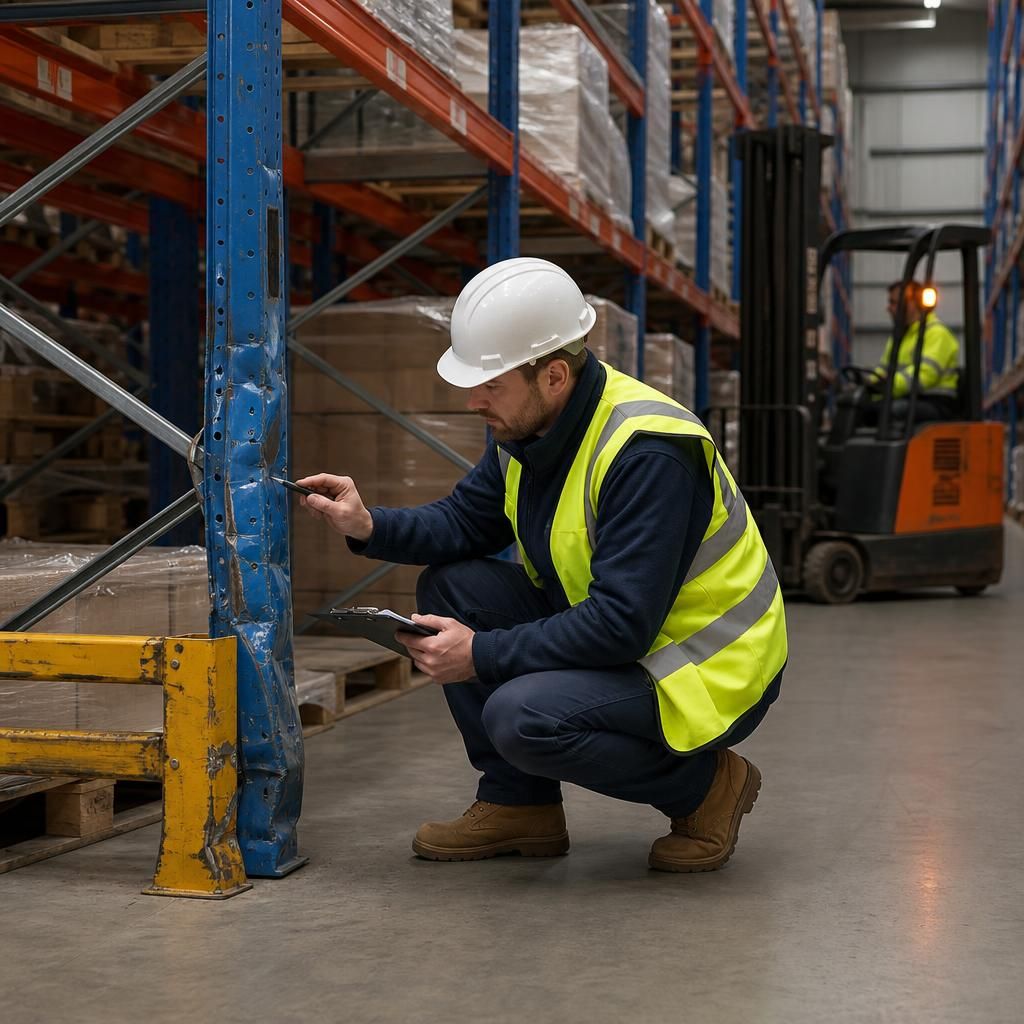
Forklift and other materials-handling equipment impacts are a leading cause of warehouse racking damage. Even a low-speed collision can bend an upright, loosen a connection or affect the stability of a bay, particularly at aisle ends, loading points and in areas with restricted visibility.
Any impact should be reported immediately and the affected location kept out of use until it has been assessed by a competent specialist. Do not straighten, weld or reuse damaged components without technical approval. Reviewing vehicle routes, operator practices, aisle clearance and protective measures can help prevent the same damage from recurring.
Arrange a warehouse racking damage assessment
If warehouse racking damage has been identified, arrange a professional assessment to establish the cause and confirm whether repair, replacement or further action is required. Contact Able Racking to arrange a warehouse racking damage assessment.