
What safety protocols are essential during warehouse racking repair and maintenance?
Essential warehouse racking repair and maintenance protocols include completing a risk assessment, isolating the affected area, controlling access, unloading or stabilising unsafe sections, and using competent operatives with suitable PPE and equipment. Repairs should follow the manufacturer’s instructions and applicable UK safety standards, with the system inspected and formally cleared before loads and normal warehouse operations are reinstated.
Essential safety protocols during warehouse racking repair and maintenance are to assess the risks, isolate the affected area, control access, remove or stabilise unsafe loads, and use competent operatives with suitable equipment and personal protective equipment. Repairs must follow the manufacturer’s instructions, relevant UK legislation and recognised industry guidance. The repaired warehouse racking should then be inspected, documented and formally cleared before loads or normal warehouse activities return.
Complete a suitable risk assessment before work starts. The assessment should identify the damage, the possible causes, the risks to people and the actions needed to make the work safe. It should consider falling loads, unstable frames, damaged beams, vehicle movements, lifting operations, work at height, nearby warehouse activities and the condition of the floor or supporting structure. A method statement should explain how the repair or maintenance will be carried out, who is responsible for each stage and what will happen if the condition of the warehouse racking changes during the work.
The assessment must be reviewed if further damage is found, if the repair differs from the planned method or if conditions change. For example, removing a damaged component can affect the stability of connected bays. Operatives should not continue simply because the original method statement has been issued; the work must remain controlled from start to finish.
Isolate the work area and prevent unauthorised access. Barriers, cones, warning signs and other physical controls should clearly separate the repair area from warehouse traffic and general personnel. Where necessary, the affected aisle or run should be taken out of service rather than relying only on verbal warnings. Forklift routes may need to be diverted, and pedestrians should be kept away from lifting operations, dismantling activities and areas where components or loads could fall.
Access controls should remain in place until the warehouse racking has been checked and released for use. A barrier that is easy to move or a sign that cannot be seen from the approach route is unlikely to provide adequate protection. The site team should understand who can authorise entry and how the exclusion zone will be monitored.
Unload or make safe any affected warehouse racking before repair. Damaged beams, frames, connectors, bracing and guards can have reduced capacity or may no longer provide the intended stability. Loads should be removed in a planned manner by trained personnel, using suitable handling equipment and following the risk assessment. If unloading could make the structure less stable, the area should first be supported or otherwise secured by a competent specialist.
Operatives should never climb on loads, stand beneath suspended loads or work beside an unstable bay. Where a damaged section cannot be safely unloaded immediately, it should be isolated and assessed for temporary stabilisation. Temporary supports must be suitable for the loads and arrangement involved; improvised materials or unapproved alterations can create additional hazards.
Use competent people and clearly defined responsibilities. Warehouse racking repairs should be planned and carried out by operatives with the appropriate practical experience, training and understanding of the system being repaired. The person supervising the work should be able to recognise structural risks, interpret the repair method and stop the job if the condition is different from that expected.
Warehouse staff also have an important role. They should report impact damage, missing components, displaced loads and other defects promptly, and should not attempt unauthorised repairs. A nominated person should coordinate communication between the repair team, warehouse management, forklift operators and any contractors working nearby.
Select suitable tools, access equipment and PPE. Equipment must be appropriate for the repair, inspected before use and used in accordance with the manufacturer’s instructions. This may include lifting equipment, access platforms, torque tools, temporary supports and equipment for handling steel components. Tools should not be used beyond their intended capacity, and damaged equipment should be removed from service.
Personal protective equipment should be based on the risk assessment. Depending on the work, this may include safety footwear, a hard hat, high-visibility clothing, gloves, eye protection and fall protection. PPE is the final layer of control and does not replace isolation, safe access equipment or proper structural support. Work at height must be planned and carried out using suitable equipment under the Work at Height Regulations, with precautions against falls and falling objects.
Control lifting operations and falling-object risks. Repair work often involves moving steel components or working above floor level. Lifting operations should be planned by a competent person, with suitable lifting accessories, a controlled route and a clearly defined area beneath and around the load. Suspended components should not be left unattended, and no one should pass below them.
Small tools, fixings and removed components can also fall from height. They should be secured or stored so that they cannot be knocked from a platform or beam. The work area should be checked for loose materials before barriers are removed.
Follow the approved repair method and manufacturer’s design. A repair should restore the intended performance of the warehouse racking rather than simply make visible damage less obvious. Components, fixings and replacement parts should be compatible with the original system and installed as specified. Cutting, drilling, welding, straightening or substituting parts without appropriate design approval can alter the structural behaviour and invalidate the manufacturer’s information.
Where the damage is significant, the repair method is unclear or the original system information is unavailable, the condition should be referred to a suitably qualified warehouse racking specialist or structural engineer. The decision may be to repair, replace, reinforce or take the section permanently out of service. A temporary repair should not be treated as a permanent solution unless it has been formally designed and approved for that purpose.
Manage vehicle and pedestrian movements throughout the work. Forklift trucks and other warehouse vehicles should be prevented from entering the repair zone. If work takes place beside an active route, physical segregation and a traffic management plan should be used. Drivers should receive clear instructions about diversions, reduced access and any temporary restrictions.
Impact from industrial trucks is a common cause of warehouse racking damage, so the underlying cause should be considered as part of the maintenance activity. Improvements may include replacing or upgrading protection, reviewing aisle arrangements, improving visibility, refreshing operator instructions or changing the traffic route. Repairing the steel without addressing repeated impacts may leave the same risk in place.
Check the completed work before the area is returned to service. On completion, the responsible person should verify that the repair matches the approved method, all fixings and components are correctly installed, temporary supports have been removed safely and no tools or loose materials remain. The surrounding bays should also be checked for connected damage or changes caused by the repair.
A post-repair inspection should confirm that the warehouse racking is stable, correctly aligned where applicable and suitable for its intended loading arrangement. The inspection should be carried out by a person with the required competence and independence for the level of risk involved. If there is any doubt about capacity or structural condition, the affected area should remain out of service until the matter is resolved.
Keep accurate records and communicate the release decision. Maintenance records should identify the location, nature and cause of the defect, the controls used, the work completed, replacement components, inspection findings and the person who authorised return to service. Photographs, drawings or updated layout information may be useful where the repair changes the arrangement or protection provided.
Warehouse personnel should be told when the area is available again and whether any restrictions apply. Load notices and other safety information must remain accurate. If the repair changes the configuration, beam levels or permitted loads, the relevant signage and warehouse records should be updated before use.
Apply recognised UK guidance and review the wider system. The work should be considered alongside the Health and Safety at Work etc. Act, the Provision and Use of Work Equipment Regulations, the Work at Height Regulations and other requirements relevant to the task. HSE guidance for workplace transport and warehouse operations, together with recognised warehouse racking guidance such as HSG76 and BS EN 15635, can help inform inspection, maintenance and safe-use arrangements. The exact requirements depend on the equipment, workplace and repair activity, so a competent assessment remains necessary.
Finally, repair and maintenance should feed into the warehouse racking inspection programme. Recurring damage, repeated loose fixings, overloaded locations or poor housekeeping may indicate a wider control failure. Reviewing inspection reports, incident records and repair history helps identify patterns and supports preventative action, keeping the storage system safe, compliant and fit for continued operation.
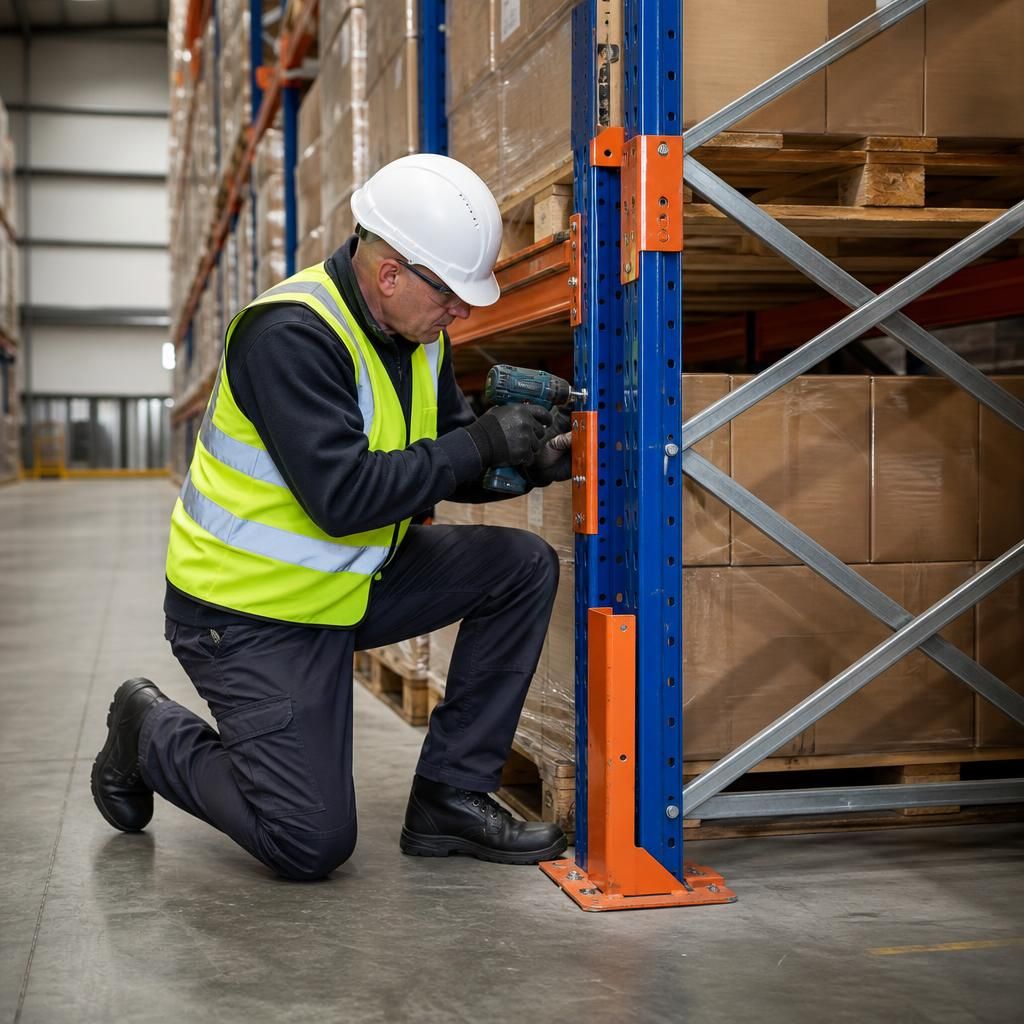
Isolating damaged warehouse racking before repair is an essential safety control. The affected bay or aisle should be taken out of service, clearly separated with physical barriers and marked with visible warning signs to prevent people, forklift trucks and other equipment entering the work area.
Any affected loads must be removed or safely stabilised by trained personnel using suitable handling equipment. Operatives must not climb on loads, work beneath suspended components or stand beside an unstable section. Temporary supports should only be used when they are suitable for the structure and approved as part of the repair method.
The exclusion zone should remain in place until a competent person has checked the completed work, confirmed that components and fixings are correctly installed, and authorised the warehouse racking for return to service.
Arrange a warehouse racking safety assessment
Arrange a warehouse racking safety assessment with Able Racking to identify damage, confirm safe loading and support compliance with UK workplace safety requirements.