
What is involved in the process of repairing warehouse racking?
Repairing warehouse racking involves making the area safe, inspecting and assessing the damage, identifying the correct repair method and completing the work with suitable components. The system should then be checked to confirm it is stable, correctly aligned and safe to return to service.
Repairing warehouse racking involves making the affected area safe, inspecting and assessing the damage, selecting an appropriate repair or replacement method, completing the work with suitable components and checking the system before it returns to service. The process should be controlled by a competent person and supported by records showing what was found, what work was completed and whether any further action is required.
At Able Racking, the repair process is tailored to the type and severity of damage, the design of the storage system and the way the warehouse operates. A repair is not simply a matter of straightening a bent component. The work must restore the intended structural performance of the warehouse racking without creating additional risks to employees, stock or handling equipment.
Making the area safe
The first step is to control the immediate risk. If a beam, upright, protection component or other part of the warehouse racking has been struck or visibly damaged, the affected bay should be taken out of use. Stock and handling equipment may need to be removed by suitably trained personnel, provided this can be done safely. Where unloading could worsen the damage, the area should be isolated until a suitable method has been agreed.
Warning signs, barriers or other access controls can be used to prevent people and equipment entering the affected area. Damage should also be reported to the responsible person so that the warehouse team understands which locations are unavailable. Continuing to load a visibly damaged bay can increase the load on weakened components and make the eventual repair more complex.
Inspecting and assessing the damage
A competent inspector examines the affected component and the surrounding structure. The inspection normally considers:
- the location, direction and apparent cause of the impact or damage;
- damage to uprights, beams, bracing, connectors, footplates and protection;
- whether components are bent, twisted, cracked, displaced or missing;
- the condition of fixings, floor connections and other supporting elements;
- the alignment and plumb of the warehouse racking; and
- whether adjacent bays or connected sections have also been affected.
Damage is not always limited to the component that was struck. An impact to an upright, for example, can affect connected bracing, beam connections or the alignment of neighbouring bays. The inspector therefore assesses the complete affected area rather than relying only on a visual check of the reported impact point.
Photographs, measurements and system details may be recorded during the assessment. These records help identify the correct components and provide a clear reference for the repair report.
Deciding whether to repair or replace
The repair method depends on the design of the warehouse racking, the extent of the damage and the recommendations of the system manufacturer or designer. Some damage may be addressed with an approved replacement component or a purpose-designed repair system. In other cases, the damaged part must be replaced because its structural capacity cannot be reliably restored.
Damaged components should not be heated, hammered straight, drilled or welded without specific technical approval. Unauthorised alterations can change the strength and load-bearing behaviour of the system and may invalidate the manufacturer’s design information. A competent repair provider identifies the required parts and confirms that they are suitable for the particular system before work begins.
Planning the work
Before installation, the repair team confirms the scope of work, access arrangements, isolation requirements and any restrictions on warehouse operations. The work area must remain controlled while components are removed and installed. Where stock needs to be relocated, the revised storage arrangement should not exceed the stated capacity or compromise access routes, clearances or stability.
The correct replacement components, fixings and protection products are checked before the work starts. Using a visually similar part is not sufficient if it has different dimensions, connection details or load characteristics. The repair should use components that are compatible with the existing warehouse racking and appropriate for the approved repair method.
Completing the repair
Repairs are carried out in accordance with the agreed method and the relevant manufacturer or engineering instructions. This may involve replacing a damaged upright, beam, brace, connector, footplate or protection component, or installing an approved repair system around the affected area. The work must be completed by experienced operatives who understand the structure and the risks associated with working in an operational warehouse.
During the work, the team checks that components are correctly positioned, connections are properly secured and the repaired section is not subjected to loading before it is ready. Temporary measures, where used, should not be treated as a permanent repair unless they have been specifically designed and approved for that purpose.
Checking the completed work
Once the repair is complete, the affected warehouse racking is inspected again. The check confirms that:
- the correct components have been installed;
- connections and floor fixings are secure;
- the structure is aligned and stable;
- protection is in place where required;
- there is no remaining visible damage that affects safe use; and
- the system is suitable to return to service within its stated design limits.
If the inspection identifies additional damage, incorrect installation or an unresolved design issue, the area should remain out of use until the matter has been addressed. A repaired bay should not be reopened simply because the visible impact has been removed.
Recording the repair and preventing a repeat
The completed work should be documented, including the affected location, findings, components replaced or repaired, photographs where useful and any restrictions or recommendations. Updated records help the person responsible for warehouse safety demonstrate that the damage was assessed and managed appropriately.
The cause of the damage should also be considered. If a forklift impact caused the problem, preventative action might include improving end protection, reviewing traffic routes, refreshing operator training or changing the way stock is presented. If overloading, poor loading practices or repeated contact is involved, the storage arrangements and working procedures may need to be reviewed as well.
After a repair, continue with planned inspections and report new damage promptly. Regular checks help identify developing problems before they affect a larger section of the system, while clear reporting and prompt isolation reduce the likelihood that damaged warehouse racking remains in use.
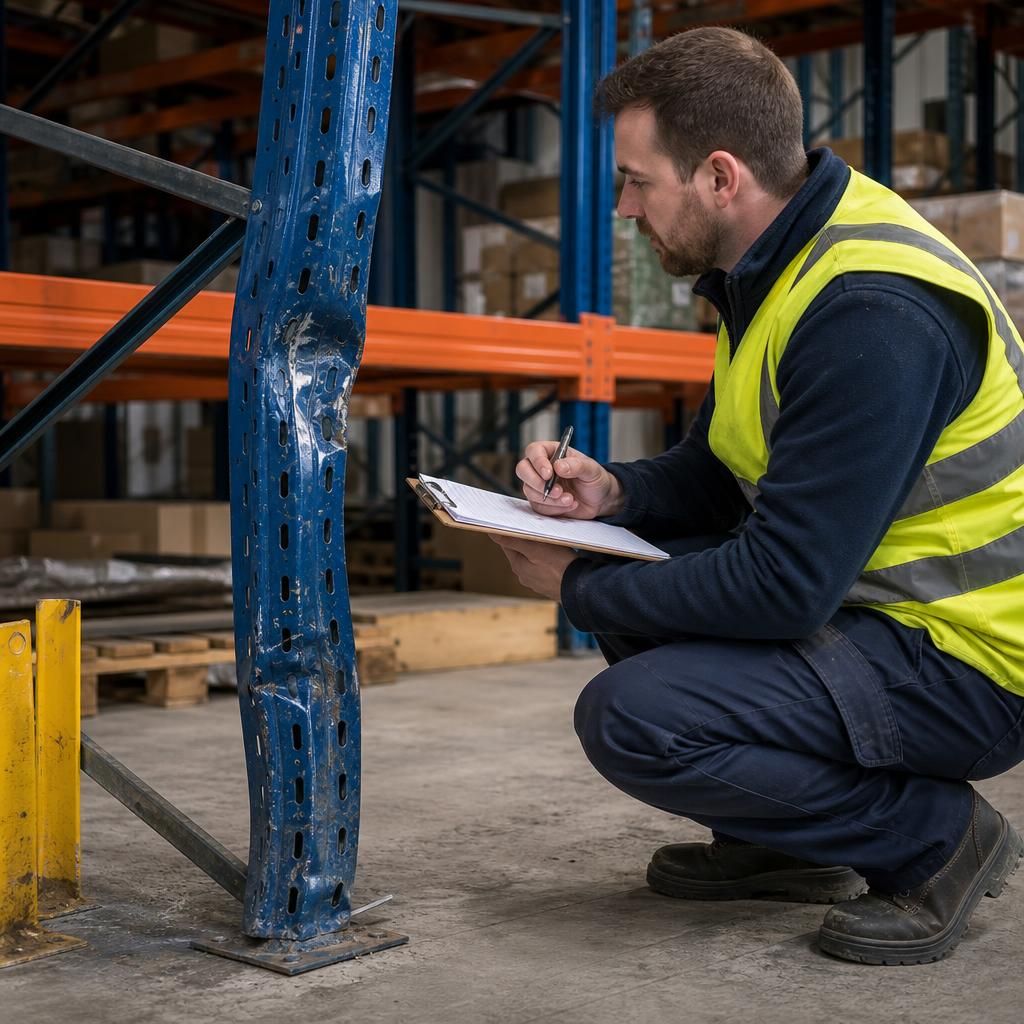
Before warehouse racking repairs begin, the affected bay and its surrounding structure must be assessed, not just the visibly damaged component. An impact to an upright, beam or protection element can affect connected parts, neighbouring bays, floor fixings and the alignment of the wider installation.
A competent inspection should identify the location and apparent cause of the damage, check for bent or displaced components, and confirm whether the area can be safely unloaded or must remain isolated. Photographs, measurements and system details help determine whether an approved repair system or a replacement component is required.
This assessment prevents unsuitable work, such as straightening, drilling or welding components without technical approval. It also ensures the repair restores the intended structural performance of the warehouse racking and that any related damage is addressed before the area returns to service.
Arrange Your Warehouse Racking Repair Assessment
If your warehouse racking is damaged or requires assessment, arrange a professional repair inspection with Able Racking. Our experienced team can identify the required repair method and advise on the steps needed to return the affected area to safe service.