
What factors should be considered when choosing the type of safety gate for a mezzanine floor?
Choosing a safety gate for a mezzanine floor depends on the opening layout, how materials and people access the platform, available operating space, load-handling requirements, and the level of protection needed at the edge. The gate should also be compatible with the existing structure, straightforward to use, and designed and installed to meet applicable workplace safety requirements.
The right safety gate for a mezzanine floor is the one that prevents falls at the exposed edge while allowing the required movement of people, equipment and materials. Selection should be based on the opening arrangement, the way the area is used, the size and weight of loads, available operating space, structural compatibility, visibility, guarding requirements and the findings of a suitable risk assessment.
A gate should be treated as part of the complete edge protection system rather than as an isolated item. The surrounding handrails, toe boards, access points and floor structure must work together so that an open loading position does not create an unprotected fall hazard.
- How the opening will be used: A gate used mainly for pedestrian access may have different requirements from one used to transfer pallets, cages, components or other bulky loads. Consider the frequency of use, the direction of movement and whether people need to pass through while carrying items.
- Type of access: Common options include hinged gates, sliding gates and loading gates that maintain protection at the exposed edge during transfer operations. The design should suit the available space and avoid creating additional collision, trapping or obstruction risks.
- Load dimensions and handling equipment: Measure the largest items that will pass through the opening, including their height, width and operating clearance. Account for pallet trucks, lifting equipment and other handling devices where applicable. A gate that is too narrow or awkwardly positioned may encourage unsafe workarounds.
- Available operating space: Hinged gates require room for the gate leaf to move and may not be suitable beside walkways, storage positions or equipment routes. Sliding designs can be preferable where swing space is restricted, provided the track and operating mechanism can be protected from impact and kept clear.
- Fall prevention while loading: Where materials are transferred over an edge, the gate must prevent access to the opening when the protection is not in its safe position. A suitable loading gate arrangement should ensure that a person cannot simply open the barrier and step into an unprotected edge. The precise arrangement should be selected following a site-specific assessment.
- Self-closing and secure positioning: Pedestrian gates should normally return to a safe closed position after use, or provide another reliable method of ensuring the opening is protected. The gate should not be easy to leave open accidentally, and any latch, locking or interlocking arrangement must be intuitive for authorised users.
- Interaction with equipment: If lifting equipment or vehicles operate near the gate, assess the risk of impact, snagging and unauthorised operation. Physical protection, controlled access or a suitable operating sequence may be needed. Controls should be positioned so that the operator can see the gate and the surrounding area.
- Visibility: Users should be able to see whether the gate is open, closed and correctly secured. Solid panels may provide useful containment but can restrict visibility, while open-bar designs may improve sightlines but need to be assessed for the size of openings and the risk of items passing through.
- Compatibility with the existing structure: Fixings must be suitable for the supporting steelwork, concrete or other substrate. The installer should verify the structure, fixing positions, clearances and any effects on the surrounding edge protection before work begins. A gate should not be attached in a way that weakens the platform or leaves gaps in the guarding.
- Environmental conditions: Dust, moisture, temperature, washdown processes and corrosive substances can affect hinges, tracks, latches, springs and finishes. In harsher environments, select materials and protective finishes that are appropriate for the conditions and allow components to remain reliable.
- Ergonomics and usability: Handles and controls should be reachable without stretching over the edge or adopting an unstable position. The gate should operate without excessive force and should not require users to defeat a safety feature to complete routine work. Poor usability can lead to propping open, bypassing or misuse.
- Protection from falling objects: Where small items could pass beneath or through the gate, consider toe boards, infill panels and the design of adjacent guarding. The required protection depends on the work carried out below and above the platform, as well as the type of materials handled.
- Fire and emergency arrangements: The gate must not obstruct designated escape routes, emergency access or firefighting arrangements. Emergency operation should be considered where the gate forms part of a regularly occupied work area, while still preventing normal access to an exposed edge.
Compliance is also a key selection factor. The gate should be specified, installed and used in accordance with the applicable workplace health and safety requirements, relevant design guidance and the manufacturer’s instructions. A documented risk assessment should consider falls from height, falling objects, unauthorised access, manual handling, vehicle impact, entrapment and foreseeable misuse. Where the installation is unusual or heavily used, competent technical advice should be obtained before the design is finalised.
The gate’s performance depends on more than its initial design. Before handover, check that it is correctly aligned, securely fixed, easy to operate and able to return to its safe position. The surrounding edge protection should be checked at the same time, including gaps, loose components, damaged finishes and signs of structural movement. Operating instructions should be clear, and relevant employees should understand when and how the gate may be used.
Maintenance requirements should influence the choice from the outset. Hinges, rollers, tracks, latches, counterbalance components and interlocks need to remain accessible for inspection and adjustment. Avoid designs that allow dirt or debris to accumulate in critical moving parts without a practical cleaning method. Planned inspections should be proportionate to the frequency of use and the working environment, with defects reported and corrected before the gate is returned to service.
In practical terms, the most suitable gate is the one that provides continuous fall protection, fits the physical opening, supports the actual handling process and remains simple enough for people to use correctly every time. A site survey should confirm the opening dimensions, surrounding traffic, load transfer method, structure, environmental conditions and emergency arrangements before a final specification is agreed.
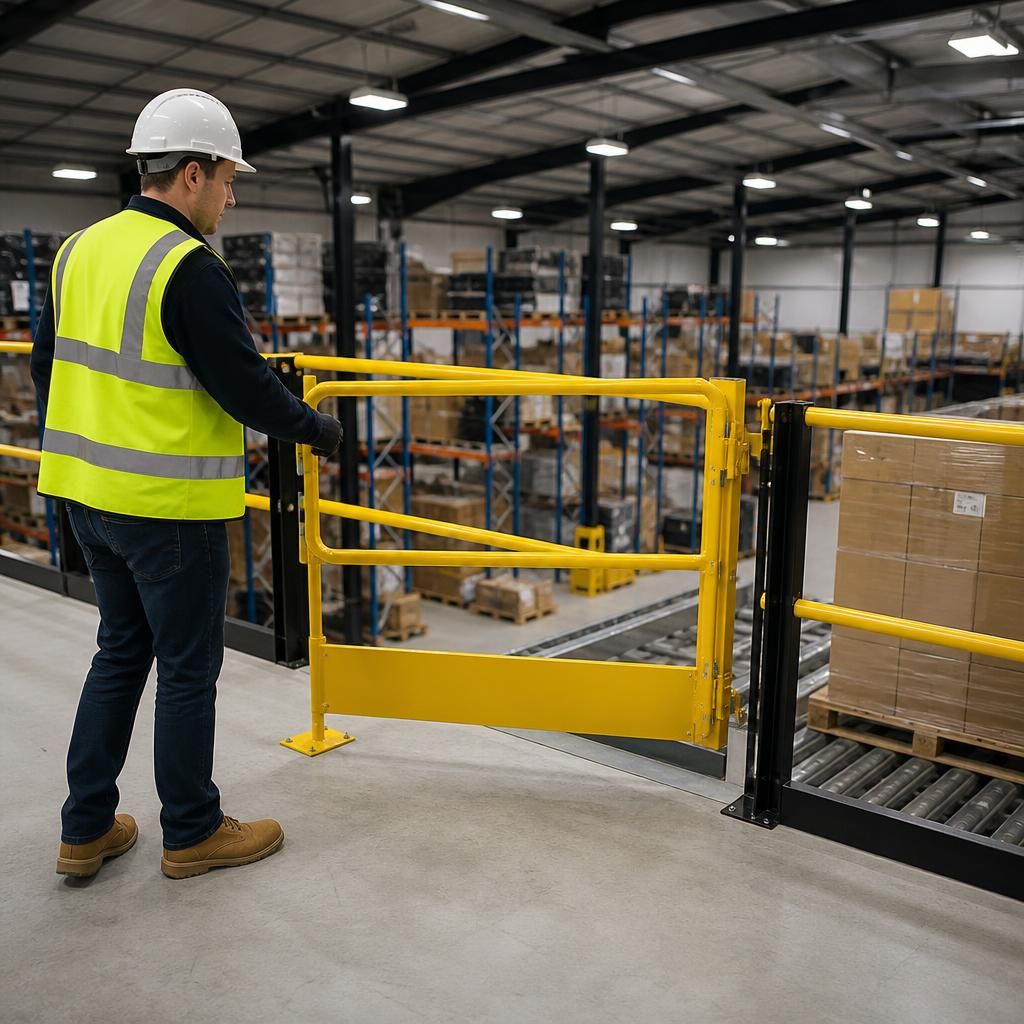
The main factor when choosing a mezzanine floor safety gate is how the opening will be used. A pedestrian access point may suit a self-closing hinged gate, while pallet or equipment transfer usually requires a loading gate that maintains protection at the exposed edge during loading and unloading.
Check the largest load, handling equipment, movement direction and available clearance before selecting the design. Hinged gates need sufficient swing space and may obstruct walkways, whereas sliding or vertically operating arrangements can be more suitable where space is restricted. In every case, the gate should be simple to operate, prevent access to an unprotected edge and remain secure when not in use.
Need help choosing the right mezzanine floor safety gate?
Need help choosing the right mezzanine floor safety gate? Speak to Able Racking for practical advice based on your opening layout, handling requirements and existing edge protection.