
What specific guidelines should I follow during a warehouse racking safety inspection for HSE compliance?
During a warehouse racking safety inspection, follow HSE guidance by using a competent inspector to assess damage, stability, protection measures, loading information and housekeeping, while checking the system against the manufacturer’s instructions and relevant standards. Record findings, risk-assess defects, isolate or unload unsafe areas immediately, and arrange suitable remedial work with documented follow-up.
For HSE compliance, a warehouse racking safety inspection should be a systematic examination by a competent person, supported by regular in-house checks, documented findings and prompt action on defects. The inspection should assess the condition, stability, protection and use of the warehouse racking against the original design, manufacturer’s instructions, loading information, the risk assessment and relevant guidance, including HSE guidance and applicable standards.
1. Use a competent inspector
The inspection must be carried out by someone with suitable knowledge, training and practical experience of warehouse racking systems. The inspector should understand common forms of damage, load capacity, structural behaviour, protection measures, installation requirements and the limits of safe use. Independence is also important: the person should be able to identify unsafe conditions objectively and recommend that affected areas are taken out of service where necessary.
For a formal expert inspection, use a suitably qualified and experienced warehouse racking inspector who can provide a written report. The inspector should be familiar with the relevant design and safety requirements, including BS EN 15635 where applicable, as well as the manufacturer’s instructions and the particular operating conditions of the site.
2. Review the information before inspecting
Before entering the warehouse racking aisles, review the information needed to judge whether the installation remains safe. This should include:
- Layout drawings and the original design specification, where available.
- Manufacturer’s instructions and system-specific maintenance requirements.
- Safe working load notices, bay identification and load configuration details.
- Records of previous inspections, repairs, alterations and reported impacts.
- The site risk assessment and any changes to vehicles, handling equipment, stock, working methods or traffic routes.
- Information about any previous overloading, movement, unauthorised alterations or structural damage.
If essential design or loading information is missing, do not assume that the warehouse racking is suitable. Record the limitation and arrange verification by a competent specialist before relying on uncertain load capacities.
3. Check the overall condition of the warehouse racking
Inspect every accessible part of the installation, not just areas where damage has already been reported. Look for:
- Bent, twisted, split, buckled or otherwise deformed uprights, beams, bracing members and other structural components.
- Loose, displaced, missing or damaged locking devices, bolts, clips, pins and connections.
- Upright frames that are out of plumb, leaning or showing signs of movement.
- Damaged, missing or incorrectly positioned floor fixings and baseplates.
- Corrosion, cracks, impact marks, damaged welds or deterioration that could reduce structural capacity.
- Missing, damaged or unsuitable decking, support bars, pallets and other load-supporting components.
- Evidence that beams, frames or other components have been altered without approval.
- Items stored in a way that places unexpected loads on structural members or creates instability.
Pay particular attention to the lower portions of frames and beams, aisle ends and locations close to forklift or other vehicle movements. Damage may be slight visually but still significant if it affects alignment, connections or load-bearing capacity.
4. Assess protection and impact risks
Check whether the protective measures identified in the design and risk assessment are present, correctly installed and in good condition. This may include frame guards, end-of-aisle protection, barriers, column protection and measures controlling vehicle movements.
Protection should be suitable for the vehicles and traffic patterns in use. It should not be treated as a substitute for repairing damaged warehouse racking. Where protection has been displaced, damaged or removed, record the defect and assess whether the affected area needs to be restricted until it is restored.
Also check aisle widths, turning areas, pedestrian routes, crossing points and visibility. Obstructions, poor segregation or inadequate clearance can increase the likelihood of impact and may make an otherwise sound installation unsafe in practice.
5. Verify loading and use
Confirm that the warehouse racking is being used within its stated design limits. Check that:
- Safe working load notices are displayed, legible and relevant to the installation.
- Loads match the specified pallet type, dimensions, weight and distribution.
- Loads are stable, secure and positioned correctly on the beams or supports.
- Heavy or high-risk loads are stored in accordance with the site’s risk assessment.
- There is no overloading, uneven loading, excessive pallet overhang or unsupported load.
- Changes in beam levels, bay configuration or storage arrangements have been approved by a competent person.
- Operators are not placing loads on damaged components or using the installation in an unintended manner.
Do not estimate capacity from appearance alone. A beam or frame that looks substantial may not have the required capacity for a particular load arrangement. Where the configuration has changed or the safe working load is unclear, obtain confirmation from the designer, manufacturer or another competent specialist.
6. Inspect housekeeping and operational controls
Good housekeeping supports safe warehouse racking use and should form part of the inspection. Check for damaged pallets, loose packaging, fallen goods, leaks, debris and stock projecting into aisles or pedestrian routes. Identify conditions that could cause trips, falling objects, blocked access or vehicle contact.
Review whether operators have suitable instructions for loading, unloading and reporting damage. The inspection should consider how work is actually carried out, rather than relying only on written procedures. Repeated damage in one location may indicate a problem with traffic management, visibility, training, aisle design or the suitability of the handling equipment.
7. Classify defects and control immediate risks
Every defect should be recorded clearly, located precisely and assessed according to the risk it presents. A practical system should distinguish between damage requiring immediate action, damage requiring remedial work within a defined period and minor damage that must be monitored.
If there is a serious risk of collapse, falling goods or further damage, stop using the affected bay or area immediately. Prevent access, unload it where this can be done safely and notify the responsible manager. Do not straighten, weld, drill, bolt or otherwise repair structural components without an approved method from a competent person. Temporary measures should not be treated as a permanent repair unless they have been specifically designed and authorised.
Where the risk is less immediate, establish a realistic completion date, assign responsibility and record the control measures in place until the work is completed. Reinspect the area after repair to confirm that the defect has been resolved and that the warehouse racking is safe to return to service.
8. Maintain suitable inspection arrangements
A formal expert inspection should be completed at intervals appropriate to the risks and in line with the manufacturer’s instructions and recognised guidance. HSE guidance and BS EN 15635 are commonly used to support an expert inspection at least every twelve months, with shorter intervals where the risk assessment, operating environment, damage history or system condition requires them.
Formal inspections do not replace routine checks. Staff should report damage as soon as it occurs, and designated personnel should carry out regular visual checks at a frequency determined by the risk assessment. These checks should cover newly damaged components, changes in use, unsafe loading, missing protection and any issue raised by operators. Staff need clear reporting arrangements and must understand that damaged warehouse racking is not to be used simply because an inspection date is not due.
9. Keep complete records
The inspection report should identify the site, installation and inspection date, name and competence of the inspector, areas examined, defects found, risk classification, photographs or marked-up locations where useful, recommended actions and any restrictions placed on use.
Keep evidence of completed repairs, replacement components, follow-up inspections, training and changes to the warehouse racking layout. Records should be accessible to managers and relevant operators, and they should demonstrate that defects were not only identified but controlled and closed out.
10. Review the inspection process
Use inspection findings to improve the risk assessment and preventative controls. Repeated impact damage, recurring overloading or frequent pallet failures may show that the underlying working method needs to change. Consider whether additional protection, revised traffic controls, improved signage, different storage arrangements, operator training or more frequent inspections are required.
An effective HSE-compliant approach is therefore continuous: inspect, record, risk-assess, control, repair and verify. This provides a defensible safety process and helps keep warehouse racking structurally sound, correctly loaded and suitable for the work being carried out.
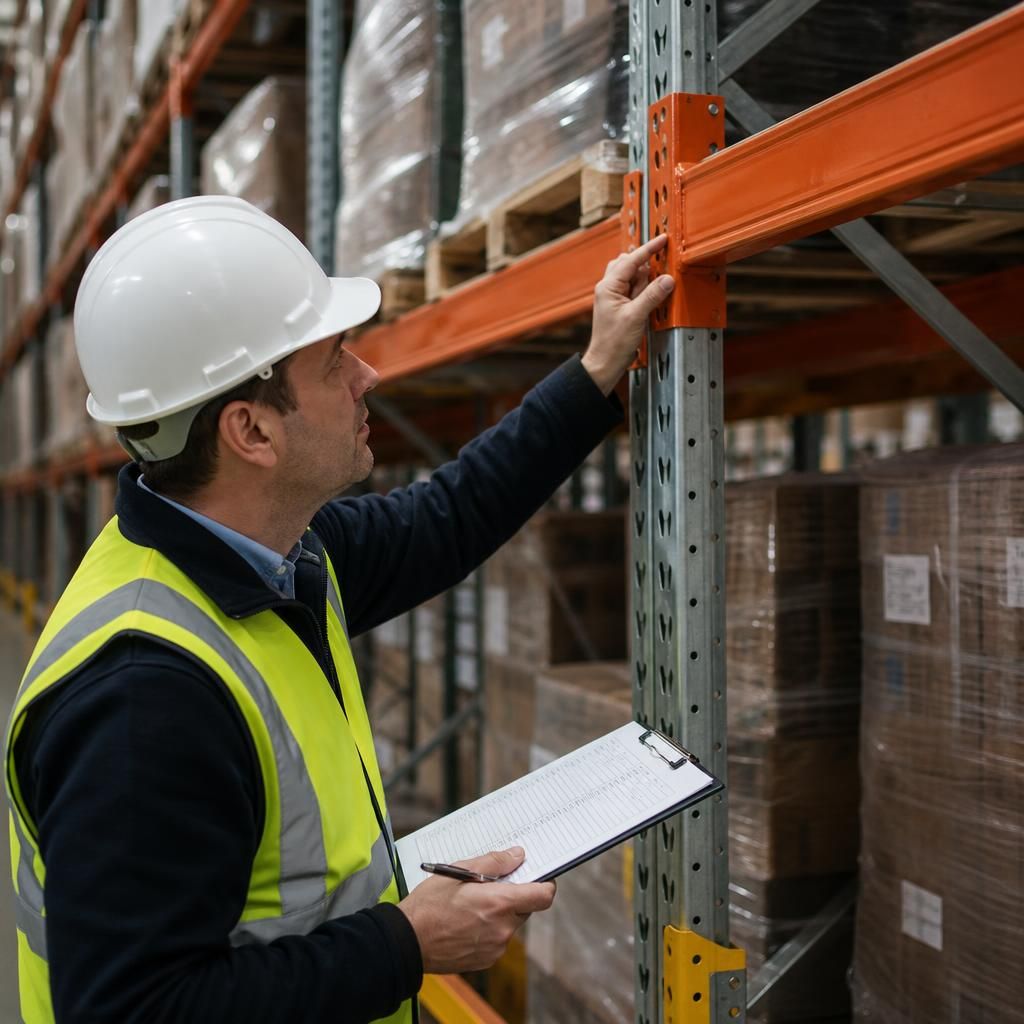
Any warehouse racking defect that could cause collapse, falling goods or further impact damage must be controlled immediately. Stop using the affected bay or area, prevent access and notify the responsible manager. If it is safe to do so, unload the area using a planned method and suitable equipment.
Do not straighten, weld, drill or alter damaged warehouse racking without an approved repair method from a competent specialist. Record the defect clearly, including its location and photographs where useful, then arrange the appropriate repair and a follow-up inspection before returning the area to service. This ensures that an inspection leads to effective risk control rather than simply documenting the problem.
Arrange your warehouse racking safety inspection
Arrange your warehouse racking safety inspection with Able Racking to identify defects, assess risks and support HSE compliance. Contact our experienced inspection team to plan a suitable review for your site.