
What should I know about the materials used by warehouse racking manufacturers?
Warehouse racking manufacturers primarily use high-strength structural steel for frames, beams and other load-bearing components, selected to withstand specified loads and repeated use. Protective finishes such as powder coating or galvanising help resist impact, corrosion and wear, while the material grade, component design, welds and quality controls all affect the system’s safety and service life.
Warehouse racking manufacturers primarily use high-strength structural steel for frames, beams and other load-bearing components. The steel is selected and formed to support the specified loads, withstand repeated use and maintain its performance in the working conditions of the warehouse. Material grade, section design, manufacturing tolerances, connections, protective finishes and quality control all affect the safety and service life of the completed system.
Structural steel for frames and beams
Upright frames are commonly manufactured from cold-formed steel sections. These profiles use shaped steel to achieve the required strength and stiffness without unnecessary material. The upright profile, thickness, perforations and bracing arrangement are designed as a complete structural assembly rather than assessed in isolation.
Beams are often produced from formed steel sections, with their shape and dimensions selected according to the span, load and connection arrangement. Heavier-duty systems may use more substantial sections or hot-rolled structural steel where the design requires greater capacity or resistance to demanding operating conditions. The correct choice depends on the manufacturer’s engineering calculations and the intended use, not simply on the apparent thickness of the steel.
Material grade and structural performance
Steel grades have different yield strengths, ductility and manufacturing characteristics. A higher-strength material may allow a manufacturer to produce a lighter section, but that does not automatically make a system safer or more suitable. The finished component must still have appropriate resistance to bending, buckling, local deformation and impact.
Warehouse racking is designed as a system. Uprights, beams, bracing, baseplates, floor fixings and connections work together to transfer loads safely into the building floor. Changes to any of these components can alter the original design assumptions. Substituting parts or mixing components from different systems should therefore only be done with suitable technical approval.
Protective finishes
Powder coating is widely used to provide a durable finish and help protect steel from general wear, minor abrasion and surface corrosion. The finish also makes components easier to identify and inspect, with different colours sometimes used for uprights, beams and protective equipment.
Galvanising applies a protective zinc coating to steel and can provide enhanced resistance to corrosion. It may be appropriate for warehouses exposed to moisture, temperature variation or more demanding environmental conditions. The suitable treatment depends on the building, cleaning regime, atmosphere and expected exposure. A coating should not be treated as a substitute for good housekeeping, prompt repairs or control of water ingress.
Painted, powder-coated and galvanised components may all be appropriate when specified for the correct environment. Ask the manufacturer or supplier about the intended coating, its limitations and any maintenance requirements before selecting a system.
Connections, welds and fixings
Beam-to-upright connections are critical parts of warehouse racking. They must engage correctly, resist the forces created by loaded bays and remain secure during normal operation. Depending on the design, components may be joined using proprietary connectors, locking pins, bolts, welds or a combination of methods.
Weld quality is important where welded joints are used. Consistent weld penetration, alignment and finish help ensure that the joint performs as designed. Bolts, nuts, locking devices and floor anchors must have the correct specification and be installed to the manufacturer’s instructions. Small or apparently interchangeable fixings should not be treated as suitable replacements without confirmation.
Ancillary materials and components
A complete warehouse racking installation may include steel mesh decking, chipboard or other load-supporting panels, depending on the design and stored goods. These materials must be suitable for the imposed load, bay dimensions and method of loading. Their condition should be checked for damage, displacement, overloading and unsuitable alterations.
Other components can include column guards, end-of-aisle protection, row spacers, backstops, guide rails, pallet supports and floor anchors. These may be manufactured from steel, polymer or other engineered materials. Their purpose is to manage impact, support stored loads or protect the main structure. They must be compatible with the system and installed in the positions specified by the design.
What to check when assessing materials
- Request the manufacturer’s technical information for the specific warehouse racking system rather than relying on a general product description.
- Confirm the safe working loads, bay configuration, beam levels and intended pallet or load type.
- Check that the system has been designed and installed in accordance with the applicable requirements, including relevant European standards such as EN 15512, EN 15629 and EN 15635 where applicable.
- Look for consistent profiles, secure connections, undamaged coatings, correctly fitted locking devices and suitable floor fixings.
- Confirm that any decking, supports, protection or accessories are approved for use with the main system.
- Obtain approval before drilling, welding, cutting, repainting or replacing structural components.
Why material condition matters during use
Even correctly specified steel can lose performance after impact, corrosion, unauthorised modification or prolonged overloading. Damage to an upright, beam, brace, connector or baseplate can change how forces are distributed through the structure. Surface rust may be cosmetic in some circumstances, but deeper corrosion, distortion, cracking or loose connections require competent assessment.
Regular inspections should consider both the original material specification and the current condition of the warehouse racking. A trained inspector can identify damage that may not be obvious during routine warehouse activities, record its location and severity, and advise whether the affected area requires unloading, repair, replacement or continued monitoring.
Material choice is only one part of reliability
The best material will not compensate for an unsuitable layout, incorrect loading, poor installation or inadequate maintenance. Reliable warehouse racking depends on the interaction between engineering design, manufacturing quality, installation, floor capacity, load control, operator training and ongoing inspection.
When reviewing a proposed or existing system, consider the environment, the loads, handling equipment, impact risks and future changes as well as the steel specification. Keeping manufacturer documentation, load notices, inspection records and repair details together makes it easier to demonstrate that the system remains suitable and to plan preventative maintenance.
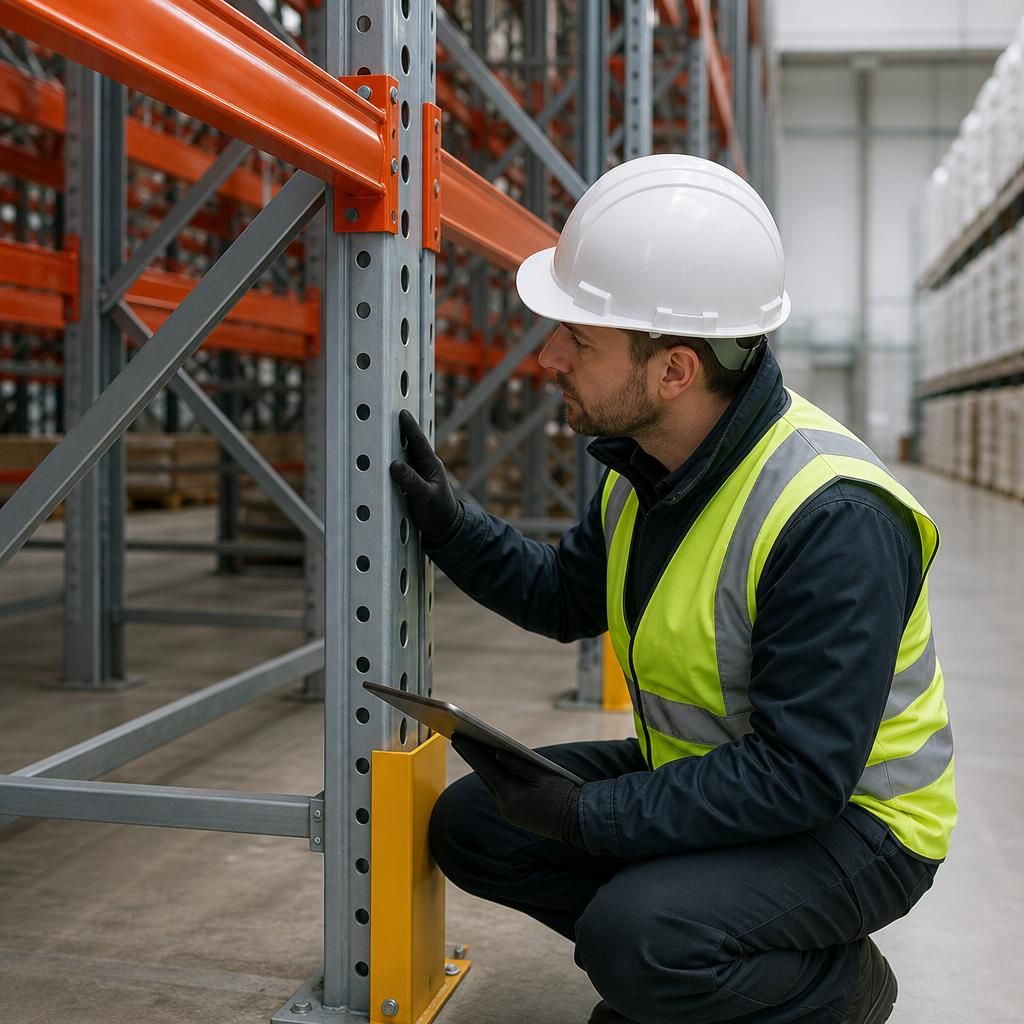
The materials used in warehouse racking must be suitable for the loads, working environment and expected level of use. High-strength structural steel is typically used for frames and beams, while powder-coated or galvanised finishes help protect components from wear and corrosion.
Material selection is only effective when components remain in good condition. Impact damage, distortion, corrosion, loose connections or unauthorised alterations can reduce the system’s performance, even when the original materials were correctly specified. During inspections, check the steel sections, protective coatings, fixings, locking devices and floor anchors, and arrange a competent assessment where damage is found.
Ask our experts about warehouse racking materials
Ask our experts to review the materials, protective finishes and components specified for your warehouse racking system. We can help you identify suitable options and advise on inspection, maintenance or repair requirements.