
What maintenance is required for mezzanine edge protection systems to ensure continued safety compliance?
Mezzanine edge protection systems require regular visual checks, competent inspections and prompt repair of damaged barriers, loose fixings, missing components, corrosion and faulty gates. Maintenance should also confirm that loading gates, handrails, guardrails, kickboards and access points remain secure, correctly aligned and suitable for the risks, with findings and remedial work recorded to demonstrate continued safety compliance.
Mezzanine edge protection systems require routine visual checks, planned competent inspections and prompt corrective work to remain safe and compliant. Maintenance should verify that guardrails, mid-rails, toe boards, gates, posts, fixings, welds and floor connections remain secure, correctly positioned and suitable for the activities taking place at the edge. Any defect that could expose a person to a fall or allow materials to fall must be controlled immediately and recorded.
The maintenance approach should be based on a suitable risk assessment, the manufacturer’s instructions and the conditions in the workplace. Inspection frequency may need to increase where the system is exposed to frequent loading activity, vehicle movements, impact risks, harsh environmental conditions, alterations or heavy use. A competent person should determine the inspection programme and understand both the protection system and the hazards around it.
- Routine visual checks: Look for missing or displaced components, bent rails, damaged toe boards, loose bolts, failed welds, corrosion, movement at the base plates and any change in alignment. Check that gates close correctly and that no opening has been left unprotected.
- Planned detailed inspections: Examine the complete system, including posts, handrails, intermediate rails, kickboards, hinges, latches, counterbalances, hinges, bearings, fixings and connections to the floor or supporting structure.
- Functional checks: Operate access and loading gates through their full range. Confirm that they open and close as intended, remain stable, latch securely and do not create an unsafe gap during loading or unloading.
- Post-incident inspections: Inspect the system after an impact, overload, unauthorised alteration, significant building movement or any event that may have affected its stability. Damage is not always visible, particularly at floor fixings and welded connections.
Particular attention is needed around loading gates. When a gate is opened, the protected position should prevent a person or load from reaching the exposed edge. The gate must not be bypassed, wedged open or used in a way that defeats its safety function. Where a gate has been struck or its operating mechanism has become difficult to use, it should be taken out of service until a competent assessment has been completed.
Maintenance inspections should cover the following areas:
- Guardrails and intermediate rails: Check for deflection, impact damage, loose joints, missing sections and gaps that could permit a person to fall through or become trapped.
- Toe boards and kickboards: Confirm that they are continuous where required, securely fixed and high enough to reduce the risk of tools, products or other materials falling from the edge.
- Posts and floor connections: Check base plates, anchors, bolts and surrounding concrete or steelwork for looseness, cracking, distortion or signs of movement.
- Gates and access points: Check hinges, springs, counterweights, latches, stops and guarding arrangements. Remove accumulated debris that could prevent reliable operation.
- Surface condition: Remove corrosion where appropriate and investigate its cause. Advanced corrosion, thinning or damage to protective finishes may require replacement rather than cosmetic treatment.
- Impact protection: Review barriers and protective measures near vehicles, handling equipment and busy transfer areas. A system that was suitable when installed may need additional protection if the work activity changes.
Cleaning forms part of maintenance because oil, dust, packaging and stored materials can conceal defects or interfere with gate operation. Cleaning should be carried out without removing essential components or placing people at an unprotected edge. Damaged parts should not be straightened, welded or altered informally; repairs and replacements must maintain the original design intent, strength and guarding arrangement.
Defects should be classified according to risk. A serious defect, such as a missing guard section, unstable post, failed gate latch or severely damaged connection, requires the affected area to be isolated and clearly identified until it has been made safe. Less urgent deterioration should still be assigned to a named person with a completion date. Temporary measures should not be treated as a permanent repair.
All inspections and maintenance should be documented. Records should identify the area inspected, date, person carrying out the work, findings, photographs where useful, actions required, completion details and any parts replaced. Keep relevant installation information, design details, manufacturer instructions and previous reports together so that changes and recurring defects can be identified. Records provide evidence that the system is being actively managed, but they do not replace the need to correct unsafe conditions.
Following repair, alteration or replacement, carry out a post-work inspection before the area is returned to normal use. Confirm that the protection is complete, fixings are secure, gates operate correctly and the repair has not introduced new gaps or interference with access. Where the structure or loading arrangements have changed, obtain appropriate technical advice and review the risk assessment rather than assuming the existing system remains suitable.
Effective maintenance is therefore a continuing cycle of checking, safe isolation, competent repair, functional testing and accurate record keeping. Combining routine checks by trained site personnel with periodic inspection by a competent specialist helps identify deterioration early and supports continued compliance with applicable workplace safety requirements, manufacturer guidance and the site’s risk controls.
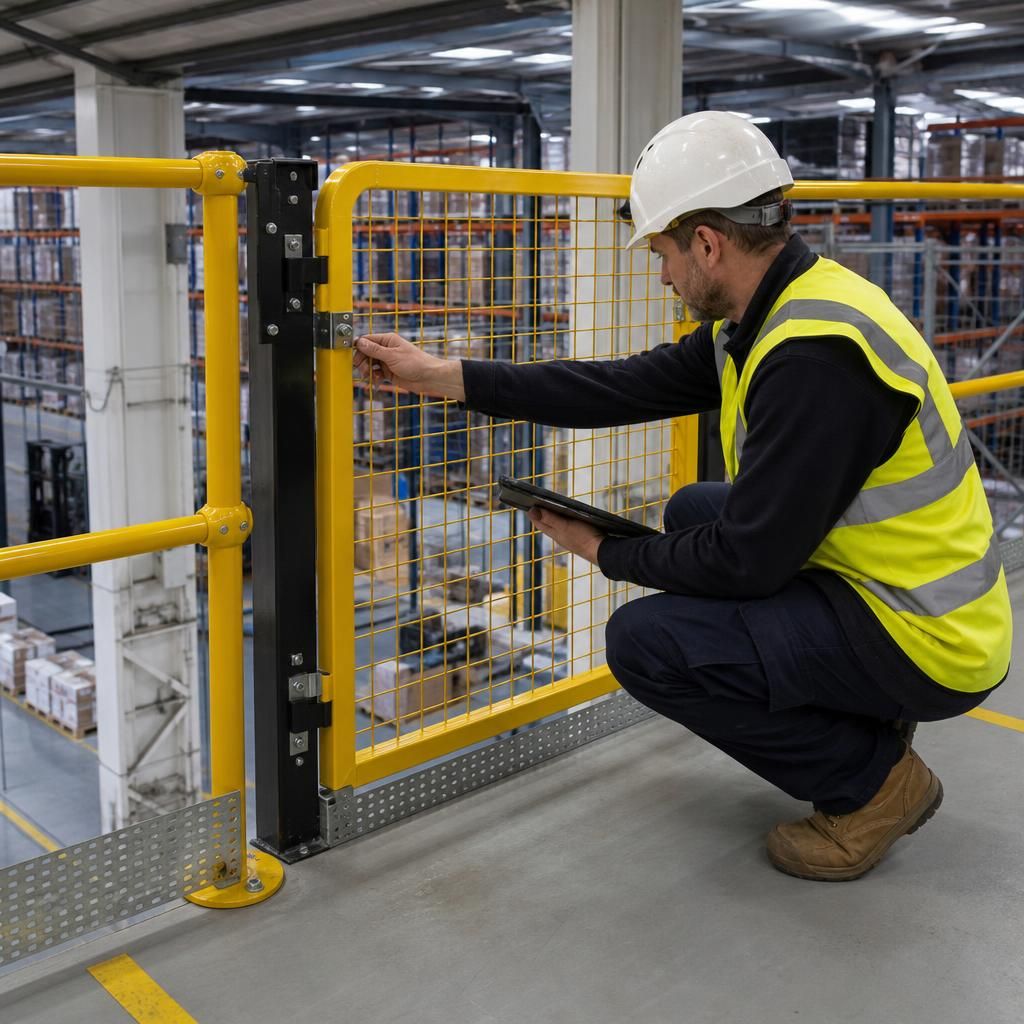
Maintenance of mezzanine edge protection systems is the planned process of checking, testing and repairing guardrails, toe boards, posts, fixings and safety gates so they continue to prevent falls and falling materials. It should include routine visual checks, detailed competent inspections and functional testing after any impact, alteration or repair.
Pay particular attention to loading and access gates. Confirm that hinges, latches, stops and counterbalance mechanisms operate smoothly, close fully and leave no unprotected opening. Any gate that has been struck, becomes difficult to operate or fails to latch securely should be isolated until it has been assessed and repaired by a competent person.
Record defects, photographs, corrective actions and completion details. After repairs, inspect the affected area before returning it to service to confirm that the protection is complete, securely fixed and still suitable for the work being carried out.
Arrange Your Mezzanine Edge Protection Maintenance Assessment
Arrange a professional mezzanine edge protection maintenance assessment with Able Racking to identify defects, confirm gate operation and support continued safety compliance.