
What are the consequences of ignoring regular warehouse racking inspections?
Ignoring regular warehouse racking inspections can leave damaged, overloaded or unstable storage equipment in use, increasing the risk of falling loads, injuries and structural failure. It can also lead to non-compliance, costly repairs, stock damage, operational downtime and disruption to warehouse activities.
Ignoring regular warehouse racking inspections increases the likelihood that damaged, overloaded or unstable storage equipment will remain in use. The consequences can include falling loads, serious injuries, structural failure, damaged stock, unplanned downtime, enforcement action and expensive remedial work. Regular inspections identify defects before they develop into incidents and provide evidence that warehouse racking is being managed responsibly.
Increased risk of falling loads and structural failure
Warehouse racking can be damaged by forklifts, pallet impacts, incorrect loading, corrosion, unauthorised alterations and general wear. Some defects are obvious, such as bent uprights or missing components, while others may be less apparent, including displaced beams, loose connections, damaged anchors or excessive deflection.
Without a structured inspection process, these defects may go unnoticed. A damaged frame or connection can reduce the load-bearing capacity of a storage system, increasing the risk of pallets falling or sections collapsing. The consequences may extend beyond the original damaged area, particularly where connected frames share loads or where an impact has affected the stability of adjacent bays.
Greater risk to employees, visitors and contractors
Falling goods, collapsing components and forklift collisions can cause severe injuries or fatalities. Even a relatively small defect can create a hazard if a pallet is stored above a busy aisle, work area or pedestrian route. Damaged warehouse racking can also create access restrictions, sharp edges and trip hazards for anyone working near the system.
Inspection findings should therefore be assessed according to the immediate risk they present. Where there is a serious risk, the affected area should be unloaded, isolated and clearly marked until a competent person has assessed the damage and suitable repairs have been completed.
Non-compliance and enforcement consequences
Employers have duties to provide and maintain safe work equipment and to protect employees and others who may be affected by warehouse activities. Warehouse racking forms part of the working environment and should be maintained, used within its design limits and inspected at suitable intervals based on the risks present.
Where inspections are ignored or records are unavailable, it may be difficult to demonstrate that reasonable precautions have been taken. Following an incident, enforcement authorities, insurers or other interested parties may examine inspection arrangements, defect reporting, repair records, load information and staff training. Inadequate controls can contribute to improvement notices, prohibition notices, prosecution or difficulties with an insurance claim, depending on the circumstances.
More expensive repairs and replacement work
Early identification usually allows a defect to be dealt with before it affects a larger part of the storage system. If inspections are missed, minor damage can worsen through repeated impacts, loading or unloading. This may turn a straightforward component replacement into a larger repair involving several bays, temporary stock relocation and specialist access equipment.
Unauthorised repairs or attempts to straighten, weld or modify components can create further risks. Repairs should be specified and carried out by suitably competent personnel, using compatible components and methods that preserve the design performance of the warehouse racking.
Stock damage and loss of materials
Unstable or incorrectly supported pallets may fall, shift or become inaccessible. This can damage products, packaging and handling equipment. Stock may also need to be quarantined if it has been affected by an impact or stored in a compromised bay.
In addition to the direct replacement cost, businesses may face disposal charges, customer claims, missed deliveries and loss of traceability. These effects can be particularly disruptive where stock is time-sensitive, hazardous, temperature-controlled or essential to production.
Operational downtime and disruption
A serious defect may require an aisle, bay or complete section to be taken out of service. If the problem follows a collision or collapse, operations may also be interrupted while the area is made safe, stock is recovered and the system is repaired or dismantled.
Unplanned disruption can affect picking routes, goods-in and despatch schedules. It may require temporary storage arrangements, additional labour, changes to traffic management and rescheduling of deliveries. A planned inspection is normally less disruptive than responding to an avoidable failure.
Loss of inspection and maintenance control
Inspections are not only a way to find physical damage. They also help identify recurring problems, such as poor loading practices, inadequate aisle protection, unsuitable pallets, vehicle impacts or a failure to observe posted load limits. Ignoring inspection findings removes an important source of information about how warehouse racking is being used.
Without accurate records, it becomes harder to establish whether defects were reported, who was responsible for action, whether an area was made safe and whether repairs were properly closed out. A robust record should identify the location, condition, risk category, immediate controls, recommended action, responsible person and completion date.
Impact on workplace safety management
Regular warehouse racking inspections should work alongside daily operator checks, planned maintenance, staff training and suitable warehouse risk assessments. They do not replace good housekeeping or safe forklift operation. Equally, a clean warehouse cannot compensate for damaged frames, missing components or loads that exceed the system’s specified limits.
Inspection frequency should reflect the warehouse environment, the type and condition of the storage system, vehicle movements, loading patterns, previous damage and any changes to layout or use. A competent person should carry out a detailed inspection at the appropriate interval, supported by routine visual checks by warehouse staff. Any change to the warehouse racking, such as relocation, reconfiguration or altered loading requirements, should trigger a review of its suitability and inspection arrangements.
How to reduce these consequences
- Carry out routine visual checks and report damage immediately.
- Arrange periodic inspections by a competent warehouse racking inspector.
- Display load notices and ensure loads remain within the specified limits.
- Keep aisles, emergency routes and access points clear.
- Use impact protection and suitable traffic controls where vehicle collisions are a foreseeable risk.
- Quarantine or unload damaged areas until they have been assessed.
- Record defects, corrective actions and completed repairs clearly.
- Investigate repeated impacts or loading errors rather than treating each defect in isolation.
- Review the warehouse racking after changes to layout, equipment, stock or operating methods.
The practical consequence of maintaining an inspection programme is better control of known risks. Inspections do not prevent every incident, but they provide a systematic way to find deterioration, prioritise action and confirm that repairs have been completed. For warehouse operators, this supports safer working conditions, more reliable storage capacity and fewer avoidable interruptions.
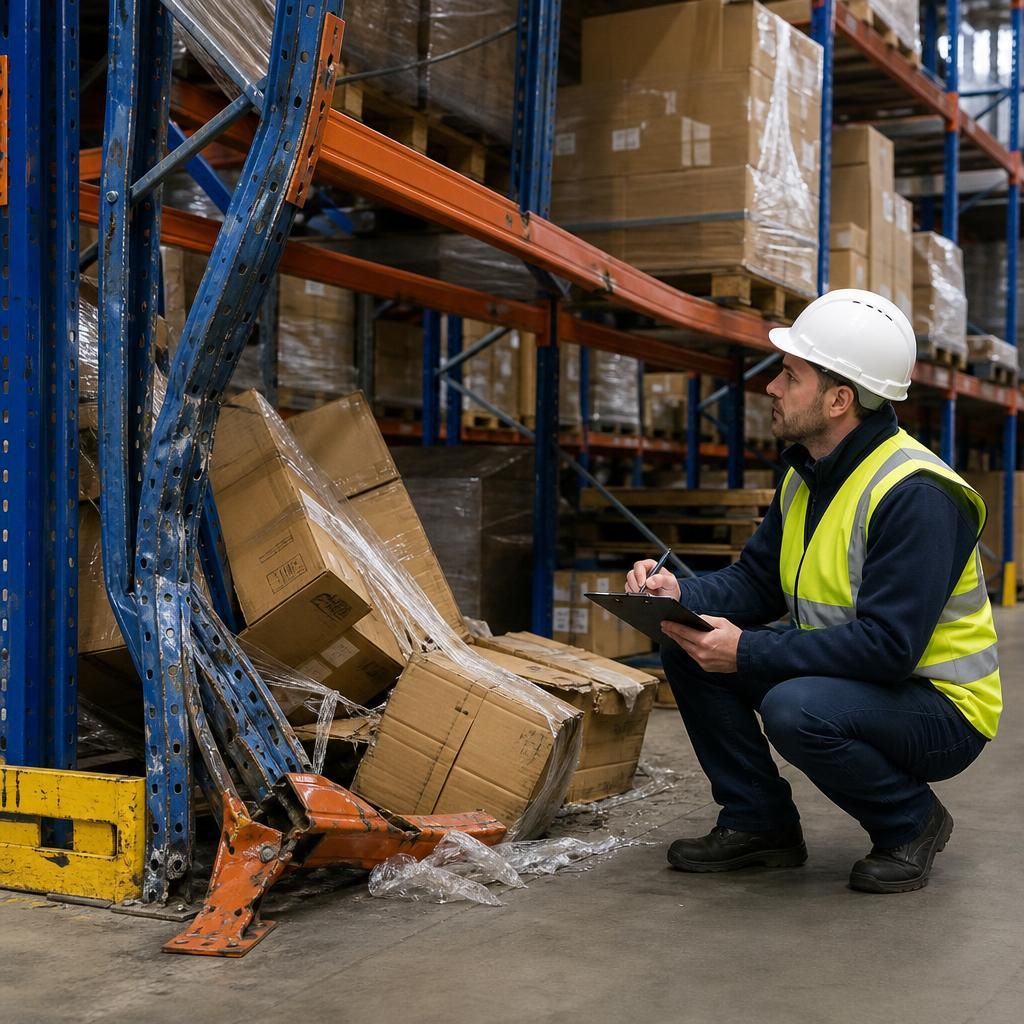
Ignoring regular warehouse racking inspections allows damage, overloading and deteriorating connections to remain unidentified, increasing the risk of falling loads, injuries and structural failure. A competent inspection can identify defects such as bent uprights, displaced beams, damaged anchors and missing components before they lead to a more serious incident.
Where damage presents an immediate risk, the affected bay or area should be unloaded, isolated and clearly marked until it has been assessed and repaired. Inspection records should document the defect, location, risk level, immediate controls, required action and repair completion. This provides practical control of known hazards and helps prevent avoidable stock damage, downtime and disruption.
Arrange your warehouse racking inspection
Arrange your warehouse racking inspection with Able Racking to identify defects, confirm safe use and address issues before they cause injury, damage or disruption.