
What are the safety considerations when implementing mezzanine loading and access systems in industrial settings?
Safety when implementing mezzanine loading and access systems depends on confirming structural capacity, controlling the movement of goods, and preventing falls during loading, unloading and personnel access. A suitable risk assessment should cover guarding, pallet gates, lifts or conveyors, safe operating procedures, emergency arrangements, inspection and maintenance, with the installation designed and reviewed by competent professionals.
Safe implementation of mezzanine loading and access systems requires coordinated control of structural loads, goods movement, personnel access and fall risks. The design should be based on the intended use of the platform, the equipment that will serve it, the loads being handled and the conditions within the workplace. A competent designer and installer should assess these factors before equipment is specified or work begins.
Confirm the structural design and load capacity
The platform must be designed and assessed for its maximum imposed loads, including stored goods, pallets, handling equipment, conveyors, lifts, people and any impact forces created during loading. Loads should be distributed as intended by the design rather than concentrated in unsupported areas. The supporting structure, columns, connections, decking and surrounding building elements must all be checked for compatibility.
Load notices should be clearly displayed and should state the permitted loading conditions in terms that operators can understand. The safe working load must not be exceeded, and any change in use, handling equipment, goods profile or loading method should trigger a design review. Unauthorised alterations, drilling, cutting or attachment of equipment can affect structural integrity and should be prohibited unless approved by a competent person.
Control fall risks at platform edges
Open edges, loading points, stairways and access openings require suitable guarding. Handrails, intermediate protection and toe boards should be installed where necessary to prevent people, goods or equipment from falling. Protection must remain effective during normal loading operations and should not be removed or left open when the area is unattended.
Particular attention is needed where goods are transferred between floor level and the platform. A pallet gate or other approved loading barrier should prevent access to the opening when it is not being used for a controlled transfer. The system should be designed so that the gate and edge protection cannot both be opened in a way that leaves an unprotected fall hazard. Operators should never stand at an unguarded edge or rely on a pallet, cage or load to act as a barrier.
Design safe access for people
Stairs should provide a stable, well-lit route with suitable handrails, consistent steps and clear headroom. Their position should avoid conflicts with vehicles, lifting equipment and loading activities. Where a lift, goods-only lift or conveyor is used, it must not be treated as a normal personnel route unless it has been specifically designed and approved for people.
Access routes should remain clear of stock, packaging, trailing cables and spillages. Doors, gates and barriers should not create pinch points or open towards a location where a person could fall. Emergency access and escape routes must remain available, clearly identified and suitable for the people who may need to use them.
Assess lifts, conveyors and transfer equipment
Every lift or conveyor should be selected for the loads, dimensions, frequency of use and available space. Interfaces between the equipment and the platform are safety-critical: transfer heights, gaps, guarding, stops and controls must prevent loads from rolling, falling or becoming trapped.
Moving equipment should have suitable guarding, emergency-stop controls and isolation arrangements. Controls should be positioned so the operator can see the loading and discharge areas or use an agreed communication system. Where automatic or powered equipment is installed, the risk assessment should consider unexpected starting, loss of power, load overrun and recovery of a trapped or failed load.
Equipment used for lifting people or goods may be subject to specific examination, inspection and maintenance requirements. The relevant duties under the Lifting Operations and Lifting Equipment Regulations and the Provision and Use of Work Equipment Regulations should be considered, with records retained where required.
Manage vehicle and pedestrian interaction
Loading operations should be planned to separate pedestrians from vehicles and other mobile equipment. Barriers, marked routes, restricted access zones and suitable speed controls can reduce the likelihood of collision. The arrangement should account for reversing, turning, parking and the visibility available to operators.
Loads should be stable, correctly positioned and suitable for the transfer equipment. Damaged pallets, leaking containers or unstable goods should be removed from the process rather than passed through an opening. A clear procedure should define who may load or unload, where they must stand and how the area is secured during the operation.
Consider fire and emergency arrangements
The platform and its access equipment must not obstruct fire exits, detection systems, sprinklers, fire-fighting equipment or emergency routes. The design should be reviewed with the building’s fire strategy, particularly where the platform changes smoke movement, escape distances or access for emergency responders.
Emergency procedures should cover power failure, equipment breakdown, a dropped or trapped load, a person falling or becoming unwell, and evacuation from the platform. Staff should know how to stop and isolate equipment and when to call for specialist assistance. Improvised rescue methods should be avoided.
Provide documented risk assessments and procedures
A suitable and sufficient risk assessment should cover installation, commissioning, normal operation, cleaning, fault finding, maintenance and eventual alteration or removal. It should address foreseeable misuse as well as the intended process. The findings should be converted into practical method statements, operating instructions and inspection arrangements.
Procedures should explain load limits, permitted goods, access controls, pallet gate operation, isolation points, housekeeping standards and the action to take if damage or a fault is found. Where contractors, temporary workers or visiting drivers are involved, responsibilities and site rules should be communicated before work starts.
Train operators and supervise the work
Only trained and authorised personnel should operate loading equipment or control access to the platform. Training should reflect the actual system, including normal loading, safe positioning, emergency stops, isolation, reporting defects and dealing with abnormal loads. Practical instruction and supervision are especially important after installation, modification or a change in working method.
Training is not a substitute for physical protection. Barriers, interlocks, guards and suitable controls should be used wherever a hazard can be designed out or reduced at source. Refresher instruction should be provided when procedures change or inspections identify repeated unsafe practices.
Inspect and maintain the complete installation
Before use, the completed system should be inspected to confirm that it matches the approved design and that guarding, gates, controls, signs, fastenings and access routes are in place. Routine checks should identify impact damage, loose components, distorted barriers, damaged decking, worn rollers, faulty controls and obstructions.
More detailed examinations should be arranged at suitable intervals based on the equipment, environment and risk assessment. Any defect that could affect safety should be reported, recorded and assessed promptly. The affected area or equipment should be taken out of service where necessary until a competent person has confirmed that it is safe to use.
Review the system after changes or incidents
Safety arrangements should be reviewed if the platform is extended, the goods change, handling equipment is replaced, operating volumes increase or the building is altered. A near miss, collision, dropped load or damage event should also lead to an investigation rather than simply a repair. The review should consider whether the original design, guarding, procedure or training remains suitable.
In practice, the safest approach is to treat the platform, loading equipment, access routes, building and operating procedures as one system. Early design checks, effective fall prevention, controlled goods transfer, competent installation, clear training and planned inspections provide the basis for compliant and dependable operation in an industrial setting.
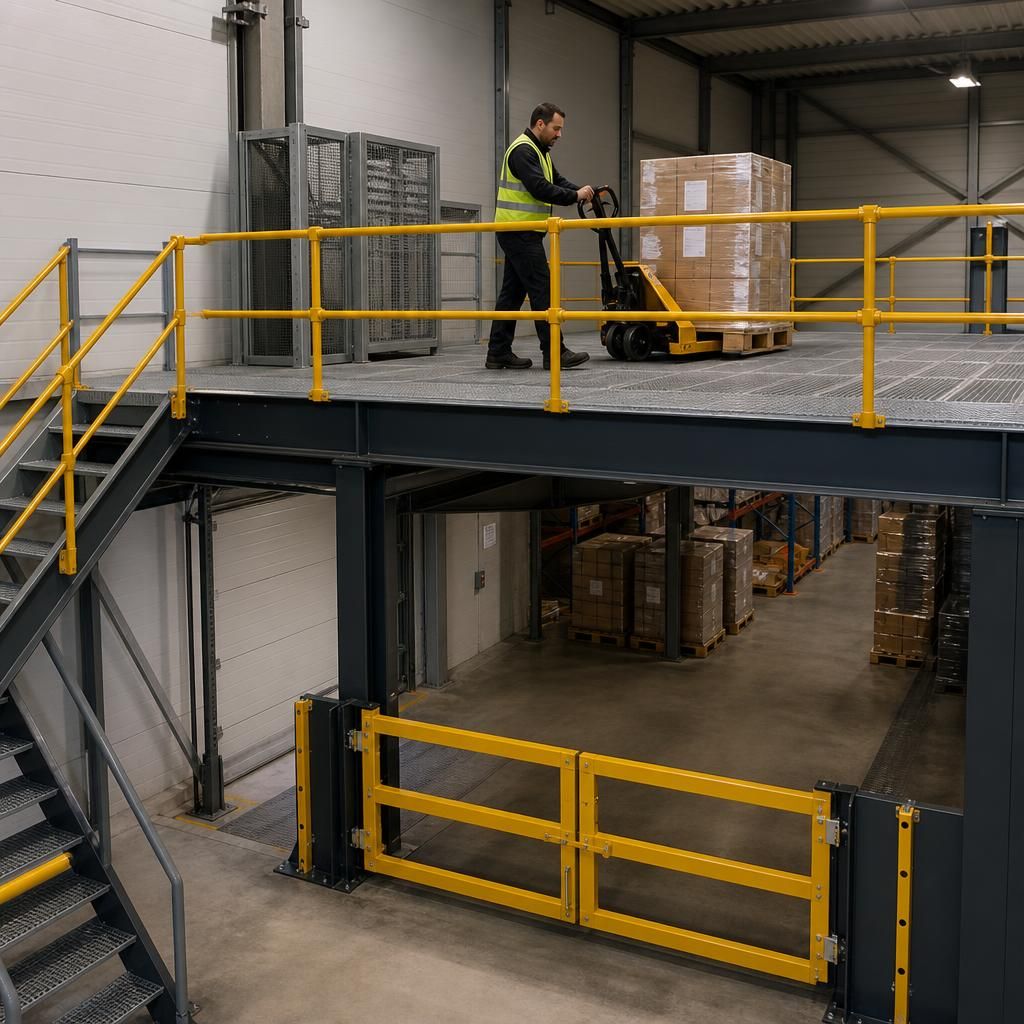
Fall protection at loading openings is a critical safety consideration when implementing mezzanine loading and access systems. A suitable pallet gate or equivalent barrier should prevent people and goods from reaching the open edge when loading is not actively controlled.
The arrangement should ensure that the loading gate cannot leave an unprotected opening during normal operation. Operators should be trained to stand in a safe position, keep the area clear of unauthorised personnel and never use a pallet, cage or load as edge protection. Regular checks should confirm that gates, handrails, toe boards and associated fixings remain secure and undamaged.
Discuss your mezzanine loading and access safety requirements
Discuss your mezzanine loading and access safety requirements with Able Racking’s experienced team to review your system, identify practical control measures and plan any inspection, maintenance or improvement work needed.