
What preventative maintenance strategies enhance warehouse racking safety? Preventative maintenance enhances warehouse racking safety by combining scheduled inspections, prompt repairs, load monitoring, housekeeping and staff training to identify defects early, maintain compliance and prevent avoidable damage.
Preventative maintenance enhances warehouse racking safety by combining scheduled inspections, prompt repairs, load monitoring, good housekeeping and staff training. These measures identify defects early, reduce the risk of collapse or impact damage, support compliance and help keep storage systems safe and efficient.
Preventative maintenance for warehouse racking is a planned programme of inspections, cleaning, monitoring, repairs and staff controls designed to identify defects before they create a risk. Rather than waiting for damage or instability to become apparent, it keeps storage systems in a serviceable condition, supports compliance with the manufacturer’s instructions and relevant workplace safety duties, and reduces avoidable disruption.
A suitable programme should be based on the type, age and use of the warehouse racking, the loads stored, the traffic around it and the history of damage or repairs. It should also define who carries out each task, how findings are recorded and when unsafe equipment must be taken out of service.
- Carry out routine visual checks. Trained warehouse staff should look for obvious damage, displaced components, missing safety pins, bent frames, damaged beams, loose fixings, leaning uprights and changes to the condition of the warehouse racking. These checks are most useful when completed regularly and when staff know exactly what defects require immediate escalation.
- Arrange formal inspections. A competent person should examine the warehouse racking at planned intervals and after events such as a collision, alteration, overloading incident or change in use. The inspection should assess structural condition, protection, stability, load notices, floor fixings and the suitability of the system for its current operation. Findings should be documented, prioritised and followed through to completion.
- Repair damage promptly. Damaged components should not be straightened, welded or modified informally. Repairs or replacements must be suitable for the specific system and completed by appropriately qualified or experienced personnel. Where damage could affect stability, the affected area should be unloaded, isolated and clearly identified until a competent person confirms that it is safe to use.
- Monitor loads and configuration. Load limits should be displayed clearly and kept consistent with the design information. Staff should not exceed beam capacities, place unsuitable loads in storage positions or alter beam levels without authorisation. Changes to the layout, load type, handling equipment or operating method may require a technical review before the warehouse racking is used again.
- Control vehicle impact. Forklift and other handling equipment damage is a common cause of deterioration. Clearly defined traffic routes, suitable operating speeds, driver training, visibility controls and correctly positioned protection can reduce collisions. Any impact should be reported immediately, even when the damage appears minor, because concealed distortion or loosening may not be visible from a distance.
- Maintain good housekeeping. Aisles, access routes and areas around the warehouse racking should be kept clear of waste, spillages and loose materials. Good housekeeping improves visibility, reduces collision risks and makes it easier to identify damaged components. Stored goods should remain stable, within their designated locations and clear of routes, emergency equipment and escape paths.
- Check protective equipment. Upright guards, end-of-aisle protection, barriers and other safety accessories should be checked for secure fixing, correct positioning and damage. Protection should complement, rather than replace, safe driving practices and regular inspections. Missing or damaged protection should be repaired or replaced without unnecessary delay.
- Manage alterations and repairs. No component should be removed, relocated or substituted without approval from a competent person. Unplanned alterations can change load capacity and stability, even when the revised arrangement appears similar to the original. Updated drawings, load information and inspection records should be retained whenever the warehouse racking is changed.
- Train and brief staff. Employees should understand load limits, safe loading methods, defect reporting, exclusion procedures and the action to take after an impact. Training should reflect the equipment and working practices used on site, with refresher briefings where procedures change or inspection findings show recurring problems.
Maintenance records should identify the location of each issue, the defect found, its risk classification, the person responsible and the date of close-out. Photographs, inspection reports, repair certificates and updated configuration information can provide a useful audit trail. Repeated defects should be reviewed for their underlying cause rather than treated as isolated repairs. For example, recurring impact damage may indicate inadequate route design, poor visibility, insufficient protection or a need for additional operator training.
Preventative maintenance is most effective when it is integrated into the site’s wider safety management system. Inspection findings should be reviewed alongside incident reports, near misses, changes in stock or handling equipment and feedback from warehouse staff. This allows the inspection frequency, training content, protection measures and operating controls to be adjusted when conditions change.
Where there is uncertainty about damage, load capacity, component compatibility or the effect of an alteration, the warehouse racking should be assessed by a suitably competent specialist before it remains in use. A planned combination of daily awareness, formal inspection, documented repairs and effective staff controls provides a practical way to preserve structural integrity, maintain compliance and prevent small defects from developing into serious safety issues.
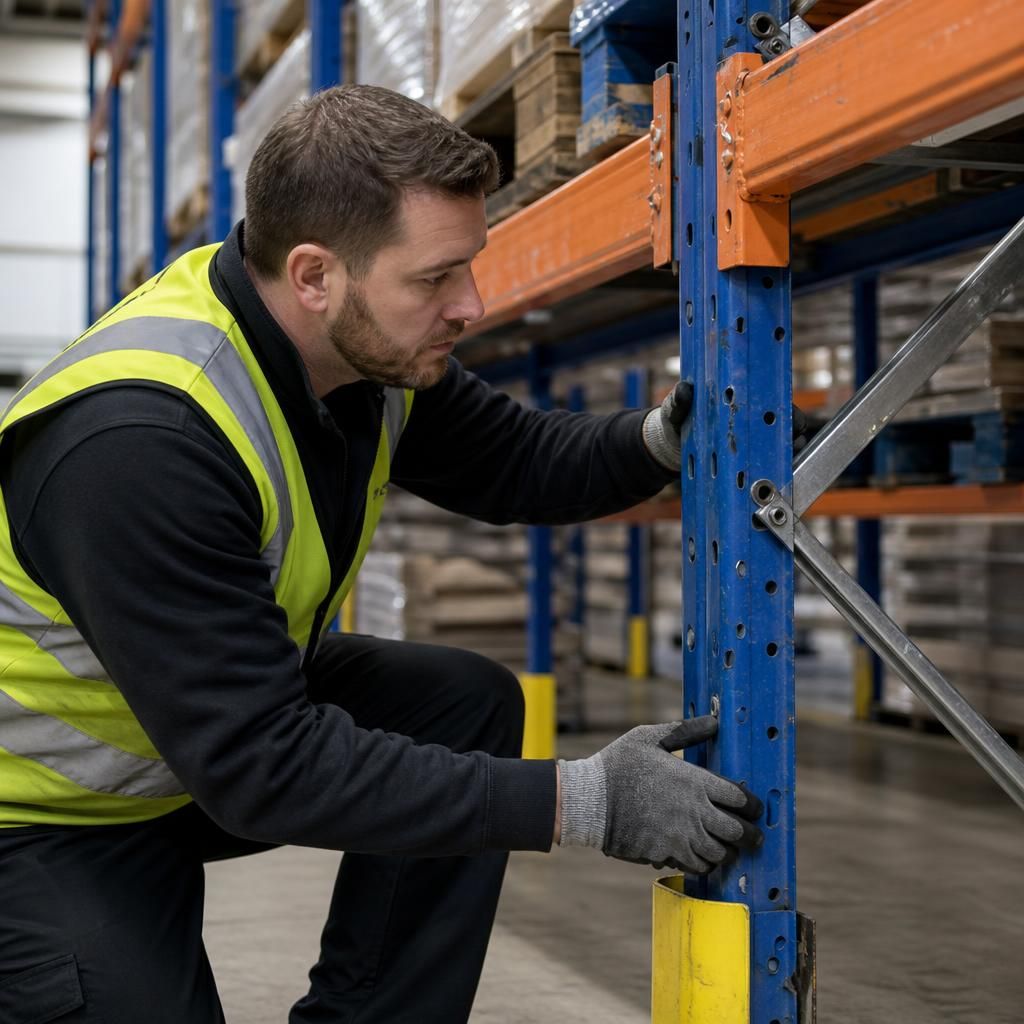
Prompt repairs are a central part of preventative maintenance for warehouse racking. When an inspection or impact report identifies a bent upright, damaged beam, missing safety pin or loose fixing, the affected area should be unloaded, isolated and clearly marked until a competent person confirms the appropriate repair or replacement.
Repairs should be recorded with the defect location, risk classification, action taken and close-out date. Components must not be straightened, welded, relocated or substituted informally, as unsuitable work can alter the system’s strength and stability. Reviewing repeated damage can also identify wider causes, such as poor traffic routes, inadequate protection or loading practices that require improvement.
Arrange a Warehouse Racking Maintenance Assessment
Arrange a warehouse racking maintenance assessment to identify defects, review your preventative maintenance controls and keep your storage systems safe and compliant. Contact Able Racking to discuss the next steps with an experienced specialist.