
What are the common repair procedures for warehouse racking systems?
Common warehouse racking repair procedures include isolating the affected area, assessing damage, replacing bent or damaged beams, uprights, bracing, clips and protectors, and securing or realigning components where appropriate. A competent technician should complete the work, followed by an inspection to confirm the warehouse racking system is stable, correctly configured and safe to return to service.
Common warehouse racking repair procedures involve isolating the affected area, assessing the damage, removing loads where necessary, replacing damaged components and checking the completed work before the system is returned to service. Repairs should be completed by competent, suitably trained operatives in accordance with the warehouse racking manufacturer’s instructions, the original design specification and relevant safety guidance.
The correct procedure depends on the location and severity of the damage. A lightly marked component may only require monitoring, whereas a bent upright, displaced beam or damaged connection can affect the stability and load capacity of the complete warehouse racking system. Damaged components should not be straightened, welded or modified on site unless a suitably qualified engineer has specifically designed and approved that method.
Isolating the damaged area
The first action is to make the affected warehouse racking safe. The bay, aisle or surrounding area may need to be cordoned off, and access should be restricted until the condition has been assessed. Loads should not be placed into, removed from or moved around a damaged section unless this has been included in a controlled repair plan.
Where damage creates an immediate risk of collapse, falling goods or instability, the area should be evacuated and stabilised under the direction of a competent person. The isolation should remain in place until the repair has been completed and a post-repair inspection confirms that the warehouse racking is safe to use.
Inspecting and recording the damage
A competent inspector examines the affected components and the surrounding structure rather than looking only at the most visible mark. The assessment normally considers:
- the condition and position of the upright frames;
- bent, twisted or displaced beams;
- damaged horizontal or diagonal bracing;
- beam connectors, locking pins and other retaining components;
- baseplates, floor anchors and the condition of the supporting floor;
- upright guards, end guards and other protective equipment;
- signs of movement, impact, overloading or unauthorised alteration; and
- the current configuration compared with the approved warehouse racking layout and load information.
Photographs, measurements and a written record help establish what has happened and what work is required. If the cause was an impact from handling equipment, the inspection should also consider nearby bays because damage may not be limited to the point of contact.
Removing loads and providing temporary support
Before components are removed, the affected warehouse racking may need to be unloaded in a controlled sequence. This must be planned carefully because taking out a beam, brace or upright can alter how forces are transferred through the structure. Loads should never be removed casually from an unstable bay.
Temporary supports, exclusion zones or other controls may be required while the repair is being prepared. These measures should be selected by a competent person and should not be improvised from unsuitable materials. Temporary support is a risk-control measure; it is not a substitute for replacing damaged warehouse racking components.
Replacing damaged beams
Warehouse racking beams that are bent, cracked, visibly distorted or no longer securely connected are commonly removed and replaced with components that match the original design. The replacement must have the correct length, section, connector arrangement and load capacity. Beam locking devices must be fitted correctly, and the beam must be seated fully in both connectors.
It is not generally acceptable to hammer a damaged beam back into shape or use it again because the distortion appears minor. Damage can reduce the component’s capacity and may affect the connection even when the beam looks serviceable after manipulation. Replacement beams should also be checked for correct level and positioning before loads are reinstated.
Replacing damaged uprights, frames and bracing
Upright frames carry significant vertical and lateral forces. If an upright is bent, buckled, split or pulled out of alignment, the affected frame may need to be replaced rather than repaired in place. Depending on the system design, this can involve removing connected beams and bracing, supporting the structure during the work, installing the new frame and reconnecting all components in the correct positions.
Horizontal and diagonal bracing is also important to the stability of warehouse racking. Damaged or missing braces, frame ties and associated fixings should be replaced with approved parts. The frame must be checked for plumb, correct spacing and secure connections after the work. A new component does not resolve the problem if the surrounding frame remains distorted or incorrectly assembled.
Repairing or replacing base components and fixings
Baseplates, floor anchors and other fixings can become damaged through impact, corrosion, movement or poor installation. A repair may involve replacing the baseplate, installing approved anchors, correcting the connection or addressing damage to the supporting floor. The suitability of the floor and fixing arrangement should be confirmed before the warehouse racking is loaded again.
Fixings should be installed to the specified requirements, including the correct position, embedment and tightening method where applicable. Drilling new holes or relocating anchors without checking the design can weaken the arrangement or interfere with existing services, so this work should be controlled by a competent person.
Replacing damaged protection
Upright guards, end guards and other protectors are often replaced after an impact. Protection should be securely fixed and positioned so that it shields the vulnerable component without obstructing access, interfering with load placement or creating a new handling hazard. A damaged protector should not be relied upon simply because the upright behind it appears undamaged.
The reason for the impact should also be reviewed. Changes to traffic routes, clearer markings, improved operator awareness or additional protection may reduce the likelihood of the same damage happening again.
Realigning and checking the system
Once replacement work is complete, the warehouse racking should be checked for alignment, level, plumb, connection security and correct configuration. The inspection should include the repaired bay and any adjacent sections affected by the work. Load notices and configuration information must remain accurate, particularly where beam levels, bay dimensions or permitted loads have changed.
Components should not be forced into position to compensate for an incorrectly assembled frame or an unsuitable replacement part. Any unexplained movement, continuing distortion or mismatch with the original design should be investigated before the system is released.
Post-repair inspection and return to service
A final inspection confirms that the repair has been completed properly and that the warehouse racking can safely return to operation. This should include checking that all beams, braces, connectors, locking devices, anchors and protective components are present and secure. Where the damage was substantial, or where the repair changed the arrangement, additional engineering review may be appropriate.
The repair record should identify the affected location, damage found, components replaced, work completed and person responsible for approving the return to service. Keeping this information with inspection and maintenance records supports future checks and helps identify recurring impact or loading problems.
Warehouse racking repairs should never be treated as cosmetic maintenance. Prompt isolation, accurate assessment, approved replacement components and a documented final inspection are the key steps in restoring safety and preserving the intended performance of the system. If the extent of damage is uncertain, keep the area out of use and arrange an assessment by a competent warehouse racking specialist.
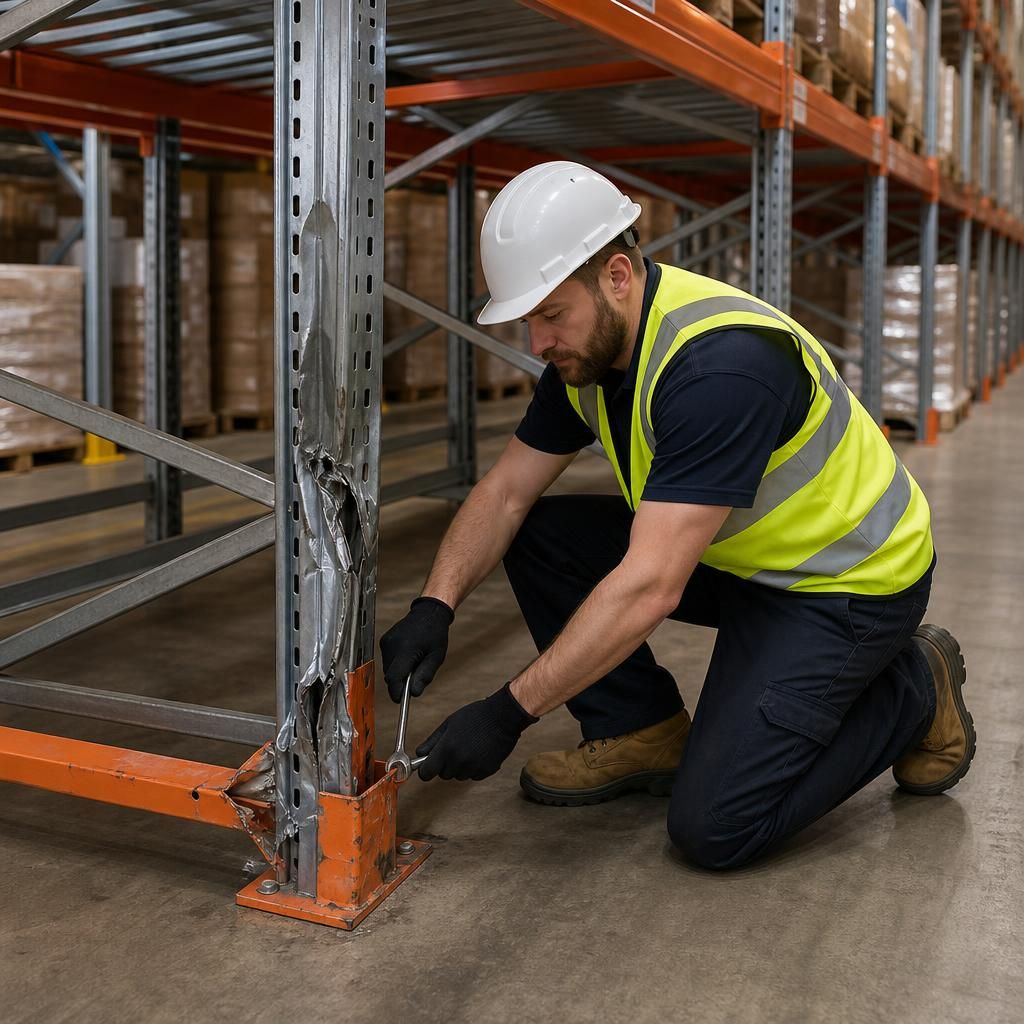
The first step in a warehouse racking repair is to isolate the damaged area and prevent further use until a competent person has assessed it. The affected bay or aisle should be cordoned off, with loads and handling equipment kept away until the risk has been properly controlled.
This prevents additional impact, falling goods or movement from worsening the damage. The assessment should cover nearby warehouse racking components as well as the visibly damaged part, because an impact can affect beams, frames, bracing, connections, anchors and protective equipment beyond the initial contact point.
Arrange a warehouse racking repair assessment
Arrange a warehouse racking repair assessment with Able Racking to identify damage, confirm the correct repair procedure and help return the affected area to safe operation.