
What are the signs that indicate warehouse racking needs repair?
Warehouse racking needs repair when you find bent or distorted frames, beams or braces, cracked welds, missing or loose components, corrosion, impact damage, or signs of instability. Any damage that affects alignment, load support or safe operation should be reported promptly, with the affected area taken out of use until assessed by a competent specialist.
Warehouse racking needs repair when any component is bent, cracked, loose, corroded, displaced or no longer supporting loads as designed. The most important warning signs are damage to frames, beams, braces, connections and protective components, together with instability, altered alignment or loads that are no longer sitting correctly. If damage could affect the warehouse racking’s strength or stability, isolate the affected bay, prevent further loading and arrange an assessment by a competent specialist.
1. Bent or distorted frames
Upright frames should remain straight and properly aligned. Bends, twists, dents, buckling or leaning can indicate that a forklift or another item has struck the warehouse racking. Even apparently minor distortion may reduce the frame’s ability to carry vertical and horizontal forces. Do not attempt to straighten an upright while it is loaded, as this can make the damage worse or create an uncontrolled movement.
2. Damaged or deflected beams
Beams should be level, securely connected and free from significant dents, bends or twists. A beam that has dropped, pulled away from its connection or developed an unusual permanent deflection may no longer provide reliable support. Check the beam connectors and locking pins as well as the beam itself. Damage at either end can affect how the load is transferred into the frame.
3. Cracked welds or split components
Cracked welds, splits, fractures and tears require prompt attention. Inspect welded joints, beam connectors, base plates, braces and other load-bearing parts for visible separation or signs that a crack is spreading. Paint flaking around a joint, fresh bright metal or a line that appears to be opening can indicate movement or impact. Cracked structural components should not be treated as cosmetic defects.
4. Loose, missing or displaced components
Missing locking pins, loose bolts, damaged anchors, displaced braces and absent safety clips can compromise the warehouse racking’s stability. Components may also become loose through impact, vibration, poor installation or unauthorised alterations. Compare the affected bay with an undamaged bay where appropriate, but do not replace parts with improvised alternatives. Replacement components need to be compatible with the system and correctly installed.
5. Impact damage and damaged protection
Forklift contact is a common cause of warehouse racking damage. Look for scrapes, dents, bent uprights, damaged end frames, displaced guards and marks on nearby flooring. Protection that has absorbed an impact may appear intact while its fixings or the structure behind it have been affected. Impact protection is not a substitute for inspecting the upright or other structural component that may have been struck.
6. Corrosion or material deterioration
Rust, pitting, flaking coatings and corrosion around joints or base plates can reduce the effective thickness and strength of a component. Corrosion may be associated with water leaks, condensation, cleaning chemicals or a harsh operating environment. Surface discolouration should be assessed carefully, particularly where corrosion is concentrated around fixings, welds or areas that are difficult to inspect.
7. Signs of instability, overloading or poor alignment
Warehouse racking may require repair or corrective work if it is leaning, rocking, visibly out of square or no longer aligned with adjacent bays. Loads that project beyond the intended position, contact frames or cause beams to sag should also be investigated. Check that the load notices remain accurate and that stored goods are within the stated capacity and configuration. A system can look generally serviceable while a localised alignment or loading problem creates a significant risk.
What to do when you identify a warning sign
- Stop placing or retrieving loads from the affected location if doing so could increase the risk.
- Keep people and materials clear of the damaged area and use a suitable temporary control to prevent access.
- Record the location, component and visible damage. Photographs can support the assessment, provided they are taken without entering an unsafe area.
- Report the issue to the person responsible for warehouse racking safety and arrange an inspection by a competent specialist.
- Follow the assessment outcome. This may involve monitoring, unloading, component replacement, structural repair or taking the bay out of service until remedial work is complete.
Warehouse racking should not be repaired by welding, drilling, cutting, heating or straightening unless the method has been assessed and approved by a suitably competent professional. Unauthorised alterations can change the design assumptions and invalidate the system’s safe working capacity. Repairs should use suitable parts, follow the manufacturer’s requirements where available and be checked before the area returns to normal use.
Routine inspections help identify deterioration before it becomes an urgent repair. Include visual checks by trained warehouse personnel, prompt reporting of impacts and regular detailed inspections by a competent person. Keep records of findings, repairs and outstanding actions so recurring damage, unsuitable traffic routes or loading problems can be addressed rather than repeatedly repaired.
Where there is uncertainty about the seriousness of damage, treat it as a safety issue rather than relying on appearance alone. A professional assessment can determine whether the warehouse racking is safe to use, needs immediate isolation or requires planned repair, helping maintain compliance and dependable warehouse operations.
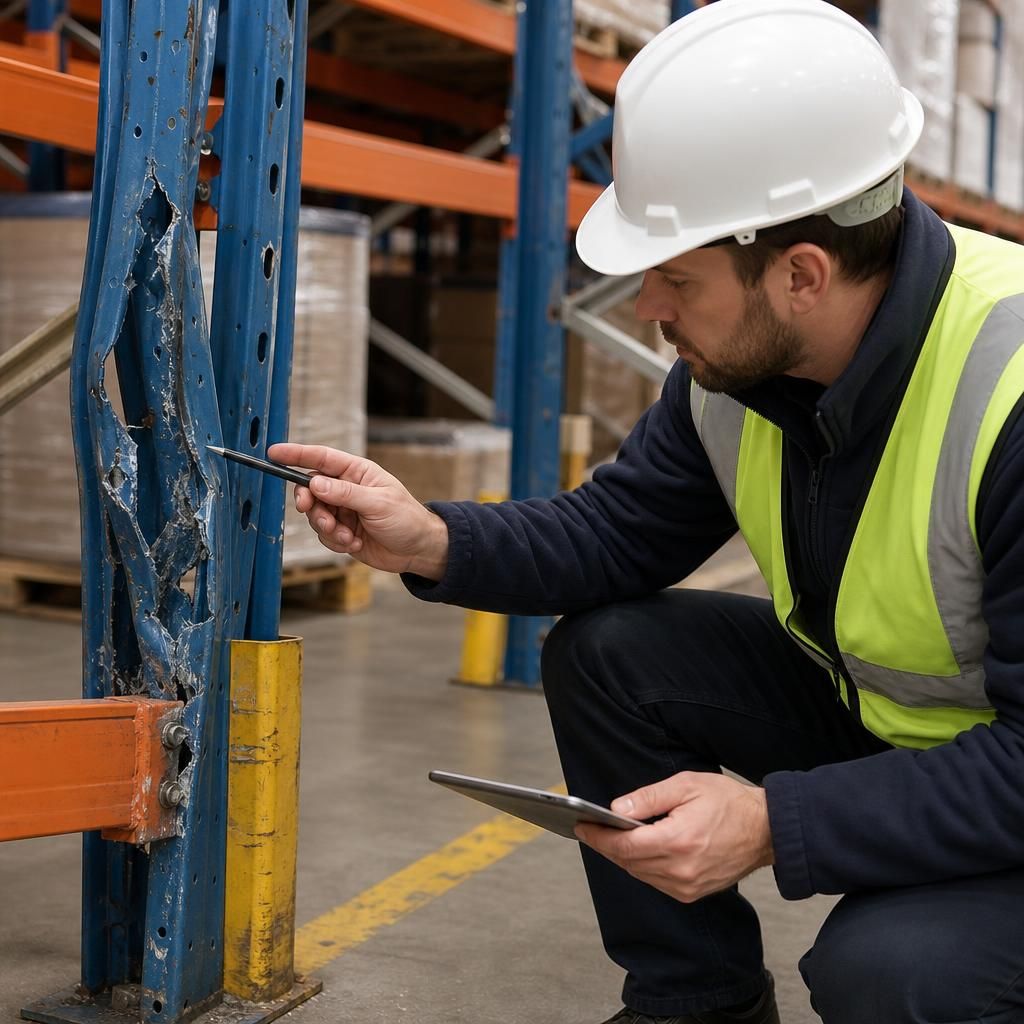
When damage is found, stop loading or unloading the affected warehouse racking bay and prevent access until it has been assessed. Bent uprights, displaced beams, damaged connectors or missing locking components can affect the system’s load capacity even when the defect appears minor.
Record the location and damage from a safe position, then arrange an assessment by a competent specialist. Do not straighten, weld, drill or alter structural components without an approved repair method. The assessment will determine whether the bay needs unloading, component replacement, structural repair or continued monitoring before it returns to service.
Arrange an expert warehouse racking repair assessment
If you have identified damage or instability, arrange an expert warehouse racking repair assessment before the affected area is used again. Able Racking can assess the condition and advise whether unloading, component replacement or an approved repair is required.