
What are the safety regulations governing mezzanine edge protection and gates?
In the UK, mezzanine edge protection and gates must comply with the Work at Height Regulations 2005, the Provision and Use of Work Equipment Regulations 1998 (PUWER) where applicable, and relevant building and engineering standards. Protection should prevent falls and falling objects, while gates must be suitable for the load, securely installed, self-closing or otherwise controlled where required, and inspected and maintained by a competent person.
In the UK, mezzanine edge protection and gates must be designed, installed and maintained to prevent people and materials falling from an exposed edge. The main legal requirements come from the Work at Height Regulations 2005, with the Provision and Use of Work Equipment Regulations 1998 (PUWER) applying where a gate is used as work equipment. Depending on the project, the Construction (Design and Management) Regulations 2015, Building Regulations and relevant structural design standards may also apply.
Work at Height Regulations 2005
The Work at Height Regulations require work at height to be properly planned, appropriately supervised and carried out by people with suitable competence. Employers and duty holders must assess the risks and select measures that prevent falls wherever reasonably practicable. Where a fall cannot be avoided, suitable collective protection must be provided before relying on individual precautions.
For an open mezzanine edge, this normally means a permanent guardrail system with:
- a top guardrail or equivalent barrier positioned at a suitable height;
- intermediate rails, infill panels or another arrangement that prevents people passing through the protection;
- toe-boards or a comparable measure where there is a risk of tools, products or other materials falling; and
- secure connections and sufficient strength and stability for the foreseeable loads and use.
Schedule 2 of the Regulations states that edge protection should be sufficient to prevent people and materials falling. It also gives established requirements for guardrail height and openings, including a top guardrail of at least 950 millimetres and restrictions on gaps. These requirements should be considered alongside the intended use, the design loading and any risk of people climbing or reaching through the barrier.
Requirements for mezzanine gates
A gate must maintain the same level of fall protection as the adjoining edge barrier. It should be suitable for its purpose, securely fixed, able to withstand foreseeable impact and loading, and arranged so that normal operations do not create an unprotected edge.
Important design considerations include:
- the gate should not open accidentally or be pushed open by a pallet, trolley or other load;
- the opening should be controlled so that a person cannot walk or fall through it when the loading area is not being used;
- the gate should be self-closing, automatically returned to a safe position or otherwise controlled where the risk assessment requires this;
- hinges, latches, stops, counterbalances and other operating components should be appropriate for the duty and protected from damage where necessary;
- the design should prevent a person from reaching beneath, over or through the gate in a way that creates a fall risk; and
- the gate should remain stable and effective when used repeatedly and when exposed to foreseeable contact from handling equipment.
Loading gates require particular care because the edge barrier may need to be opened while goods are transferred. A compliant arrangement must ensure that the load is supported and the opening is protected throughout the transfer process. For example, a pallet gate may use a counterbalanced or vertically moving barrier that allows goods to be loaded while maintaining protection on the accessible side. The precise arrangement should be selected by a competent designer following a site-specific assessment, rather than treating one gate type as suitable for every application.
PUWER and gate safety
PUWER may apply where the gate is work equipment used by employees. In that case, the gate must be suitable for the work, positioned and used safely, maintained in an efficient condition and inspected where deterioration could create a significant risk. Employees should receive appropriate information, instruction and training, including guidance on safe loading, the correct operating sequence and what to do if the gate is damaged or does not close correctly.
Powered gates, gates with powered movement or systems incorporating interlocks require additional consideration. Controls should be clearly identifiable, movement should not expose people to avoidable danger, and guarding or interlocking should be provided where appropriate. Any control system must be assessed for foreseeable misuse, including attempts to bypass a safety feature.
Structural design and installation
Edge protection and gates are only compliant when the supporting structure is also suitable. The mezzanine, columns, beams, connections, floor and barrier fixings should be designed for the intended imposed loads, impact risks and operating environment. The design should take account of the goods handled, handling equipment, traffic routes, clearances, fire arrangements and the possibility of accidental contact.
Relevant design and fabrication standards may include Eurocodes, standards for the execution of steel structures and standards for barriers or access equipment, where applicable to the system. These standards do not replace the legal duties under the Work at Height Regulations. A competent structural engineer or specialist designer should identify which standards apply to the particular installation and confirm the design basis.
Where a new structure is being built or an existing structure is modified, Building Regulations and local authority requirements may also be relevant. Installation work can fall within the scope of the Construction (Design and Management) Regulations, particularly where the project involves design coordination, structural alterations or more than one contractor. The duty holder should retain suitable design information, installation records and handover documentation.
Inspection and maintenance duties
Regulation 12 of the Work at Height Regulations requires equipment and surfaces used for work at height to be inspected at suitable intervals and after circumstances that could affect safety. For edge protection and gates, this means inspections should be based on the level of risk, frequency of use, operating conditions and the potential consequences of failure. An inspection should also be arranged after impact, alteration, relocation, prolonged disuse or a reported defect.
Checks should cover the condition and security of:
- posts, rails, panels, toe-boards and fixing points;
- gate frames, hinges, rollers, counterbalance components and latches;
- stops, catches, interlocks and self-closing mechanisms;
- the floor and supporting steelwork around the protection; and
- signage, access arrangements and any barriers protecting loading openings.
Inspections should be completed by a competent person who understands the system and its hazards. Findings should be recorded, defects categorised and corrective action given a clear priority. A damaged or ineffective gate should be taken out of service or protected by an alternative control until it has been repaired and confirmed safe. Repairs should not weaken the original design or introduce unapproved modifications.
Practical compliance checks
A compliance review should confirm that the protection has a suitable design, has been installed in accordance with that design and remains effective in everyday use. It should consider the behaviour of people and loads, not just whether the barrier appears intact. Particular attention is needed where goods are transferred, where vehicles operate close to the edge, where access routes have changed or where the gate is frequently left open.
In practice, the responsible person should retain the risk assessment, design calculations or specifications where available, installation and handover information, inspection records, maintenance evidence and staff training records. Periodic review is necessary if the use of the mezzanine, the stored goods, the handling equipment or the access arrangements change.
The safest approach is to treat edge protection and gates as part of one fall-prevention system. A competent assessment should confirm the applicable legislation, define the required performance, verify the installation and establish an inspection and maintenance regime that reflects actual site conditions.
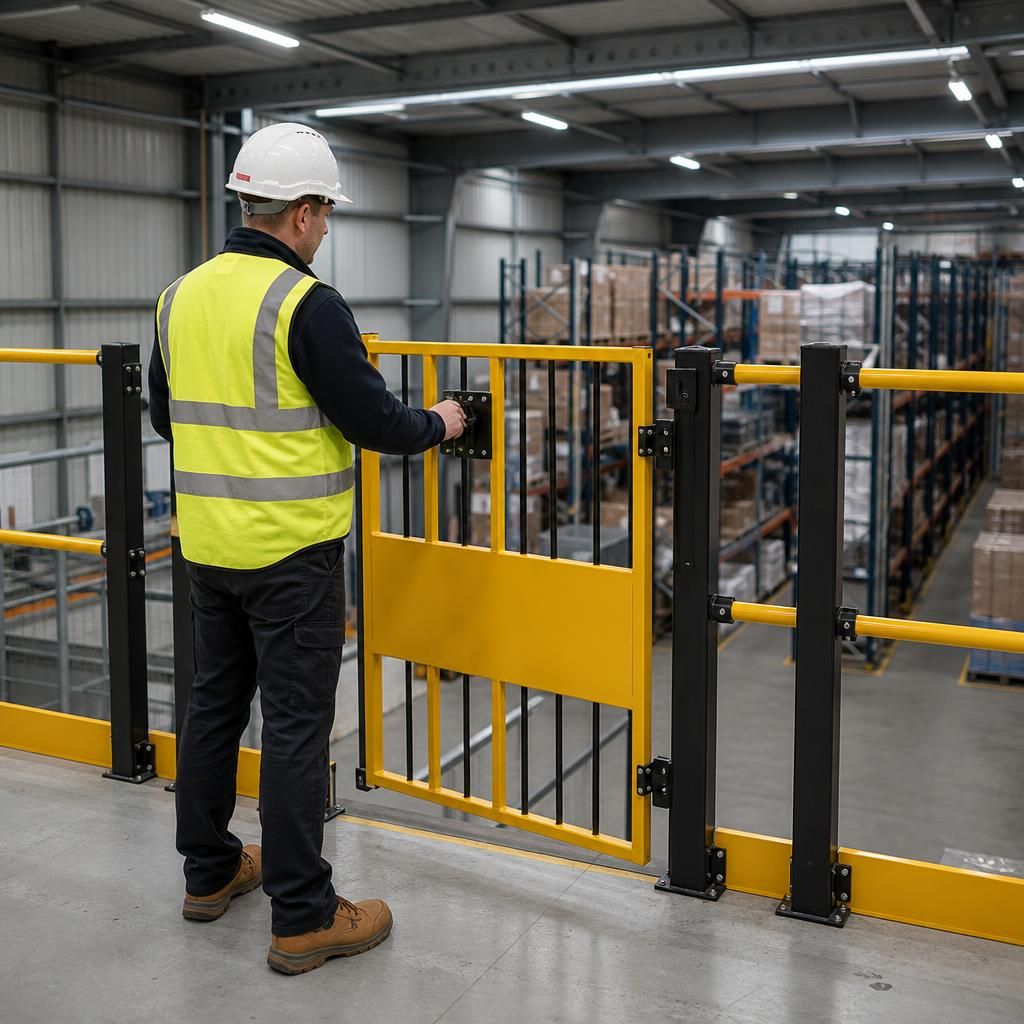
Mezzanine loading gates must protect the open edge whenever goods are being transferred. The gate should allow the load to pass safely while preventing people, pallets and materials from falling through the opening.
A suitable design may use a counterbalanced or vertically moving barrier, depending on the load, operating method and surrounding space. The arrangement should be assessed by a competent person to confirm that:
- the gate cannot be opened accidentally or pushed out of position by a load;
- the opening remains protected on the accessible side during loading;
- the gate returns to a safe position after use, where required by the risk assessment;
- hinges, latches, stops and counterbalance components are secure and suitable for repeated use; and
- the system remains effective if handling equipment makes foreseeable contact with it.
If the gate is damaged, fails to close or no longer provides continuous protection, the loading point should be taken out of service or protected by an alternative control until a competent inspection and repair have been completed.
Review Your Mezzanine Edge Protection and Gate Safety
Arrange a professional review of your mezzanine edge protection and gates to confirm they remain secure, effective and compliant with current site requirements.