
How do warehouse racking inspections contribute to workplace safety?
Warehouse racking inspections improve workplace safety by identifying damage, instability and other hazards before they cause falling loads, structural failure or injury. They also provide documented recommendations for corrective action, helping businesses maintain safe storage systems and support compliance with workplace safety duties.
Warehouse racking inspections contribute to workplace safety by identifying damage, instability, overloading and unsafe use before they result in falling loads, structural failure or injury. A competent inspection provides a systematic assessment of the storage system, records defects clearly and sets out corrective actions that help keep warehouse operations controlled and compliant.
Storage systems are exposed to regular operational risks. Forklift impacts, unsuitable loading, missing components, movement of beams and deterioration over time can all reduce the safe performance of warehouse racking. Some defects are immediately visible, while others may affect the stability or load-bearing capacity of the system without being obvious to warehouse personnel. An inspection gives these risks focused attention.
Key ways inspections improve workplace safety include:
- Detecting physical damage: Uprights, beams, bracing, guards, anchors and other components are checked for impact damage, distortion, looseness, corrosion or missing parts. Early identification allows the affected area to be made safe before the defect becomes more serious.
- Identifying instability: The inspection considers whether frames are plumb, connections are secure and the structure remains properly supported. Movement, displacement or damaged bracing can indicate that the warehouse racking is not performing as intended.
- Preventing falling loads: Beam damage, unsuitable pallets, poor load placement and inadequate support can increase the risk of products falling. Inspections help identify these conditions and support practical changes to loading and storage practices.
- Highlighting overloading and misuse: Load notices, beam levels and operating conditions are reviewed against the way the system is being used. Where loads exceed stated capacities or are positioned incorrectly, the business can take corrective action before the structure or stored goods are put under avoidable stress.
- Reducing vehicle impact risks: Damage caused by forklift trucks and other warehouse vehicles is a common safety concern. Inspections help identify affected components and may indicate where traffic routes, protection measures, driver awareness or working practices need review.
- Supporting safe access and housekeeping: Obstructions, poorly stored goods, damaged floor areas and unsuitable clearances can make loading and picking less safe. Identifying these issues helps reduce collision, trip and manual-handling risks around the storage system.
An inspection is also an important part of a wider warehouse safety process. It should work alongside routine visual checks by trained employees, suitable operator training, clear loading procedures, planned maintenance and prompt reporting of damage. A formal inspection is not a substitute for reporting a defect as soon as it is noticed. Conversely, daily checks may not identify every structural or compliance issue that a competent inspector is trained to assess.
Following an inspection, defects should be prioritised according to their potential risk. A serious issue may require the affected section to be immediately isolated, unloaded or taken out of service until suitable repairs are completed. Less serious defects may still need planned attention within a defined timescale. Clear defect descriptions, photographs where appropriate and location references help warehouse managers brief staff and contractors accurately.
Inspections improve safety most effectively when the recommendations are acted upon. Repairs should be completed using suitable components and competent operatives, and the repaired area should be checked before it returns to normal use. It is also important to investigate the cause of recurring damage. If the same upright or beam is repeatedly struck, repairing it alone may not resolve the underlying problem; vehicle routes, protection, visibility, training or layout may also need to be addressed.
Documented inspection records provide evidence that the business is actively monitoring its warehouse racking and managing identified risks. They can support internal safety reviews, maintenance planning and communication between warehouse managers, employees and contractors. Records should normally identify the inspected areas, inspection date, findings, risk priorities, recommended actions and the person responsible for closing each action.
For the inspection to provide reliable assurance, it should be carried out by a suitably competent person with practical knowledge of warehouse racking systems, common damage mechanisms, safe loading principles and relevant workplace safety requirements. The scope should cover the structure, its environment and the way it is operated, rather than treating individual components in isolation.
In practical terms, warehouse racking inspections help prevent incidents in three stages: they reveal hazards, they provide a basis for controlling those hazards, and they create a record that allows outstanding work to be followed through. Arranging inspections at the appropriate frequency, carrying out routine checks between formal visits and responding promptly to defects helps maintain a safer, more reliable warehouse.
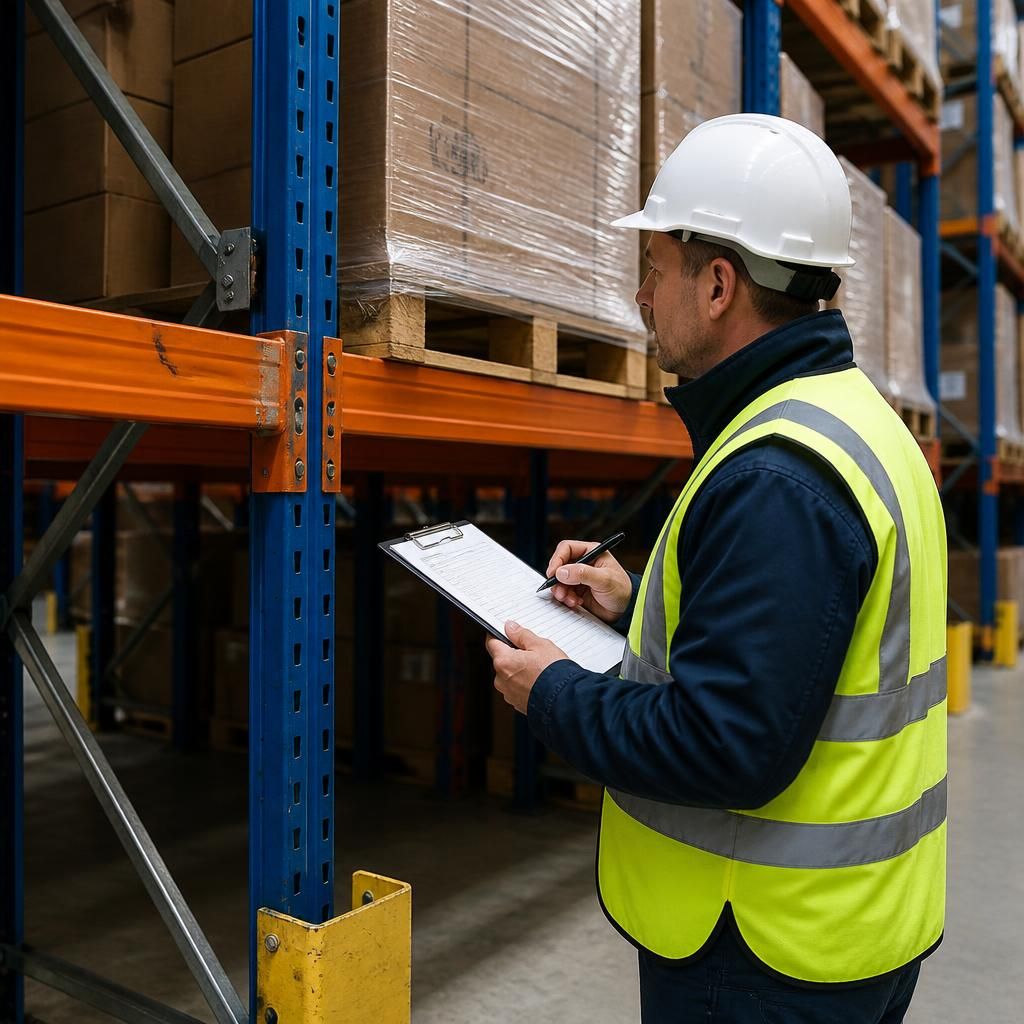
Warehouse racking inspections improve workplace safety by identifying defects early and prioritising the actions needed to control them. A competent inspector assesses damage, displacement, missing components, overloading and unsafe operating conditions, then records the location and severity of each finding.
This allows warehouse managers to respond proportionately. A serious defect may require the affected area to be isolated, unloaded or removed from use immediately, while a lower-risk issue can be scheduled for planned repair. Clear photographs, location references and corrective recommendations also help employees and contractors understand what must be done.
Safety benefits are achieved when inspection findings are acted upon promptly. Repairs should use suitable components and be completed by competent operatives, with the repaired area checked before normal use resumes. Inspection records can then demonstrate that hazards have been identified, controlled and followed through as part of the wider warehouse safety process.
Arrange Your Warehouse Racking Inspection
Arrange your warehouse racking inspection with Able Racking to identify defects, prioritise corrective action and support a safer storage system.