
What safety measures should be considered when implementing mezzanine loading systems? Mezzanine loading systems require suitable load limits, edge protection, secure gates, controlled access, safe operating procedures, regular inspections and thorough operator training.
Mezzanine loading systems should have defined load limits, suitable edge protection, secure loading gates and controlled access to prevent falls, overloading and unauthorised use. Safe operating procedures, competent installation, regular inspections and thorough operator training are also essential for maintaining compliance and safe day-to-day use.
Mezzanine loading systems should be designed around the loads, equipment and work activities they will support, with protection against falls, dropped goods, overloading and unauthorised access. Effective safeguards normally include a suitable structural design, edge protection, secure loading gates, controlled access, safe operating procedures, competent installation, planned inspections and thorough operator training.
Confirm the design loads and intended use
Before selecting or installing a loading system, establish the maximum weight, dimensions and handling method for every item that will pass through the loading point. The design should account for stored goods, pallets, containers, lifting equipment, impact forces and any dynamic loads created during loading or unloading. Loads must not exceed the rated capacity of the floor, gate, lift, conveyor or other handling equipment.
Load limits should be clearly displayed at relevant positions and communicated to everyone who uses the system. Where the operation changes, such as introducing heavier goods or different handling equipment, the design and risk assessment should be reviewed before the change is made.
Protect open edges and loading points
Any exposed edge or opening presents a fall risk. Suitable guardrails, mid-rails, toe boards or other engineered protection should be provided wherever people could fall from a raised platform. The arrangement must prevent people, pallets and loose materials from passing through the opening unintentionally.
Loading gates should provide a physical barrier when the loading position is not in use. They need to be selected for the particular load and operating method, installed correctly and used in accordance with the manufacturer’s instructions. A gate that leaves the opening exposed during loading should be supported by a safe operating procedure and suitable controls to prevent people from entering the danger area.
Toe boards and protective screens may also be necessary where goods could be pushed, rolled or dropped towards people or work areas below. The required protection depends on the goods, equipment, layout and foreseeable misuse identified during the risk assessment.
Control access to the danger area
Access to the loading position should be limited to trained and authorised personnel. Physical barriers, gates, access controls, warning signs and clearly defined working zones can help prevent people from walking into an open loading area or beneath suspended or moving loads.
Where a lift, conveyor or powered handling system is used, controls should be positioned so that operators can see the loading area or have an effective alternative means of confirming that it is clear. Interlocks, guards, emergency stops and other safety devices should not be bypassed. Any isolation procedure must be understood by the people responsible for clearing blockages, carrying out adjustments or performing maintenance.
People should not be permitted beneath raised loads or in areas where items could fall from the platform. If goods are transferred above a pedestrian route, consider segregation, impact protection, exclusion zones or changes to the work process.
Provide safe access and working space
Stairs, walkways and access points should be suitable for the expected traffic and kept clear of pallets, packaging and obstructions. Handrails, slip-resistant surfaces, adequate lighting and clearly marked routes are important, particularly where operators need to work close to an opening.
The layout should allow people to load and unload without reaching through guardrails, climbing on equipment or standing on pallets. Sufficient clearance is needed for the load, lifting equipment and operator, including space to manoeuvre safely without striking the structure or adjacent equipment.
Assess lifting equipment and powered systems
Where a lift is part of the solution, it should be suitable for the load, travel distance, duty cycle and landing arrangement. Doors, gates and controls should prevent access to the lift shaft or platform when the equipment is not correctly positioned. The system should include appropriate guarding, emergency arrangements and protection against unintended movement.
Conveyors and other powered equipment need guarding at nip points, drive components and other accessible moving parts. Emergency stop controls should be accessible, identifiable and tested. The interface between the conveyor, lift and landing gate should prevent loads from being released into an unsafe position.
Applicable UK requirements may include the Provision and Use of Work Equipment Regulations 1998, the Lifting Operations and Lifting Equipment Regulations 1998 and the Work at Height Regulations 2005. The exact duties depend on the equipment and activity, so the design should be checked against current legislation and relevant guidance by a competent person.
Use competent installation and commissioning
Installation should be completed by people with the necessary technical competence and experience. The supporting structure, fixings, gates, guards, controls and interfaces between items of equipment should be checked as a complete system rather than as isolated components.
Before the system is put into service, verify that it has been installed to the approved design, that safety devices operate correctly and that load and operating information is available. Any changes made during installation should be recorded and assessed. Commissioning should include practical checks under controlled conditions, with defects corrected before routine use begins.
Introduce documented operating procedures
Written procedures should explain how to receive, position, transfer and remove goods safely. They should cover the use of loading gates, lifts and conveyors, communication between operators, exclusion zones, maximum loads, equipment faults, blocked routes, spillages and emergency stops.
Procedures should also state what operators must do if a gate, guard, interlock or other safety device is damaged or unavailable. Unsafe equipment should be taken out of service and reported through a defined process rather than being used with temporary workarounds.
Inspect, maintain and review the system
Pre-use checks can identify obvious damage, displaced guards, defective gates, unusual noises, damaged controls or obstructions. These checks should be supported by planned inspections at intervals based on the equipment, usage, environment and risk.
Inspections should examine the structure, connections, flooring, edge protection, loading gates, lift components, conveyor guards, controls, safety devices and signage. Pay particular attention to impact damage, corrosion, loose fixings, distortion and changes to the surrounding layout. Records should identify the equipment inspected, findings, corrective actions, responsible persons and completion dates.
Maintenance must follow the manufacturer’s instructions and the site’s isolation arrangements. After repairs, alterations or an incident, the system should be checked before being returned to service. A review is also needed when loads, processes, equipment or staffing arrangements change.
Train and supervise operators
Training should be specific to the equipment and the actual loading process. Operators need to understand load limits, safe positioning, gate operation, pedestrian controls, communication signals, emergency procedures and the consequences of bypassing safeguards.
Competence should be confirmed through instruction, practical demonstration and appropriate supervision. Refresher training is advisable after an incident, a significant change to the system, a period of non-use or evidence that procedures are not being followed. Visitors, contractors and temporary workers should receive suitable site instructions before entering the working area.
Maintain suitable records
Keep the design information, load assessments, installation and commissioning records, inspection reports, maintenance history, training records, risk assessments and operating procedures together. Clear documentation helps demonstrate that the system is being managed throughout its working life and makes it easier to identify recurring defects or changes that require further assessment.
A competent safety review should be completed before implementation and repeated when the system or work process changes. This approach ensures that the protection remains appropriate for the actual loading activity, rather than relying solely on the presence of a gate, guard or warning sign.
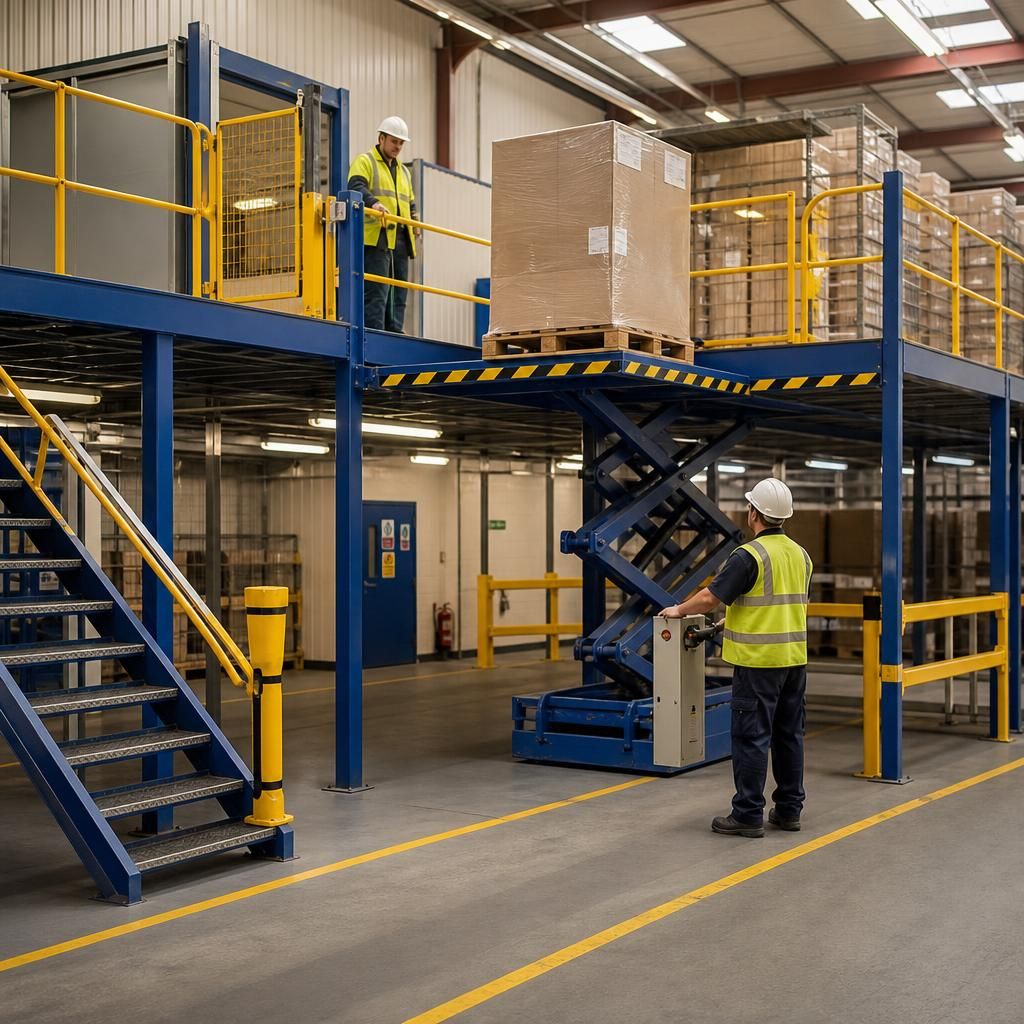
Regular inspections are essential for keeping mezzanine loading systems safe and reliable. Checks should cover the structure, flooring, edge protection, loading gates, lifts, conveyors, controls, fixings and warning signs, with particular attention to impact damage, corrosion, distortion and loose components.
Pre-use checks should be supported by planned inspections and manufacturer-led maintenance. Any defect, alteration or change in load should be assessed by a competent person, recorded clearly and rectified before the equipment is returned to service.
Book a Mezzanine Loading System Safety Review
Book a mezzanine loading system safety review with Able Racking to identify hazards, confirm that safeguards remain suitable and ensure your equipment is managed in line with current requirements. Our experienced team can provide practical recommendations for inspection, maintenance and safe operation.