
What are the signs that my warehouse racking needs repair or maintenance?
Warehouse racking needs repair or maintenance when you find bent or damaged components, loose connections, corrosion, impact marks, missing safety pins or beams that are visibly distorted or overloaded. Any damage or change from the original condition should be reported, assessed by a competent person and repaired or made safe before the affected area is used again.
Warehouse racking needs repair or maintenance when any component is bent, cracked, loose, corroded, displaced or otherwise different from its original condition. Warning signs also include missing safety pins, damaged guards, impact marks, unstable loads, overloaded beams and connections that no longer appear secure. Any suspected damage should be reported immediately, assessed by a competent person and either repaired or made safe before the affected section is used again.
Visible damage to frames, beams or bracing
Inspect the upright frames, horizontal beams, bracing and base plates for signs of damage. Common examples include:
- Bent, twisted or dented uprights
- Beams that are bowed, sagging, displaced or no longer level
- Cracked welds, split components or fractured metal
- Distorted bracing or missing bracing members
- Damaged base plates, floor fixings or anchor bolts
- Components that have moved from their original position
Damage may be obvious after a vehicle or handling equipment impact, but smaller distortions can also affect the load-carrying capacity and stability of the structure. Do not attempt to straighten, drill, weld or modify a damaged component without an appropriate technical assessment.
Impact damage and repeated contact
Forklift and other material-handling equipment impacts are a frequent cause of warehouse racking damage. Look for scrapes, dents, chipped paint, exposed metal, bent guards and marks on nearby components. A component does not need to look severely damaged to require attention. Repeated minor impacts can weaken connections or gradually move a frame out of alignment.
Impact protection can reduce the likelihood of damage, but it does not make damaged warehouse racking safe to use. Guards and barriers should also be inspected because they may have absorbed an impact while transferring force to the uprights, floor fixings or surrounding structure.
Loose, missing or displaced connections
Check that beams are fully engaged with the frame connections and that locking devices or safety pins are correctly fitted. Missing pins, loose fixings, displaced clips and damaged connectors can allow a beam to lift, move or disengage. Bolted connections should not be assumed to be secure simply because they appear present; signs of movement, damaged threads or gaps around the connection require investigation.
Do not replace a missing component with an unsuitable substitute. Replacement parts must be compatible with the warehouse racking system and installed in accordance with the manufacturer’s requirements or a suitable technical specification.
Changes in alignment, level or stability
Warehouse racking should remain plumb, level and stable in normal use. A frame that leans, a beam that is no longer horizontal, or a run that has moved from its intended alignment may indicate impact damage, failed fixings, uneven flooring or a connection problem. Movement, vibration, unusual noise and visible gaps at joints are also reasons to stop and arrange an assessment.
Alignment should not be judged solely by eye where the condition is uncertain. A competent inspector can assess whether the deviation is within the system’s acceptable limits and identify the underlying cause.
Overloaded or incorrectly loaded beams
Loads should match the design capacity and be placed as specified for the warehouse racking system. Warning signs of a loading problem include beams that visibly deflect, pallets that overhang, loads that are unstable or unevenly distributed, and load notices that are missing, unclear or inconsistent with the current layout.
- Do not exceed the stated safe working load.
- Keep loads centred and stable on the beams or supports.
- Do not store damaged pallets where they could fail or fall.
- Keep aisles, access routes and working clearances unobstructed.
- Review the system if the type, weight, size or arrangement of stored goods has changed.
A change in operational use can make a previously suitable installation unsuitable. Altering beam levels, adding components or changing the loading pattern should be reviewed by a competent person before implementation.
Corrosion, wear and deterioration
Rust, flaking coatings, pitting, moisture damage and chemical deterioration can reduce the effective strength of metal components. Pay particular attention to areas exposed to water, cleaning chemicals, condensation, salt, battery charging activity or damaged protective coatings. Corrosion around joints, welds, base plates and floor fixings is especially important because these areas can be difficult to assess during routine visual checks.
Surface discolouration is not always structural damage, but it should not be ignored where it is spreading, deeply pitted or associated with thinning metal. The cause of corrosion should be addressed as part of the repair and maintenance plan.
Missing safety information or protective equipment
Missing load notices, safety pins, end-of-aisle protection, upright guards, anti-collapse measures and other protective equipment can indicate that the installation is incomplete or has been altered. Safety equipment may also have been removed during repairs or damaged during operation.
Clear load information is essential for safe use. If the warehouse racking layout, beam positions or stored goods have changed, the displayed information should be checked and updated by an appropriately qualified person. Staff should not rely on memory or assumptions when deciding whether a load is suitable.
Falling goods, unstable pallets or repeated operational problems
Goods falling from storage, pallets leaning on beams, products being pushed out of position or repeated difficulty placing loads can indicate a problem with the structure, the loading method or the handling process. These incidents should be investigated rather than treated as isolated operator errors.
Check for damaged pallets, inadequate clearance, poor load distribution, unsuitable accessories and changes in vehicle operation. Until the cause is understood, the affected location should be isolated or unloaded safely where necessary.
What to do when damage is found
- Stop using the affected location if the damage could affect stability, capacity or safe access.
- Prevent further loading and keep people and handling equipment away from the area where appropriate.
- Report the damage through the site’s established reporting procedure.
- Record the location, component, type of damage and any relevant impact or operational information.
- Ask a competent person to assess the condition and classify the required action.
- Arrange an approved repair, replacement or other corrective measure.
- Do not return the area to service until the repair has been completed and its safety has been confirmed.
Temporary measures such as unloading, isolating a bay or installing a clearly controlled restriction may be appropriate while a repair is arranged. Temporary measures should be documented and monitored; they are not a substitute for a proper repair.
Routine inspections help identify problems early
Warehouse operators should have a clear inspection and reporting system covering pre-use checks, routine visual observations and periodic expert inspections appropriate to the site’s risks and operating conditions. Inspections should consider traffic levels, impact frequency, changes to the installation, environmental exposure, loading patterns and the condition of protective equipment.
Records should show what was inspected, what defects were found, who assessed them, what action was taken and whether the issue has been closed. A competent inspection is particularly important after a significant impact, alteration, change of use or repair. Maintenance should address the cause of damage as well as the damaged component, for example by reviewing vehicle routes, protection, training, load control or housekeeping.
When in doubt, treat any unexplained change as a reason for assessment rather than waiting for visible failure. Prompt reporting and competent warehouse racking repair can prevent a minor defect from becoming a wider safety or operational problem.
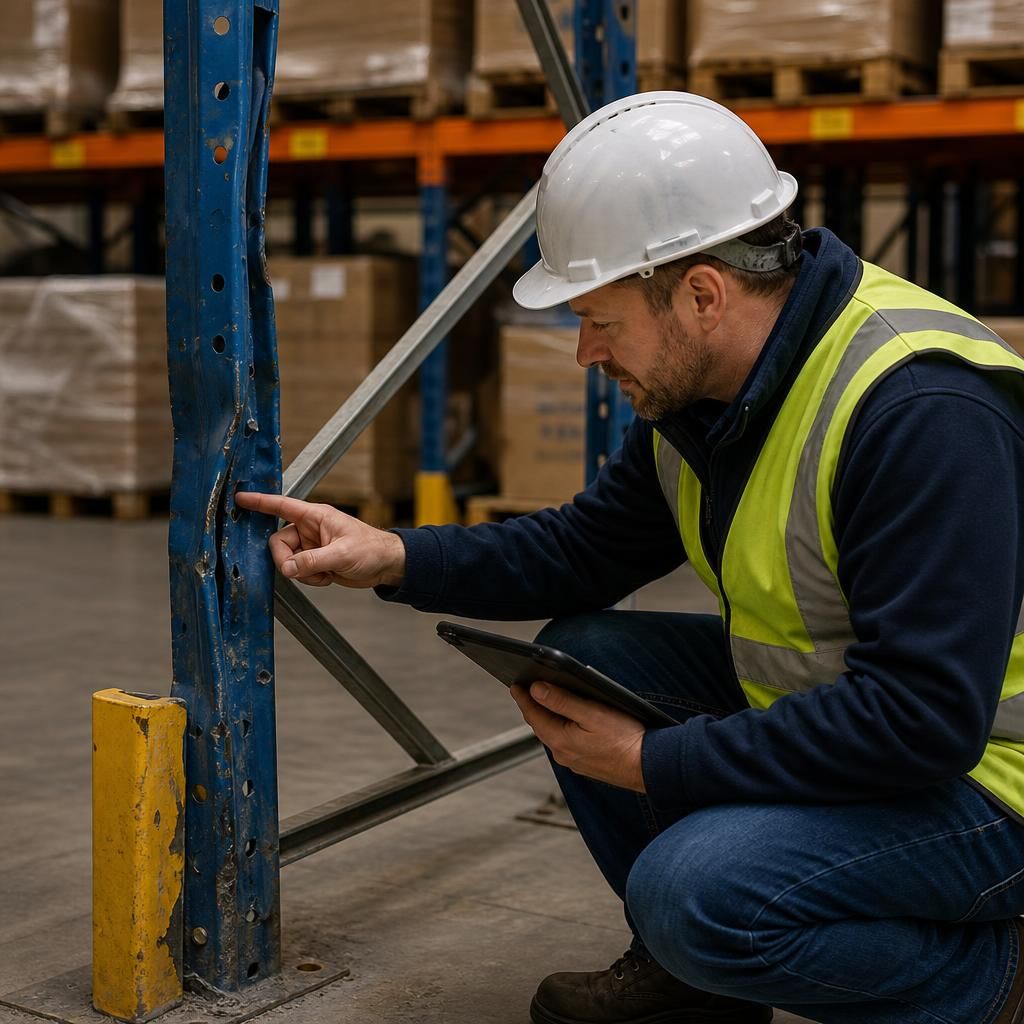
Impact damage is a key sign that warehouse racking may need repair or maintenance, even when the damage appears minor. Dents, scrapes, bent guards, displaced beams or distorted uprights can affect stability and load capacity.
Stop using the affected location, prevent further access where necessary and report the damage for assessment by a competent person. Do not straighten, weld or modify damaged components without suitable technical advice. The area should only return to service after an approved repair or other corrective action has been completed and its safety confirmed.
Arrange an expert warehouse racking repair assessment
Arrange an expert warehouse racking repair assessment with Able Racking to identify damage, make the affected area safe and confirm the appropriate repair or maintenance.