
How do mezzanine loading systems enhance warehouse efficiency and safety?
Mezzanine loading systems improve warehouse efficiency by providing controlled methods for moving goods between floor levels, reducing manual handling and unnecessary travel. Properly designed systems, including lifts, conveyors and pallet gates, also support safer workflows by controlling access, protecting operators and helping goods move consistently.
Mezzanine loading systems enhance warehouse efficiency and safety by providing controlled, repeatable ways to move goods between floor levels. A properly designed solution may combine goods lifts, conveyors, pallet gates, loading platforms and access controls to reduce unnecessary travel, limit manual handling and keep people separate from moving loads.
The most suitable arrangement depends on the type of goods, load dimensions, throughput, available space, floor levels and the way operators use the facility. The objective is not simply to move products upwards or downwards; it is to create a safe, predictable process that fits the wider handling operation.
How loading systems improve efficiency
- Shorter movement routes: Goods can travel directly between working levels rather than being carried around long access routes or moved through unsuitable areas.
- More consistent handling: Lifts and conveyors provide a repeatable method of transferring products, helping reduce delays caused by ad hoc manual movements.
- Better use of floor space: Vertical handling allows working areas to be arranged over multiple levels while keeping transfer points defined and controlled.
- Reduced manual effort: Mechanical assistance can limit lifting, carrying and pushing, particularly where goods are heavy, bulky or handled frequently.
- Clearer workflows: Defined loading and unloading points make it easier to organise receiving, storage, picking and dispatch activities without conflicting movements.
A lift is generally suitable where goods need to move between fixed levels and the load varies in size or weight. A conveyor can be more effective where products follow a regular route and arrive at a steady pace. In some facilities, a conveyor feeds a lift or connects with a pallet gate so that each stage of the transfer is controlled. Selecting equipment based on the actual process, rather than the available equipment alone, helps prevent bottlenecks and unsuitable manual workarounds.
How loading systems improve safety
Safety comes from controlling the hazards associated with changes in level, moving equipment, falling objects, vehicle movements and access to open edges. The system should be designed so that operators do not need to improvise when loading, unloading or clearing a transfer point.
- Protected edges: Guardrails, toe boards and suitable gates help prevent people or goods falling from elevated platforms.
- Controlled access: Interlocked gates, barriers and clearly defined loading areas can prevent access to an open edge while a lift or transfer operation is in progress.
- Load containment: Pallet gates and other restraints should be appropriate for the loads being transferred and should prevent pallets, cartons or loose items from moving unexpectedly.
- Safe separation: Pedestrian routes, vehicle routes and loading zones should be planned to reduce the likelihood of people entering the path of moving equipment.
- Emergency controls: Emergency stops, isolation points and clearly understood recovery procedures should be available where the equipment and risk assessment require them.
- Good visibility: Lighting, signs, markings and suitable guarding help operators identify safe positions and recognise when equipment is available for use.
Interlocking is particularly important at lift entrances and pallet transfer points. A gate should not be capable of opening onto an unprotected edge, and the equipment should not operate when a person could be exposed to the moving load. The precise control arrangement must be selected following a suitable risk assessment and validated as part of commissioning.
Design considerations for an effective system
Before installation, the complete handling process should be reviewed. This includes the goods being moved, how often transfers take place, the largest and smallest loads, the equipment used to present the load, operator positions and what happens if a load is damaged or the system stops.
- Confirm the intended loads, including their dimensions, weight distribution, stability and packaging.
- Map the movement of goods from the point of arrival to the point of collection, identifying crossings, queues and potential pinch points.
- Establish the required loading and unloading positions, including enough space for safe manoeuvring and temporary holding.
- Specify suitable guarding, gates, controls, access arrangements and emergency provisions.
- Check that the supporting structure, floor and landing areas are suitable for the imposed loads and equipment forces.
- Consider maintenance access, cleaning requirements and how faults or blockages will be dealt with safely.
- Test the completed arrangement before normal use and provide instructions and training for the people operating it.
Capacity must be considered across the entire system, not only at the lift or conveyor. The supporting floor, platform, landing, gate and any load-bearing equipment must each be suitable for the expected forces and working conditions. Loads should be presented squarely and within the equipment’s stated limits. Exceeding capacity, using damaged pallets or allowing unstable loads onto a transfer point can undermine otherwise effective safeguards.
Training and operating controls
Operators should understand the normal sequence for loading and unloading, the meaning of control indicators, the permitted load types and the action to take if the system stops. Training should also cover exclusion zones, emergency stops, isolation procedures and reporting of damage or unsafe conditions.
Written procedures are useful where several people or shifts use the same equipment. They should explain who may operate the system, how loads are checked, when access is permitted and how faults are escalated. Staff should never bypass an interlock, remove guarding or attempt to retrieve a trapped load without following the approved isolation and recovery procedure.
Good housekeeping supports both efficiency and safety. Transfer areas should be kept clear, spillages dealt with promptly and damaged pallets or packaging removed from service. Obstructions around gates, controls and emergency equipment can delay a response and encourage unsafe handling.
Inspection, maintenance and review
Regular inspection and planned maintenance help preserve the protection provided at installation. Checks should cover gates, hinges, locks, interlocks, barriers, guarding, landing surfaces, conveyor components, lift doors, controls, warning devices and visible structural damage. The inspection frequency should reflect the equipment, operating environment, intensity of use and findings from previous checks.
Any defect that could affect safe operation should be reported, assessed and dealt with before the equipment is returned to normal service. Temporary measures must not become a substitute for a permanent repair. Where lifting equipment is used, examination and maintenance should follow the applicable legal requirements, manufacturer instructions and site risk assessment.
The system should also be reviewed when the operation changes. New load types, altered traffic routes, increased throughput, changes to the platform layout or different handling equipment may introduce risks that were not present during the original design. A review can identify whether guarding, controls, training or operating procedures need to be updated.
In practice, the safest and most efficient mezzanine loading system is one that matches the goods and workflow, protects open edges, controls access to moving equipment and remains easy to inspect and maintain. Treating the loading point as part of the complete warehouse process, rather than as an isolated item of equipment, provides better control over delays, manual handling and operational risk.
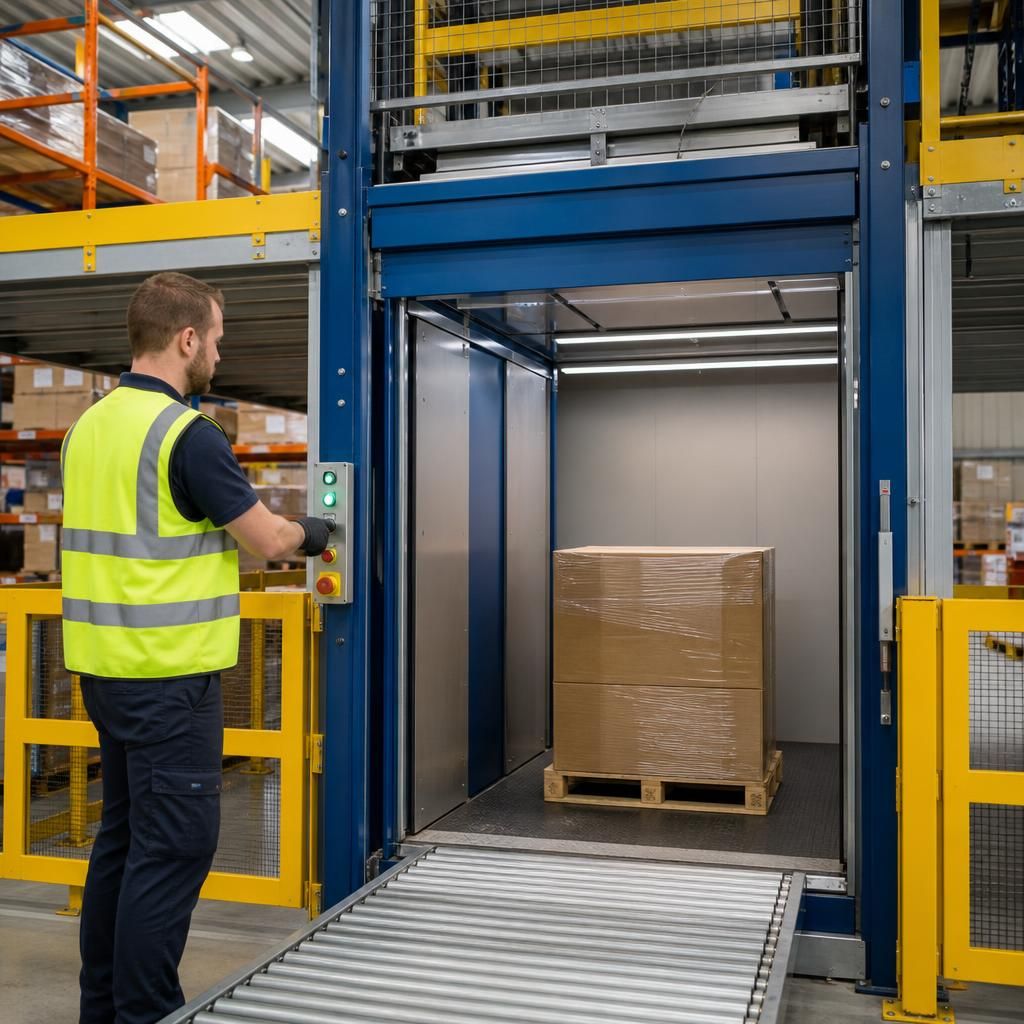
Interlocked pallet gates and edge protection are central to making mezzanine loading systems safe. They control access to open loading edges while goods are transferred, helping prevent people or items from falling from the platform.
A suitable arrangement should keep the gate closed whenever the loading position is exposed and prevent the lift or handling equipment from operating if the gate is in an unsafe position. Guardrails, toe boards, barriers and load restraints should be selected for the goods being handled and integrated with clearly marked exclusion zones. Operators should also receive practical instruction on normal loading, emergency stops, isolation and fault reporting.
These safeguards require regular checks. Hinges, locks, interlocks, barriers, warning devices and surrounding surfaces should be inspected for damage, obstruction or deterioration. Any defect that could affect safe operation should be reported and resolved before the system is returned to service.
Arrange a Mezzanine Loading System Assessment
Arrange a mezzanine loading system assessment to review your goods-handling process, access controls and safety measures, and identify practical improvements for safer, more efficient operations.