
Would warehouse racking protection help reduce recurring impact damage?
Yes. Warehouse racking protection can help reduce recurring impact damage by absorbing or deflecting contact from forklifts and other handling equipment, but damaged components must still be assessed and repaired or replaced by a competent professional.
Yes. Warehouse racking protection can reduce recurring impact damage by absorbing, deflecting or preventing contact between handling equipment and vulnerable components. It is most effective when combined with a warehouse racking inspection, competent repairs, suitable protection for the specific hazard and improvements to traffic management. Protection does not make damaged warehouse racking safe, and it should never be used to conceal bent, displaced or otherwise compromised components.
Recurring impact damage usually indicates that the underlying cause has not been resolved. Forklift trucks may be operating too close to uprights, pallets may be difficult to position, visibility may be restricted, or pedestrian and vehicle routes may not be clearly separated. Tight turning areas, poor housekeeping, uneven floors and changes to storage layouts can also increase the likelihood of contact. A suitable protection plan should therefore address both the physical impact point and the way the warehouse is being used.
Common forms of warehouse racking protection include:
- Upright guards: These are positioned around exposed frame uprights to help absorb or deflect low-level contact.
- End-of-aisle protection: This helps protect the exposed ends of warehouse racking runs, where turning vehicles may be more likely to make contact.
- Barrier systems: Freestanding barriers can separate warehouse racking from vehicle routes, loading areas or other sources of impact.
- Corner and frame protection: These solutions can help shield vulnerable corners and frame sections where vehicle movement is restricted.
- Guide rails and traffic barriers: These can influence vehicle positioning and reduce the opportunity for direct contact with warehouse racking.
The correct solution depends on the type of handling equipment, the speed and direction of likely impacts, the available aisle space, the warehouse racking design and the nature of the stored loads. A protector that is suitable for one location may be ineffective or obstructive in another. For example, a bulky barrier could restrict access, reduce usable clearance or create a new collision risk if it is installed without considering vehicle movement and pallet handling.
Protection should be selected after examining the damage pattern. Damage concentrated at the bottom of an upright may call for a suitable upright guard, while repeated damage to the end of a run may require a more substantial barrier and a review of vehicle routes. Damage at beam levels or to bracing may indicate poor load positioning, unsuitable pallet dimensions or a handling practice that protection alone cannot correct.
Before installing protection, existing damage should be assessed by a competent person. Bent uprights, damaged bracing, displaced beams, missing locking devices and other defects may affect the structural integrity of the warehouse racking. The affected area should be controlled where necessary, and components should be repaired or replaced in accordance with the warehouse racking manufacturer’s requirements and relevant safety guidance. Guards should not be fitted over defects without an appropriate assessment.
Installed protection also needs to be inspected. Check that it remains securely fixed, has not moved after an impact and has not become damaged in a way that reduces its performance. Protection can absorb an impact while appearing serviceable, but the warehouse racking behind it may still require examination. Inspection findings should be recorded, and repeated damage should trigger a review rather than simply a replacement of the same guard.
Several practical controls can improve the effectiveness of warehouse racking protection:
- Keep vehicle and pedestrian routes clearly defined and free from obstructions.
- Review aisle widths, turning areas and visibility where impacts are recurring.
- Make sure loads are stable, suitable for the pallet positions and within the permitted warehouse racking capacity.
- Train operators to approach storage locations at an appropriate speed and align equipment before placing or removing loads.
- Use signs, floor markings and barriers where they can improve route discipline.
- Report impacts promptly, even when no obvious damage is visible.
- Include protection and the surrounding warehouse racking in routine visual checks and formal inspections.
Protection is particularly valuable in locations with unavoidable exposure, such as aisle ends, transfer points and areas where vehicles must manoeuvre close to storage equipment. It is less likely to solve the problem where the warehouse racking is incorrectly positioned, the layout is unsuitable for the handling equipment or operators cannot achieve safe clearance. In those circumstances, changing the layout, adjusting working methods or selecting different handling equipment may be more effective.
A professional review can identify whether protection is appropriate, what type is required and whether recurring damage has already affected the warehouse racking. Able Racking can assess the condition of the installation, identify patterns in impact damage and advise on repairs, protection and preventative measures. The aim is to reduce repeat incidents while keeping the warehouse racking safe, accessible and suitable for the operation.
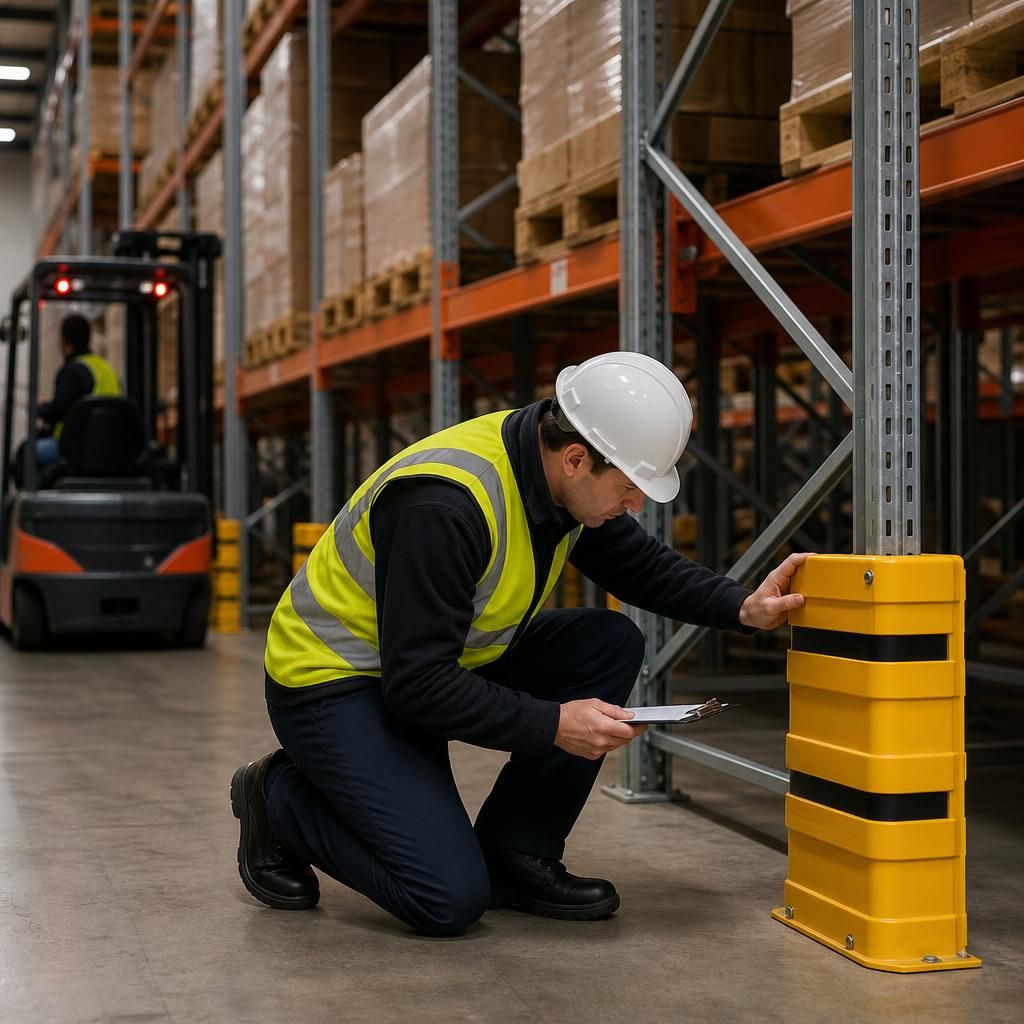
Warehouse racking protection helps reduce repeated impact damage by absorbing or deflecting contact from forklifts and other handling equipment. It is most effective at exposed uprights, aisle ends and turning points where vehicle movements bring equipment close to the installation.
Protection must not be fitted over damaged warehouse racking without a competent assessment. Bent uprights, displaced beams or damaged bracing may require repair or replacement, while recurring impacts may indicate that vehicle routes, aisle clearance, visibility or operator practices also need review. A suitable protection plan should address both the vulnerable component and the cause of the contact.
Arrange an expert warehouse racking protection assessment
Arrange an expert warehouse racking protection assessment with Able Racking to identify recurring impact risks, assess existing damage and determine suitable protective measures.