
How do mezzanine safety gates improve workplace safety in industrial environments?
Mezzanine safety gates improve workplace safety by preventing people and materials from falling at loading areas while allowing authorised access when required. They help separate open edges from operational areas, support safer goods handling and contribute to compliance with relevant workplace safety requirements.
Mezzanine safety gates improve workplace safety by protecting open loading edges while allowing authorised personnel to transfer goods between floor levels. A correctly selected and installed gate creates a controlled barrier at the loading point, helping prevent people, equipment and materials from falling without obstructing normal handling activities.
Loading areas are among the highest-risk locations on a mezzanine because the edge protection must be opened or configured to allow goods to pass through. Without a suitable gate, an open edge may be left unprotected during loading, unloading or access. Safety gates reduce this exposure by providing a physical barrier whenever the loading position is not actively in use.
They support safer operations in several important ways:
- Fall prevention: The gate helps prevent people from stepping or falling into an open loading area.
- Material containment: It helps stop items, tools and packaging from passing accidentally over the edge and striking people below.
- Controlled access: Access can be limited to trained and authorised personnel rather than leaving the loading point freely accessible.
- Safer goods transfer: Properly designed gates allow materials to be moved between levels without requiring workers to work around an unprotected opening.
- Clear separation: The barrier distinguishes the loading zone from the working area, making the hazard easier to identify and manage.
The most suitable gate depends on the way goods are handled, the opening arrangement, available space and the type of equipment used. Common solutions include pallet gates, lift-out gates and counterbalanced or self-closing designs. Some systems use a two-part arrangement that keeps a barrier across the exposed edge while goods are being placed or removed. The important principle is that the opening should not be exposed unnecessarily and should be protected by a system appropriate to the task.
A good safety gate should be robust, stable and compatible with the existing edge protection. Its guarding should be high enough and sufficiently close to adjacent barriers to prevent people or materials passing through unintended gaps. The design should also account for the size and weight of the loads, the method of transfer, the movement of vehicles or lifting equipment and the risk of items being dropped or displaced.
Gate operation is also central to safety. The mechanism should be straightforward for trained users, but not so easy to leave open unintentionally. Depending on the design, this may involve self-closing action, a secure latch, counterbalancing or an interlocked arrangement. Operators should be able to see whether the gate is correctly closed, and the gate should not swing or move into a position that creates another hazard. Where powered lifting equipment is used, the operating procedure should make clear when the gate may be opened and how loads are to be positioned.
Safety gates do not remove the need for safe working procedures. They should form part of a wider control system that includes:
- a suitable risk assessment for loading, unloading and access activities;
- clear instructions for operators and other people working nearby;
- training on the correct use of the gate and the handling equipment;
- restricted access to the loading area where appropriate;
- good housekeeping to prevent trips, obstructions and unstable loads;
- appropriate controls for work taking place beneath the loading point; and
- planned inspections and prompt action when defects are found.
Regular inspection is particularly important because gates are frequently handled and can be affected by impacts, overloading, misuse or gradual wear. Checks should confirm that the frame, posts, hinges, pivot points, counterbalance components, latches and fixings remain secure and serviceable. Inspectors should also look for distortion, corrosion, damaged guarding, loose connections, unusual movement and signs that the gate is not closing or securing correctly.
Any gate that is bent, difficult to operate, unable to close fully or missing a locking component should be taken out of service until it has been assessed and repaired by a competent person. Temporary workarounds, such as leaving the opening unattended or relying on loose materials as a barrier, do not provide an equivalent level of protection.
Installation quality affects both the protective performance and the long-term reliability of the system. The supporting structure must be suitable for the proposed gate, fixings must be correctly selected and the gate must be aligned so that it operates without fouling nearby equipment or edge protection. Installation should be followed by functional checks and handover information explaining operation, inspection points and any restrictions on use.
In practice, the greatest safety benefit comes from matching the gate to the actual workflow rather than treating it as a standard accessory. A site assessment should consider how loads arrive, where people stand during transfer, whether vehicles or lifting equipment approach the opening, what could fall through the area and how the gate will behave if used repeatedly throughout the working day. Able Racking can assess these conditions and advise on a suitable safety arrangement, installation requirements and ongoing inspection measures for industrial environments.
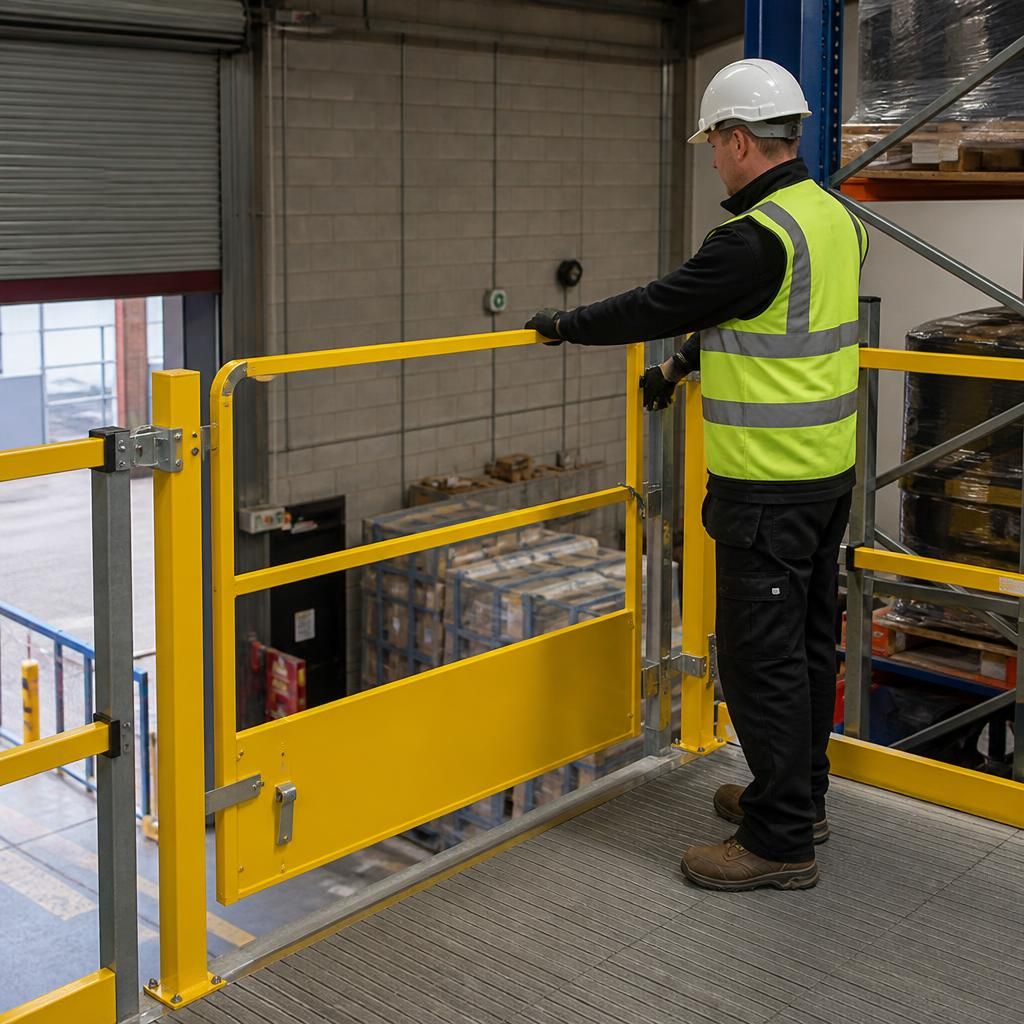
Mezzanine safety gates improve workplace safety by keeping loading openings protected when goods are not being transferred. They provide a physical barrier at the exposed edge, reducing the risk of people, tools, packaging and materials falling to a lower level.
The gate should be selected for the way the loading area is used and should operate without creating additional hazards. Self-closing, counterbalanced or securely latched designs can help ensure the opening is protected after each transfer. Operators should be able to confirm that the gate is fully closed, while access should remain limited to trained personnel.
Safe performance also depends on regular checks. Hinges, latches, fixings, guarding and supporting posts should be inspected for damage, looseness, distortion or corrosion. A gate that does not close securely or is difficult to operate should be removed from use until it has been assessed and repaired by a competent person.
Arrange a Mezzanine Safety Gate Assessment
Contact our team to arrange a mezzanine safety gate assessment and confirm that your loading areas have suitable protection, reliable operation and appropriate inspection measures.